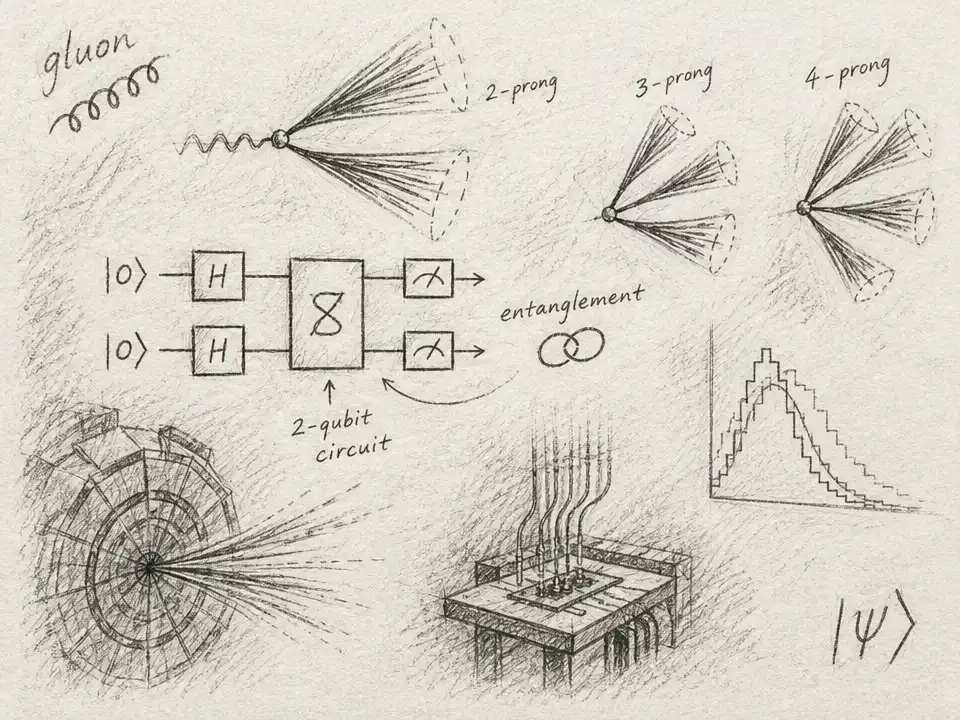
At the Large Hadron Collider, proton collisions can briefly produce a Z boson, which almost immediately decays into a pair of lighter particles. Those particles are long gone, but their directions remain in the data. Physicists have now used those directions to reconstruct a surprising feature of the vanished bosons: across different kinds of collisions, their average spin orientation appears to curl around the beam axis like a vortex.
The result came from a reanalysis of measurements already published by the ATLAS experiment. The researchers did not collect new collisions or discover a new particle. They set out to try a quantum-tomography technique on what seemed like a straightforward test case. Instead, patterns in the data suggested that the Z bosons’ polarization changes in an unexpectedly organized way—and that, at one particular range of motion, the spin information nearly washes out.
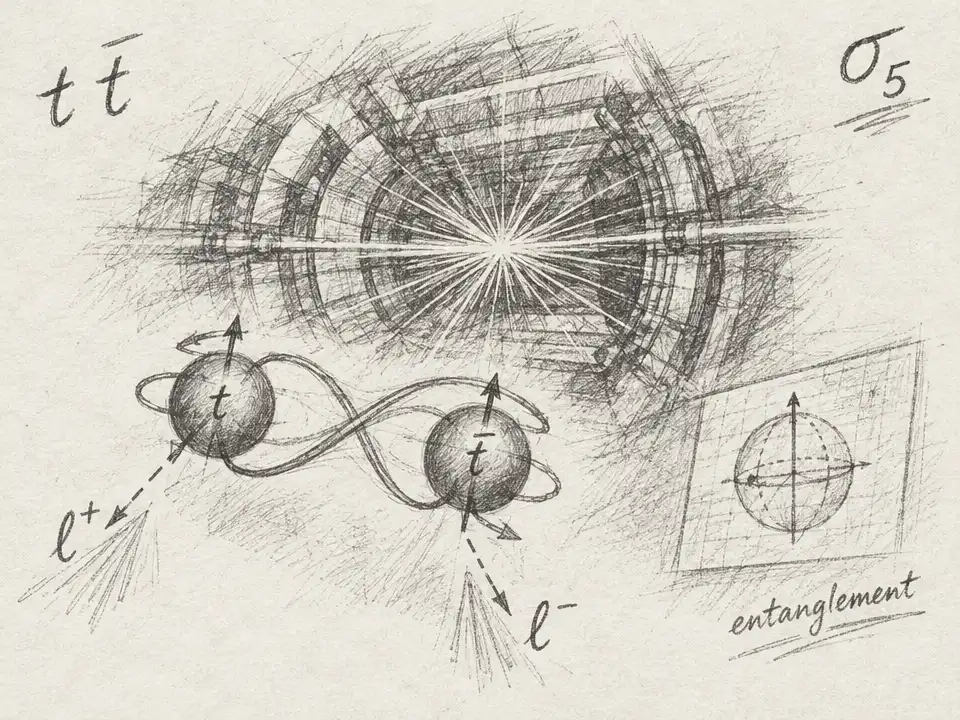
Spin is an intrinsic quantum property, not a tiny ball literally turning on its axis. For a Z boson, it can point in different directions or occupy a mixture of possible states. The boson disappears too quickly for anyone to measure its spin directly. But its decay products carry clues: the angles at which the resulting lepton and antilepton fly away depend on the boson’s spin state. Gather enough events, and those angular patterns can be used to infer the state that produced them.
That is the basic promise of quantum tomography: reconstructing an otherwise hidden quantum state from the effects it has on a known probe. Here, the probe is the Z boson’s decay into a lepton pair. The team translated measured angular-distribution coefficients into a description of the boson’s polarization, using the known Standard Model coupling between the Z boson and its decay products. This let them examine the observed patterns without first choosing a detailed model for how the protons produced each boson.
The analysis focused on lepton pairs with an invariant mass of 80–100 GeV, a range dominated by Z-boson production. In the ATLAS data, the proton beams collided at a center-of-mass energy of 8 TeV. The researchers also compared angular measurements from CMS and LHCb, whose data came from collisions at 13 TeV. Those comparisons broadly supported the angular-coefficient trends, but the most striking features in the reconstructed polarization came from the ATLAS measurements.
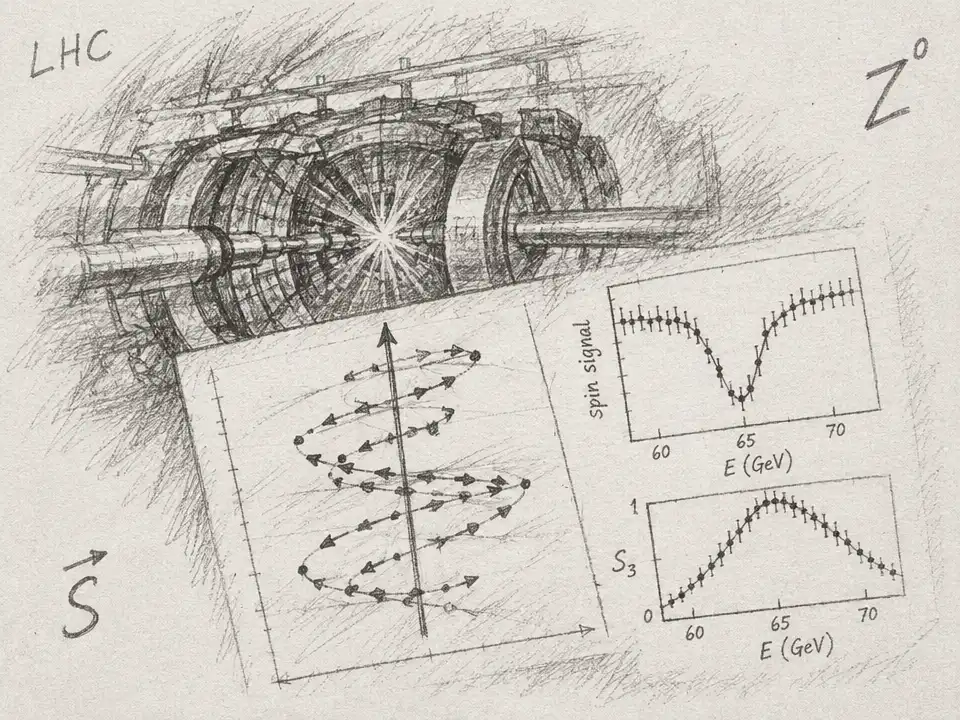
One feature appeared when the pair’s transverse momentum—the part of its motion sideways to the incoming beams—was around 65 GeV. The three eigenvalues that summarize the reconstructed spin state moved close together, while the net spin vector dipped. In everyday terms, the inferred state became less dominated by any one polarization direction.
The researchers also calculated the state’s quantum entropy, a measure of how mixed or uncertain that state is. It rose to about 1.06, close to the maximum possible value of 1.0986 for this three-dimensional spin system. That is consistent with a state approaching the fully mixed, unpolarized limit. It does not mean the data have stopped carrying information: the spin vector is only one part of the full description, and the analysis also accounts for other polarization features.
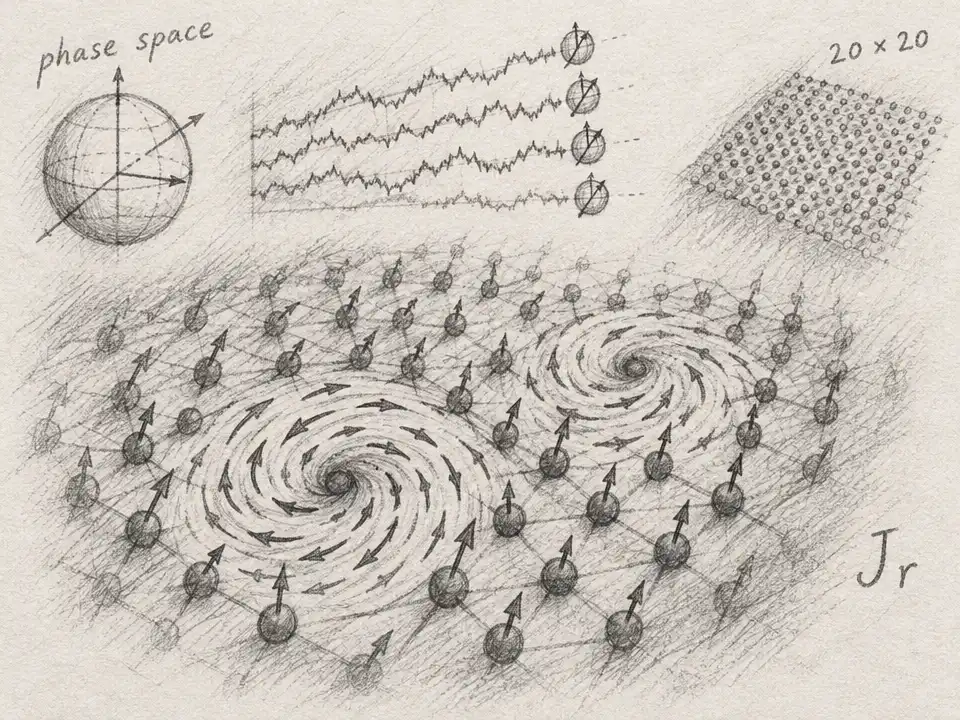
Then came the image that gives the result its name. The beams define a central axis, and the boson’s transverse momentum supplies a direction in the plane around it. Reconstruct the spin components across that plane, and their orientations form a spiral-like vector field. The researchers call it a vortex-like configuration. The crucial qualification is that this is a map of average spin information across classes of events—not a swarm of individual bosons visibly circling the beam pipe, and not a photograph of particles spinning in place.
The map also contains another change: between about 90 and 110 GeV of transverse momentum, one spin component reaches a maximum and later changes sign. The paper describes these features as resonance-like, but that phrase describes the shape of the variation; it does not establish a resonance or identify a new object. The authors say they do not know why the patterns occur or why they appear at those momentum scales.
Some of the measured quantities have symmetry properties that make the finding especially intriguing. One component is odd under transformations associated with charge conjugation, parity, and time reversal. But an observable with this mathematical behavior does not, by itself, prove that nature violates fundamental time-reversal symmetry. In particle scattering, such a signal can arise from complex phases in the amplitudes—the mathematical descriptions of competing ways a collision can unfold. Ordinary corrections to Standard Model calculations can generate those phases; physics beyond the Standard Model is another possibility, not a conclusion.
That restraint matters. The researchers note that the measurements overall trend toward agreement with Standard Model predictions, even as some comparisons with high-order quantum-chromodynamics calculations remain difficult. Their work turns familiar angular measurements into a new way of inspecting polarization, but it does not settle whether the patterns reflect subtle known effects, limitations in the theoretical calculations, or something else. The entropy estimate also depends on physical constraints applied to the reconstructed state, and the analysis starts from published measurements rather than a fresh study of the underlying collision records.
What began as a test of a method has therefore become a question about old data: how much structure can be hiding in a measurement that seemed to summarize the collisions already? The answer, for now, is a spin field that seems to twist, a near-unpolarized state around 65 GeV, and no established explanation. The next step is not to declare a discovery, but to work out whether independent analyses and more detailed calculations can make the same strange pattern stand still.