A material can seem to change its story without changing at all. In a September 2026 arXiv comment, physicist Sergey Borisenko revisited photoemission measurements of t-PtBi2, a material studied as a possible Weyl semimetal. The earlier analysis had reported no clear sign of superconductivity in the measured surface states down to 3 K. Borisenko’s reanalysis reached a different conclusion: features resembling an energy gap were already present in the deposited data, and signs of that gap-like behavior extended to 19 K.
The surprising part is not a new sample or a fresh run of an instrument. It is a new reading of existing measurements—and an argument that small choices about how the data are lined up can change what the measurements appear to say.
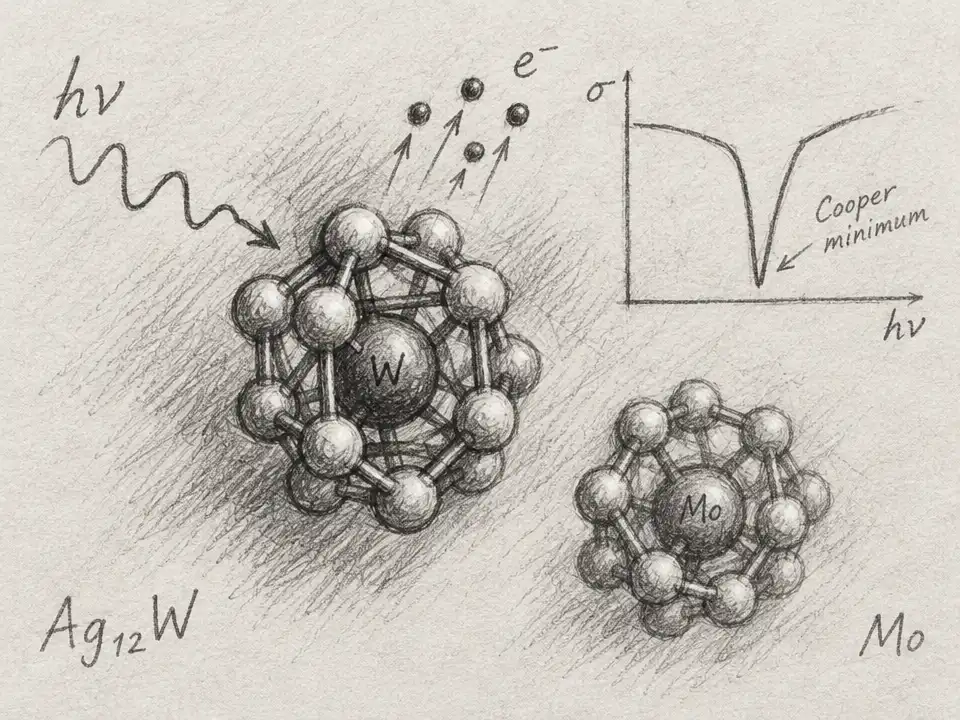
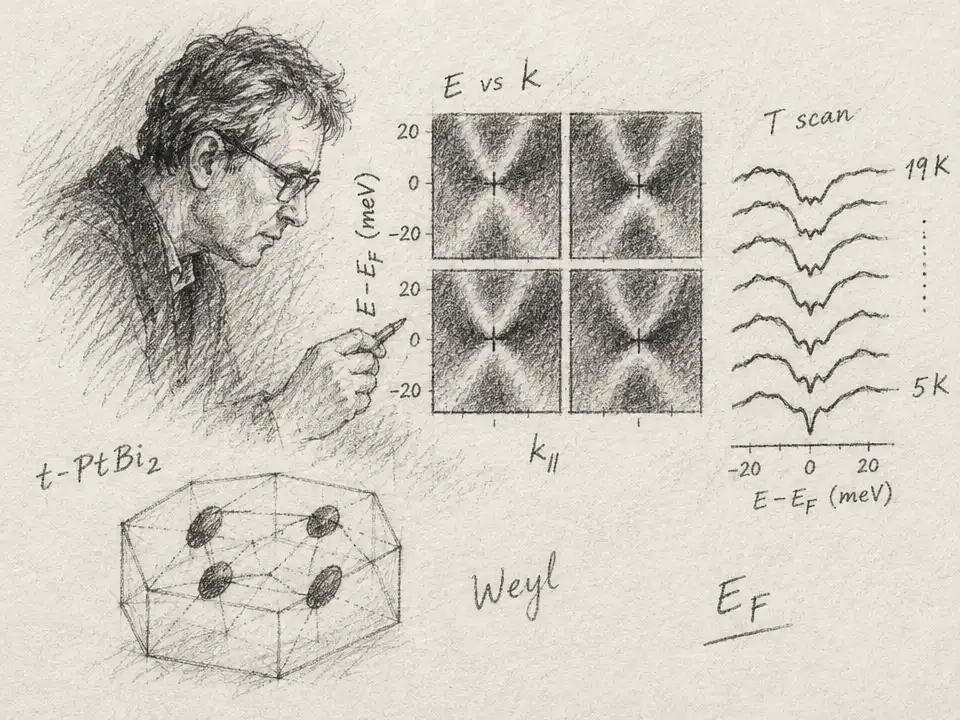
The experiment used angle-resolved photoemission spectroscopy, or ARPES. Researchers shine light on a material and measure the energy and direction of electrons that escape. Those electrons provide a map of the electronic states inside the solid. In t-PtBi2, the map includes unusual surface states called Fermi arcs: open tracks in momentum space associated with Weyl semimetals. Researchers had also reported evidence of superconductivity in these surface states, making the question of whether a gap appears there especially interesting.
A superconducting gap is an energy range in which the usual electronic states are suppressed as electrons join the collective superconducting state. ARPES does not photograph a gap directly. Scientists look for telltale changes in the spectra: a shift in where the signal begins, and a bend in the measured energy bands near the Fermi level. That makes comparisons delicate. When the expected shifts are only a few millielectronvolts, modest errors in aligning measurements can matter.
The original study’s conclusion rested partly on spectra taken at different temperatures. Borisenko argues that those temperature scans did not sample the same surface termination as the earlier figures in that study. A crystal surface can end in different atomic arrangements, and those terminations can produce different electronic patterns. He also points to temperature-dependent changes in the momentum and energy coordinates used to present the scans. In the paper’s analysis, the momentum scale changes by 8.1% at 11 K and 11.3% at 19 K relative to the 3 K data.
To compare the temperature scans, Borisenko registered their energy positions using a broad signal from the material’s metallic bulk states, rather than relying on a shallow surface band as a fixed reference. After this alignment, the spectra showed low-energy gaps of approximately 2, 2, 1, and 0.8 meV at four points where the surface states cross the Fermi level. The measurements also showed that the gap-like suppression varied around the arc instead of staying uniform. In other low-temperature cuts, three ways of estimating the relevant energy scale produced values that increased to roughly 3–5 meV away from a near-nodal direction.
A second clue came from the shape of the measured bands. In superconductors, the energy bands can turn back near the Fermi level—a feature known as back-bending, caused by the mixing of electron-like and hole-like states. Borisenko reports back-bending of about 1–2 meV away from the near-nodal direction, where the effect becomes much smaller. The important point is that the new analysis uses several kinds of spectral markers, not just the brightness of the signal, which can vary for reasons unrelated to a gap.
Then comes the temperature surprise. After the scans are aligned, the off-nodal crossings still show gap-like suppression at 19 K, the warmest temperature in that series. That does not mean superconductivity itself has been demonstrated at 19 K. The comment describes the higher-temperature behavior as consistent with a pseudogap-like regime: an energy suppression that may persist above the temperature where coherent superconductivity sets in, without by itself establishing its microscopic cause.
There is a useful reality check here. Borisenko’s paper is a comment and a reanalysis of measurements collected by another group, not a new experiment. Its conclusion depends on how the deposited data are registered and interpreted. The comment argues that the energy alignment is independently constrained by the bulk signal, and reports an rms variation of 0.272 meV across eight cuts used for one part of the analysis. Still, a reanalysis is not the same as a separate measurement designed to settle the dispute. The original researchers’ interpretation and the new comment’s interpretation are competing readings of the evidence.
That distinction is part of what makes the case instructive. Scientific data are not merely pictures waiting to reveal an obvious answer. Researchers must decide which features to track, how to compare scans, and which reference points are physically trustworthy. Those decisions can be tested: Borisenko’s paper lays out the procedures and uses the deposited spectra so that other researchers can inspect the same evidence.
The revised reading, if it holds up, would mean the earlier dataset did not simply fail to find a superconducting gap; it may have contained a faint, strongly directional signal that was obscured by the way different scans were compared. The broader lesson is not that a gap has been settled beyond doubt. It is that, in a material whose electronic signatures shift by mere millielectronvolts, getting the coordinate system right can be part of the physics—not just housekeeping.