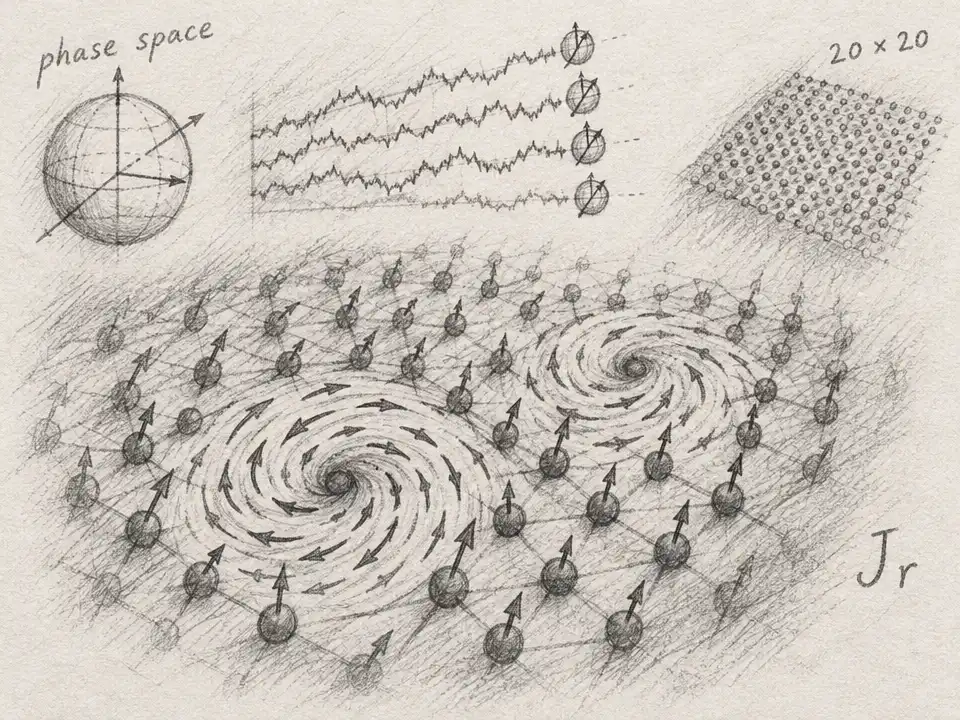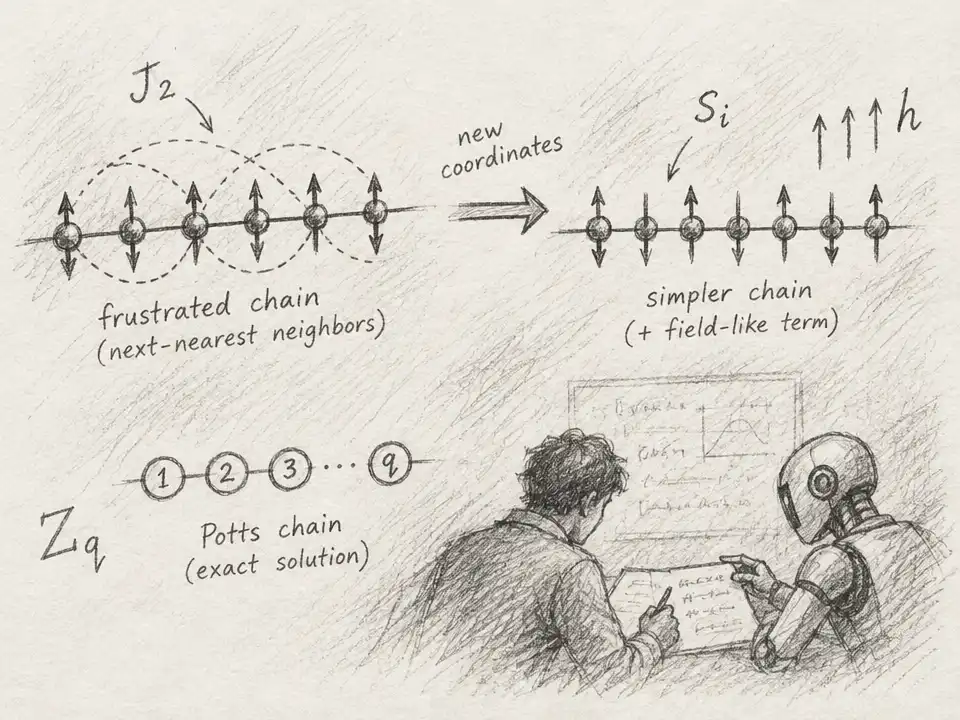
Picture a row of tiny compass needles, each tugged by its nearest neighbors. Now let every needle also respond to the one two places away. Those competing instructions can leave the chain unable to settle into a simple pattern—a condition physicists call frustration. In a new mathematical result, that tangled arrangement gets an unexpected change of scenery: for a broad class of one-dimensional spin chains, it can be rewritten as a simpler chain with a field-like influence. The physical ingredients have not vanished. They have been rearranged into a coordinate system that makes their relationship easier to see.
The theorem concerns open chains: rows with ends, rather than loops. The spins are classical, and each can point in a range of directions. In the original description, interactions link neighboring spins and next-nearest neighbors. In the transformed description, one set of those interactions becomes a local preference for pointing along a chosen axis; the other becomes an ordinary neighbor-to-neighbor interaction. The two descriptions match exactly, not approximately. The mapping works for arbitrary interaction functions that may vary from one spot in the chain to another, and for every spin dimension covered by the theorem.
The key is to stop watching the spins from one fixed viewpoint. Instead, track how each pair of neighbors is oriented relative to the pair before it. In three dimensions, the chain’s bond angles and twists carry the information needed to build a moving local frame. A sequence of geometric reflections then transports that frame down the row. In the new coordinates, a relationship that originally spanned two bonds becomes a relationship between adjacent transformed spins. The trick resembles walking alongside a winding path: a turn that looks complicated from a distant viewpoint can look simple when your reference frame turns with it.
That change matters because it links two familiar physical stories. In one, a system’s collective pattern emerges spontaneously from competing interactions. In the other, an external field encourages spins to line up in a preferred direction. For the standard linear interactions, the theorem maps a chain with nearest- and next-nearest-neighbor couplings onto a chain with a neighbor interaction and a field. Some correlations in the original chain become magnetization-like quantities in the new one. Instead of treating frustration and field-driven alignment as entirely separate problems, researchers can sometimes examine them through the same mathematical lens.
The result reaches beyond the simplest, uniform chains. The interaction rules may change from site to site, and they need not have a simple linear form. That flexibility opens the door to mathematical models of chains with alternating or irregular structures. It does not mean every such system has an easy solution. A map can reveal that two problems are equivalent without making either one simple enough to solve on paper. But when the transformed model is tractable, the original inherits that advantage.
A second version of the result applies to Potts chains, where each site can occupy one of q discrete states. Here, the useful coordinates are not angles but differences between neighboring state labels. A staggered relabeling turns the original next-nearest-neighbor comparison into a nearest-neighbor comparison in the new chain. For the one-dimensional, open-boundary Potts model with the standard pair of interaction ranges, the mapping gives a closed-form exact solution for every q ≥ 2 and every chain size L ≥ 1. That is a concrete payoff: a complicated-looking model can inherit an exact answer from a simpler one.
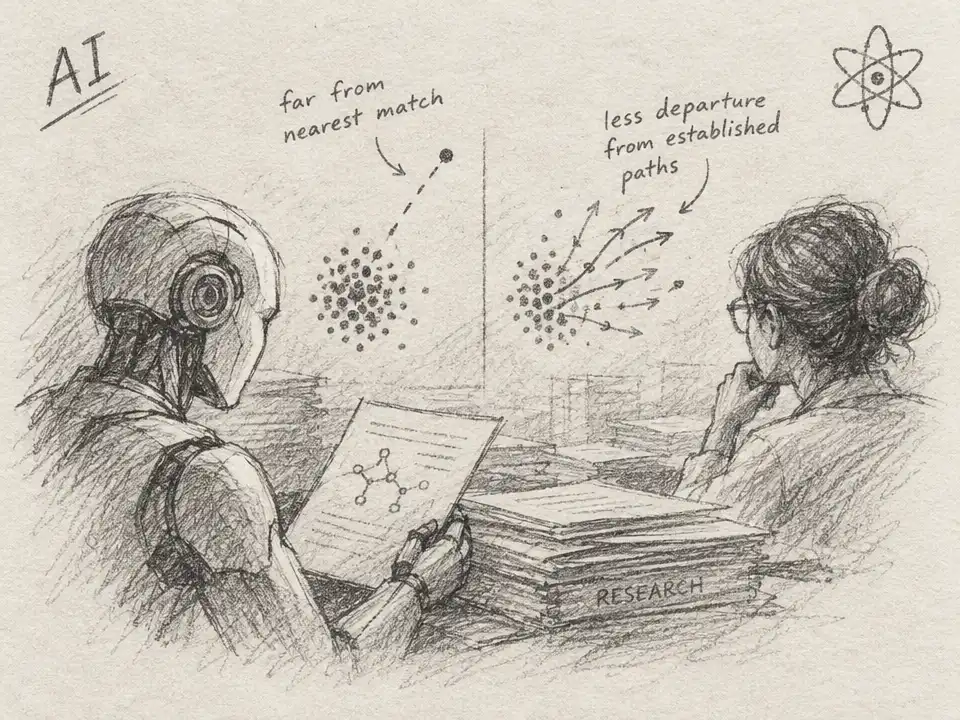
The path to the theorem was itself a collaboration. The paper’s author describes a research program that began with thermodynamic connections between different spin models and kept the AI model involved as questions were generalized and checked. The model proposed a broader class of interactions and produced parts of the geometric proof; the human researcher then recognized how to extend the result to interactions that vary along the chain and reviewed the mathematical claims. The achievement is not that a machine announced a result and the scientist accepted it. It is that a proposed route had to survive derivation, comparison, and scrutiny before it could become a theorem.
That distinction is the price of the possible new research workflow. A language model can suggest an elegant bridge, but its fluency is no guarantee that the bridge holds. In this case, the claims are mathematical: the paper provides proofs of the mappings. Its account of who first recognized each idea, however, comes from one documented collaboration, not from a controlled comparison of research teams. The paper explicitly treats its larger claim—that sustained AI involvement may help produce discoveries—as a proof of concept, not evidence that this approach reliably increases breakthroughs.
The theorem also has boundaries. It concerns classical one-dimensional open chains, not every magnetic material or every lattice. Closing the chain into a loop changes the boundary conditions that make the transformation work as stated. And an exact correspondence between mathematical models is not an experimental observation that a particular substance behaves like either model. Researchers still have to decide whether a real system fits the assumptions, whether the mapped problem yields useful predictions, and what those predictions mean physically.
There is a more general lesson in the change of coordinates. Sometimes the obstacle is not missing information but a representation that hides a relationship already present in the mathematics. A chain of spins is hard to read in one frame and unexpectedly orderly in another. AI’s potential here is not simply to calculate faster; it may help researchers try unfamiliar ways of describing a problem. The frontier is finding more such useful maps. The cost is the patient work of proving that a promising route is real—and knowing exactly where it stops.