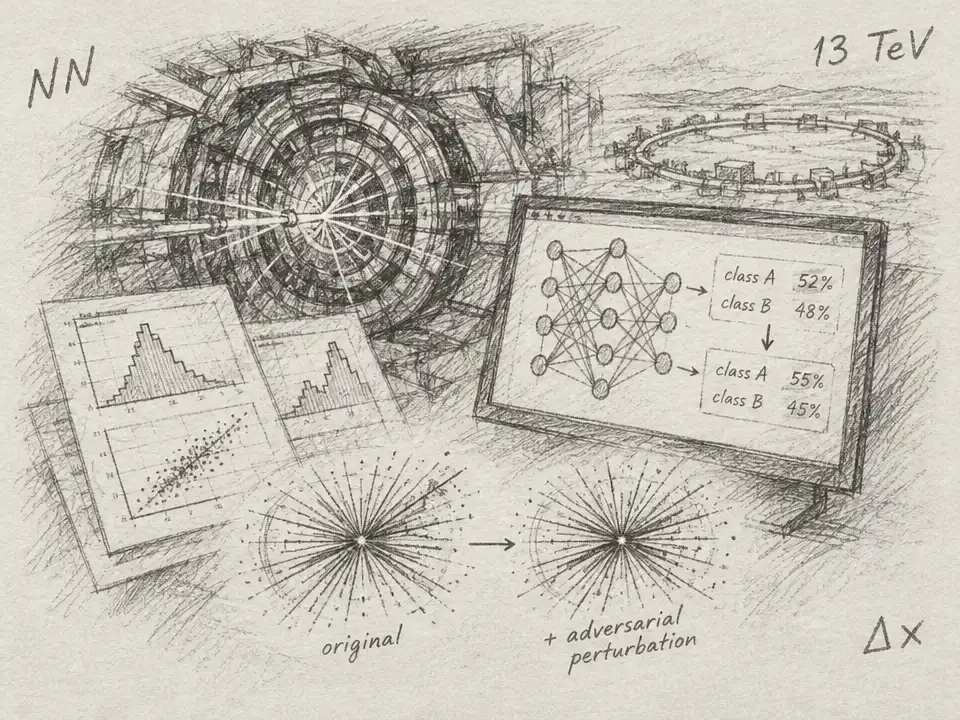
In the debris of proton collisions, a new particle rarely announces itself as a neat dot on a screen. It appears instead as a small excess in a carefully assembled mass spectrum: a bump that survives checks, while countless random combinations fade into the background. At CERN’s LHCb experiment, researchers found just such a bump—one that points to a previously unseen kind of heavy hadron. The surprise is not only that it is there. It weighs less than conventional models led physicists to expect.
Hadrons are particles built from quarks bound by the strong force. The familiar recipe for a meson is one quark paired with one antiquark. For decades, models of how those constituents move and bind have helped organize a crowded particle family. But some particles do not fall into the expected mass slots. A charm-and-strange meson discovered in 2003, for example, was about 150 MeV/c2 lighter than quark-potential models predicted. Physicists wondered whether that mismatch was an isolated quirk—or a clue to a broader pattern.
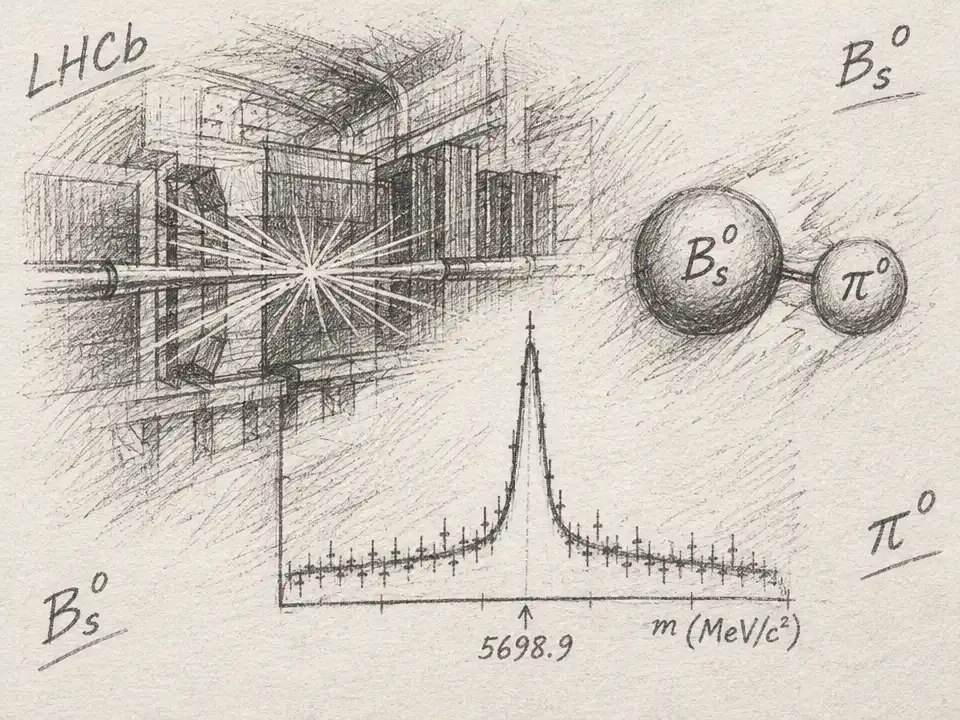
The new result reaches into the heavier “beauty” sector, where a beauty quark takes the place of a charm quark. The LHCb team searched for a beauty-strange particle appearing as a Bs0 meson and a neutral pion, π0. They used proton-collision data collected from 2011 to 2018 at center-of-mass energies of 7, 8, and 13 TeV, totaling 9 fb−1 of integrated luminosity. Finding the candidate meant reconstructing the particles from their own decay products—not observing the short-lived parent directly.
That reconstruction had several paths. The researchers identified Bs0 mesons through three different decay modes, then paired each candidate with a π0, itself reconstructed from two photons in the detector’s electromagnetic calorimeter. A genuine new state should leave a peak at the same mass across these independent routes. It did. The feature remained stable across data-taking periods, magnet settings, and selection choices; checks using control samples and mixed events found no similar fake peak.
The combined analysis attributed 343+44−41 signal candidates to the new structure. Its measured mass is 5698.9 ± 1.5 (stat) ± 0.6 (syst) MeV/c2. The signal’s local significance exceeds 8 standard deviations, and its global significance exceeds 7. Those figures make this far more than a hint. The natural width, however, is too small to pin down precisely: the analysis sets limits of Γ < 9.8 (11.8) MeV at 90% (95%) confidence level. In other words, the observed peak is consistent with an exceptionally narrow particle.
Why would a heavy particle be unexpectedly light—and so narrow? One likely interpretation is that the bump is the lowest-lying scalar beauty-strange meson, the beauty-sector counterpart of the puzzling charm-and-strange state. In that picture, its mass sits below the threshold for decay into a B meson and a K meson. That ordinary strong-force route is then closed. The observed Bs0π0 decay is suppressed by isospin symmetry, which helps explain why the state does not simply fall apart quickly.
But a strong signal does not settle the particle’s internal identity. The paper says the data are also compatible with an axial-vector beauty-strange state, with a photon from a related decay escaping detection, or even a combination of two nearby states. The results establish a new resonance; they do not yet tell physicists exactly how its quarks and surrounding fields are arranged. Some explanations treat such particles as partners of familiar mesons shaped by chiral symmetry. Others allow a substantial molecular component: a bound pair of neighboring hadrons, rather than a simple quark–antiquark arrangement. The current measurement fits these broader ideas but does not choose between them.
A particularly intriguing clue comes from comparing the new state with its charm-sector analogue. If the new particle is the predicted scalar, its mass lies 332.0 ± 1.5 (stat) ± 0.6 (syst) MeV/c2 above the ground-state Bs0. The corresponding separation in the charm system is 349.2 ± 0.7 MeV/c2. The close values suggest that the dynamics responsible for the unexpectedly light states may persist even when the heavy quark changes from charm to beauty—a test of whether a pattern seen in one part of the particle family travels to another.
That is the deeper reversal: the surprise may not be that one model missed one mass, but that a similar mismatch appears in two different heavy-quark systems. More data and measurements of related decays, especially Bsγ, could distinguish the competing interpretations and reveal a possible partner state. For now, the new resonance is both a discovery and a question. The old quark model remains a powerful map of hadrons, but this lighter-than-expected visitor suggests that the strong force may be drawing some of its boundaries in more complicated ways.