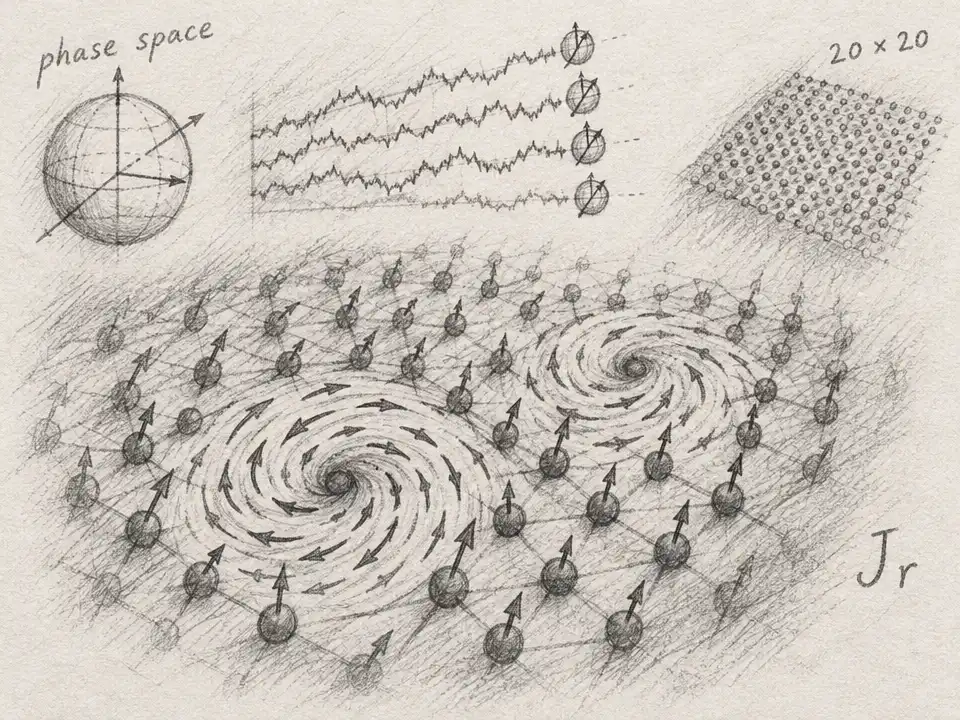
Imagine a checkerboard with 400 tiny quantum spins, each tugging on its neighbors while the surrounding environment steadily drains energy from the array. The puzzle is not just what pattern the spins settle into. It is how to calculate their collective behavior without tracking an impossibly large quantum state—and how to see the twists and defects that might disrupt the pattern along the way.
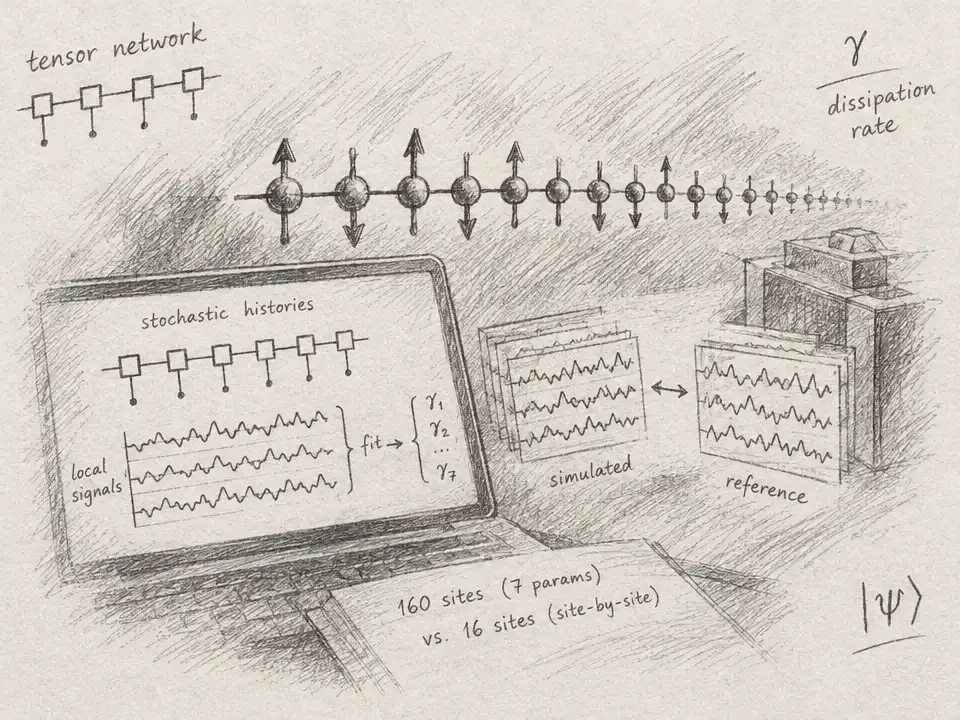
That is the challenge Igor Timofeev, Dawid A. Hryniuk, and Marzena H. Szymańska take on in a new computational method for open spin systems. Their approach turns the calculation into an ensemble of noisy trajectories, one simulated path for each spin site. In tests on a two-dimensional, 20-by-20 lattice, those paths expose structures that are difficult to spot in averages alone—and show that a familiar prediction of simpler calculations can fail.
The difficulty begins with quantum bookkeeping. A lattice of interacting spins does not behave like a collection of independent little magnets: each spin can become correlated with others, and the number of possible joint states grows exponentially as sites are added. Now include the environment, which can make spins lose energy, and long-range interactions that connect distant sites. Standard methods can struggle to reach the size and geometry needed to see what the whole array is doing.
The researchers’ new map starts by representing each spin with coordinates on a sphere called a Bloch sphere. That is not a claim that quantum spins literally travel along classical paths. The spheres are part of a phase-space representation: a mathematical way to encode quantum states and calculate their averages. The team derives its rules from the quantum equation for a system coupled to its environment, then makes a controlled approximation that converts the evolution into stochastic equations. Those equations include both the interactions’ influence and noise associated with environmental loss.
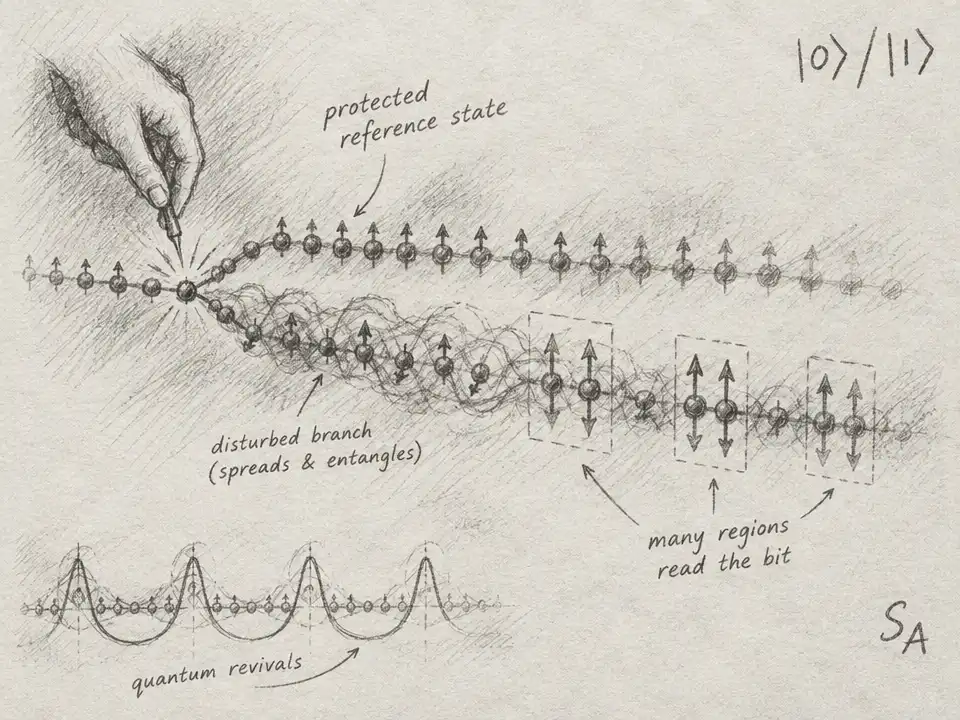
In practice, each run produces one possible noisy history for the entire lattice. Run the calculation many times and average the results to estimate measurable properties. The payoff is more than a smaller bookkeeping problem: individual histories can also be inspected. The method therefore gives researchers a way to ask not just whether an average pattern survives, but how it gets disrupted.
There is a trade-off. The new equations come from truncating an expansion of the exact quantum description, so the method is an approximation, not a shortcut to an exact answer for every large system. The authors check it against exact calculations for a single-spin model, including different spin sizes. For the two-dimensional lattice, they compare their results with an advanced tensor-network calculation. The agreement is qualitative for the average spin polarization, with a maximum error of about 10% in the comparison reported for that quantity. That makes the method useful, while leaving clear reasons to keep testing it.
The first surprise comes from the simplest interaction pattern: each spin interacts only with its nearest neighbors. Mean-field theory—a common approximation that treats each site as responding to an average of its surroundings—predicts a checkerboard-like staggered pattern of sideways spin alignment once the coupling is strong enough. But the new simulations find that this predicted order is strongly suppressed. A correlation that mean-field theory says should be present is about 40 times smaller in the simulations.
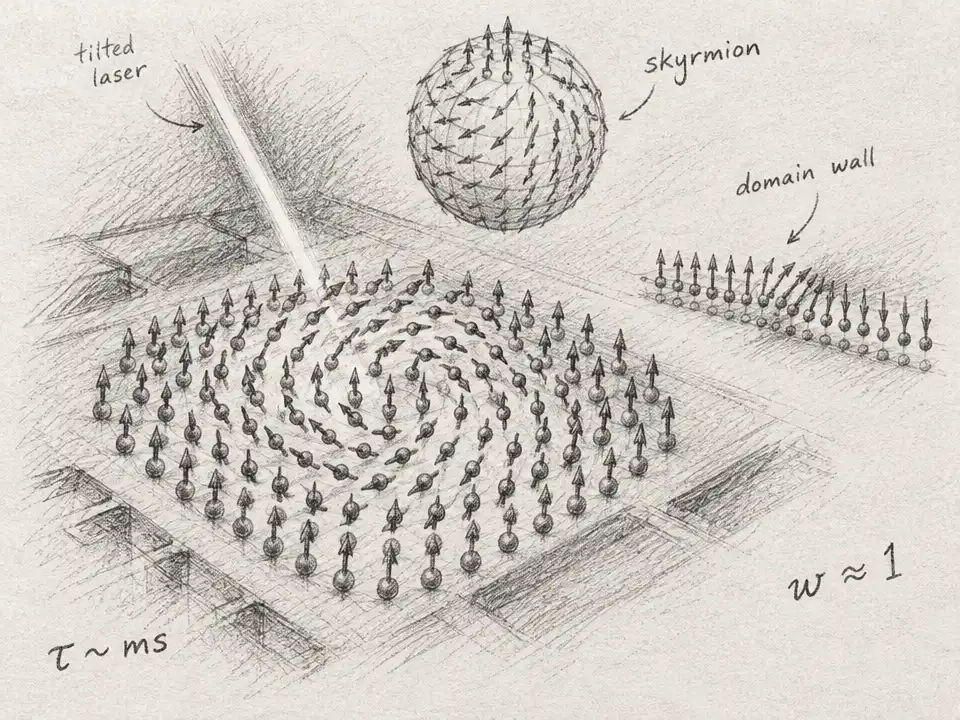
The trajectories suggest why. As the system evolves, local orientations swirl around points where the pattern winds through a full turn. These topological defects come in two kinds, vortices and antivortices. In the simulations, they appear in pairs and spread through the lattice, breaking the alignment into domains. For one reported snapshot, the researchers identify 56 vortices and 56 antivortices. Their proliferation is consistent with the loss of the mean-field pattern; in the nearest-neighbor model, correlations fade rapidly with distance.
Then the team lets the interactions reach farther. In their model, the coupling weakens with distance according to a power law, and an exponent called alpha controls how quickly it fades. Smaller alpha means more influence from distant spins; larger alpha makes the interaction more local. The researchers map how the system settles as they vary both this range and the interaction strength.
Here, long-range coupling can stabilize a different kind of order, one with a two-way symmetry: flipping the sign of the relevant spin components leaves the system’s overall pattern equivalent. In the 20-by-20 calculations, the signal for this order becomes visible near a dimensionless interaction strength of 0.4 and is strongest near 1. But the ordered region does not simply expand as the coupling grows. For alpha above about 2, it closes again at strong coupling, returning the simulated system to disorder. At alpha equal to 3, the region spans roughly 0.5 to 2 in interaction strength. As alpha increases further, the region narrows until no order is resolved beyond about 3.5 at the accessible system size.
That return to disorder is called reentrance: stronger coupling first helps produce order, then helps destroy it. Mean-field theory misses this boundary, as well as the way the ordered region closes when interactions become shorter-ranged. The result is a reminder that coupling more strongly is not always a recipe for greater coordination. Collective patterns can depend on the balance among interactions, fluctuations and loss.
The work is a theoretical demonstration, not a report of a newly observed laboratory effect. Its 400-spin results come from simulations of a specific dissipative anisotropic XY model, and the finite lattice limits how confidently the phase boundaries can be extended to much larger systems. Still, the approach offers a way to study combinations that are hard to handle together: two-dimensional geometry, long-range forces and environmental noise. That could help researchers interpret experiments with platforms such as trapped ions, magnetic atoms and polar molecules, where some of these ingredients can be engineered.
Most importantly, the method turns the calculation into a kind of moving map. It tracks not only the average landscape of spin behavior, but also the noisy routes through which order breaks down—or survives. In a field where a system’s complexity can hide the mechanism behind a result, that extra view may be as valuable as reaching a larger lattice.