At first glance, the experiment’s crucial adjustment seems almost too small to matter: a laser wavefront tilted by just 0.04 degrees. But inside a Penning trap, that slight angle helps turn a rotating crystal of more than 150 beryllium ions into something like a miniature, programmable landscape of spins.
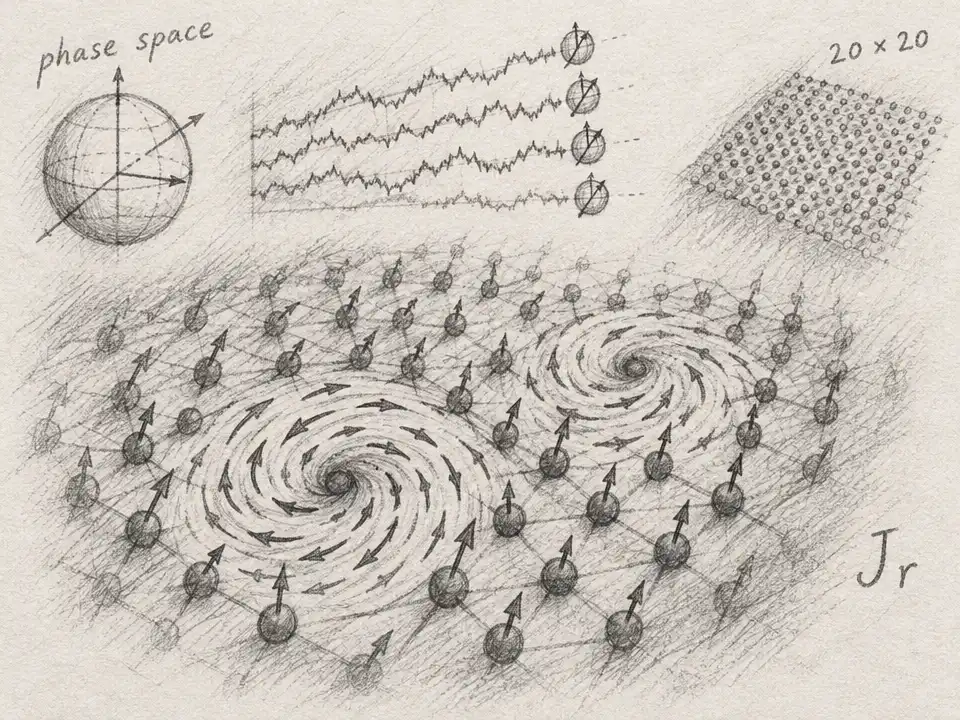
The landscape is hard to see directly. Each ion carries a tiny quantum spin, and the researchers’ goal was to arrange those spins so their directions change across the crystal in a precise, swirling pattern called a skyrmion. It is a hidden world not because it lies far away, but because its order lives in how tiny arrows point from place to place—and in how that pattern maps onto an abstract sphere.
Skyrmions are known in certain magnetic materials, where spins form stable, whirlpool-like textures. Here, the team did not make a piece of magnetic material with a skyrmion inside it. Instead, they prepared a related pattern among the internal spin states of individual trapped ions. That distinction matters: the ion crystal is a controllable stand-in for studying complex quantum systems, not a miniature copy of a naturally occurring magnet.
The ions sit in a flat, circular arrangement and rotate together in the trap. Ordinarily, the shared motion and uniform control of a large ion group make it difficult to give different locations different spin instructions. The team found a way to make the crystal’s rotation work for them. They tilted the wavefront of a spin-dependent optical force so the force varied slightly across the crystal. The tiny tilt made each ion’s response depend on where it sat.
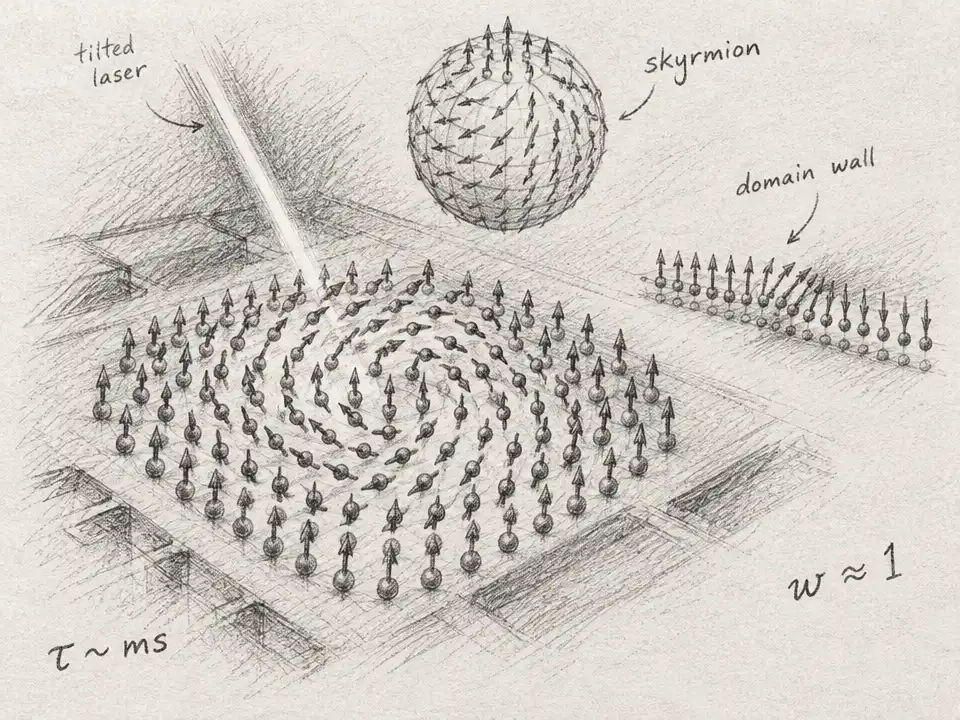
Microwaves first set the spins moving together. Then the patterned laser force made their motion diverge in an organized way. Ions near the center precessed slowly; those farther out precessed faster. The direction of each ion’s spin rotation also depended on its position around the circle. After a carefully chosen pulse, the outer spins had turned to point opposite the central ones, with the spins between them forming a smooth transition.
The result is easier to picture by imagining a small arrow at every ion. At the center, the arrows point one way. Moving outward, they tilt, while also turning around the circle. Taken together, those arrows cover the full range of directions on a sphere once. That one-time wrap is the skyrmion’s topological signature: a global pattern that cannot be described by looking at just one spin.
To test whether they had built the intended texture, the researchers measured the ions along three different spin axes. They repeated the measurements and used the individual ions’ positions to reconstruct the local spin directions. In the main skyrmion measurement, the pattern reached a winding number of −0.99 ± 0.02, close to the value of −1 expected for a single wrap. The negative sign indicates the orientation of the central spin relative to the outer region. The average local fidelity—the overlap between measured spins and the target pattern—was 0.87 ± 0.04.
There is an important limit to what that reconstruction establishes. The team measured the average spin direction at each location; it did not perform full state tomography, which would also capture correlations between different ions. The result is a detailed map of the local texture, not a complete accounting of every quantum relationship in the crystal.
The same platform produced a different kind of hidden geography: a domain wall, where one region of spins points one way and another region points the opposite way. To make it, the researchers used a tightly focused laser beam to reset ions outside a chosen radius. The boundary between the regions was 28 ± 12 micrometers wide—comparable to the spacing between neighboring ions. Its measured average fidelity was 0.93 ± 0.02.
These patterns are valuable not simply because they look striking in a reconstructed map. They give researchers distinct starting arrangements for experiments on what happens when a quantum system is suddenly made to evolve. The team’s longer-term aim is to study how topological order and spatial patterns influence that evolution. In other words, the skyrmion and domain wall are prepared starting lines, not the finish of a completed study of quantum dynamics.
That next step will have to contend with an unexpectedly ordinary obstacle: magnetic-field noise. The researchers traced an important source of spin dephasing to a field fluctuation around 100 hertz, with an amplitude of a few nanotesla. In a test of the prepared texture, its order parameter retained about 73% of its initial value after 12 milliseconds. The pattern was visible and measurable, but its order did not remain untouched.
That combination—careful control and fragile coherence—is part of what makes the experiment revealing. A 0.04-degree tilt can imprint a pattern across hundreds of quantum spins, and measurements can show that the pattern wraps the Bloch sphere almost exactly once. Yet even a small magnetic fluctuation can blur the organized picture over time. The work opens a route to exploring how complex spin patterns behave in a programmable quantum system, while making clear that the next adventure begins after the pattern is made.