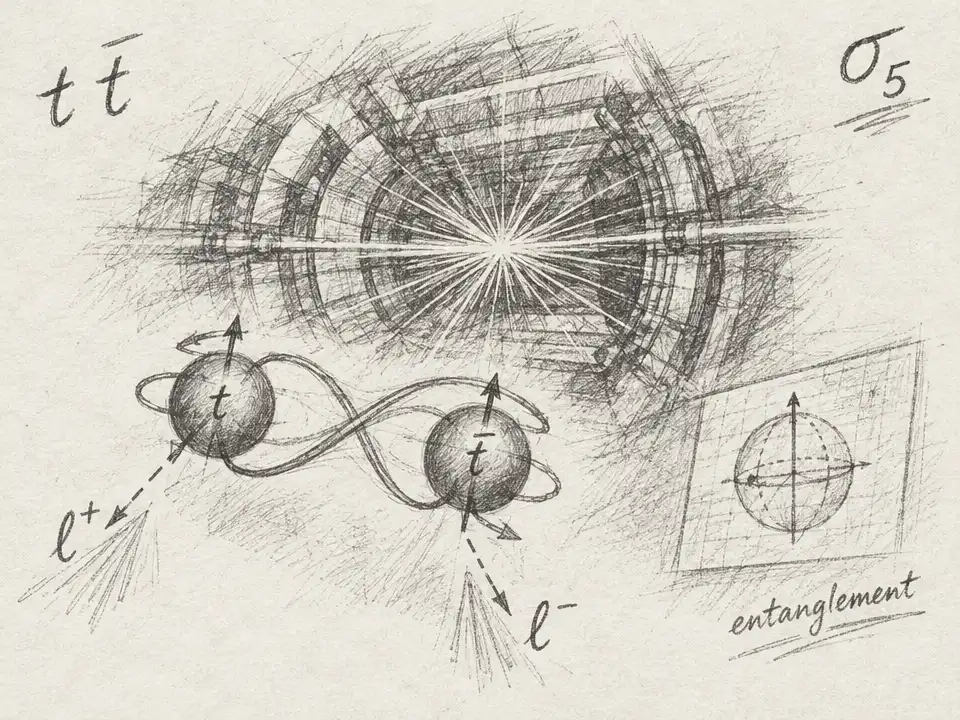
When two protons collide in the Large Hadron Collider, the aftermath is a spray of particles. Buried in some of those collisions is a short-lived pair: a top quark and its antimatter partner, the antitop. They are not just another pair to count. Their spins can be linked in a way that quantum information researchers call entanglement—and the particles’ astonishingly brief lives make that link unusually accessible.
This is where two fields meet. Quantum information theory has developed tools for describing and testing entanglement, often in carefully controlled systems. High-energy physics offers something different: collisions that create quantum systems moving at extreme energies. The challenge is to translate the language of one field into measurements the other can make. In a recent overview, physicists Yoav Afik and Juan Ramón Muñoz de Nova explain how top-quark spin turns that translation into an experiment.
A qubit is a quantum system with two possible states. The top quark’s spin can serve as one; the antitop’s spin supplies another. Together, their spins form a two-part quantum system. If the pair is entangled, their joint state cannot be described as two independent spins, each carrying its own set of hidden instructions. Instead, the relationship between them is part of the state itself.
That description might sound abstract. The top quark makes it measurable because it decays before its surroundings can scramble much of its spin information. Its mass is approximately 172.5 GeV, its width is approximately 1.42 GeV, and its lifetime is approximately 4.6 × 10⁻²⁵ s. In that tiny interval, it decays before hadronization or other processes can decorrelate its spin. The decay products therefore carry clues about the spin the top had just before it disappeared.
Among those clues are charged leptons, whose directions are especially useful for reading out the parent particles’ spins. Researchers reconstruct the top and antitop decays from the particles detected by the experiments, then study how the two lepton directions line up. No detector catches the top quarks and measures their spins directly. Instead, the researchers infer the shared quantum state from patterns across many collision events.
Quantum information supplies a framework for making that inference. In quantum tomography, researchers reconstruct a system’s state from measurements of selected observables. A complete description of two qubits involves 15 independent quantities, including each particle’s spin polarization and the correlations between their spins. In principle, those quantities provide a fuller picture of the pair’s state. But collider data are limited, and a full reconstruction is not always necessary to answer one key question: are the spins entangled?
For that, physicists can use an entanglement witness: a measured quantity with a boundary that no separable, non-entangled state can cross. The top-pair proposal reviewed by Afik and Muñoz de Nova uses a single spin-correlation measure related to the angle between the two charged leptons. If the measurement passes the relevant boundary, it is sufficient to show entanglement. It does not, by itself, establish every stronger kind of quantum correlation, such as Bell nonlocality.
The most promising place to look is near the top-pair production threshold, where the pair is produced with relatively little motion in its shared center-of-mass frame. The theory described in the paper predicts a strongly entangled spin-singlet state there. The region also offers a practical advantage: it has a substantial top-pair signal, and the singlet’s rotational symmetry lets researchers combine events with different top-flight directions. That helps make a subtle quantum signature visible in real data.
The ATLAS and CMS collaborations applied the proposed approach to their 13 TeV proton-collision data from LHC Run 2. They measured the spin-correlation quantity at -0.537 ± 0.019 for ATLAS and -0.452+0.025-0.026 for CMS. Both measurements crossed the entanglement witness’s separability boundary by more than five standard deviations. The result was the highest-energy observation of entanglement reported in the overview.
The striking twist is that the top quark’s fleeting lifetime is not merely an obstacle. Because it decays so quickly, it gives physicists a way to use its decay products as tracers of spin before other processes can erase the signal. Quantum-information methods make those traces interpretable; collider experiments supply the extreme setting and the data. Neither field replaces the other. Their meeting makes a new kind of question experimentally answerable: how does quantum entanglement behave among particles created in a relativistic collision?
The top quark is only one possible route into that question. The paper points to studies of other particles and to further quantum-information ideas that could be explored with collider data. Each brings its own experimental difficulties, and observing entanglement is not the same as building a quantum computer or demonstrating every feature of quantum information. Still, the method opens a useful exchange: particle collisions can test quantum concepts in a regime no tabletop system can reproduce, while quantum theory gives physicists a sharper way to read what those collisions reveal.