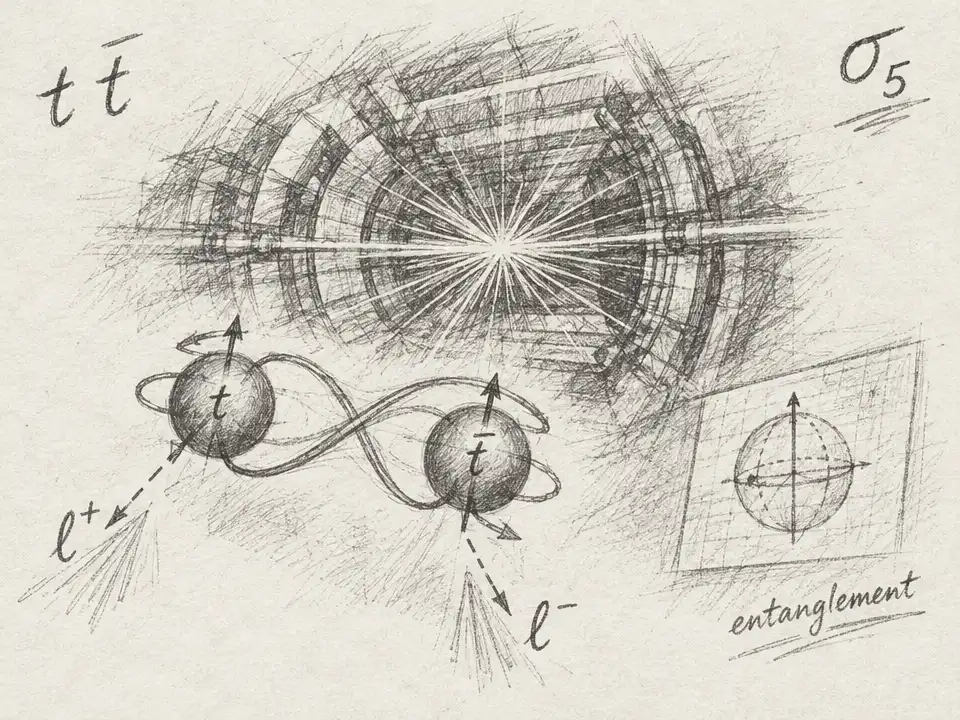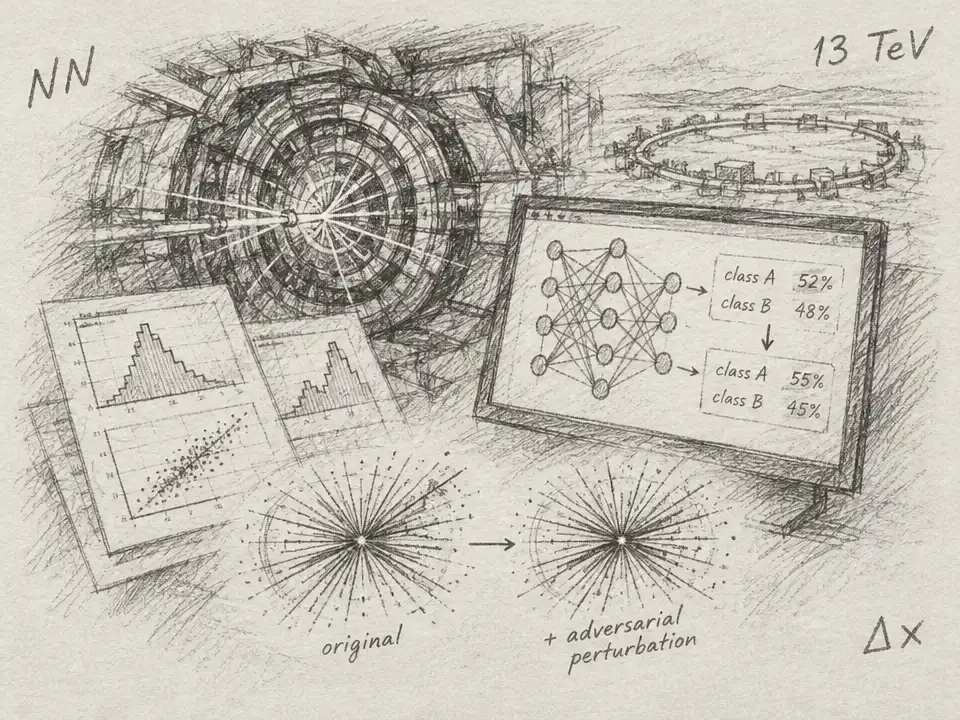
Inside a particle collider, a high-energy collision can set off a cascade. A quark or gluon splits; its offspring split again; the chain ends in a crowded spray of particles called a jet. Physicists can detect the spray, but reconstructing the quantum events that built it is another matter. A new study offers a compact way to model one small piece of that cascade: a gluon splitting into two gluons, represented by a circuit with just two qubits.
The challenge is not simply to divide up momentum. In quantum chromodynamics, or QCD, the theory of quarks and gluons, the particles in a split also carry quantum properties such as helicity, a kind of intrinsic angular momentum. Those properties can become entangled: the two offspring may share a joint quantum state that cannot be fully described by treating each one on its own. Standard shower simulations are powerful tools, but their usual step-by-step sampling treats branchings classically and leaves such quantum coherence out of the picture.
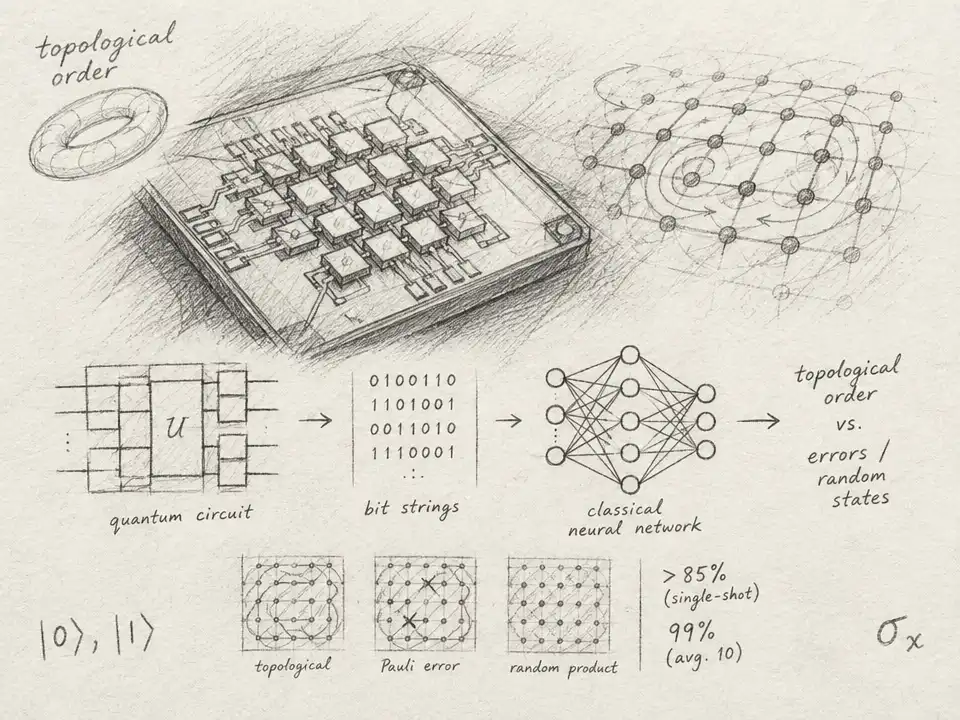
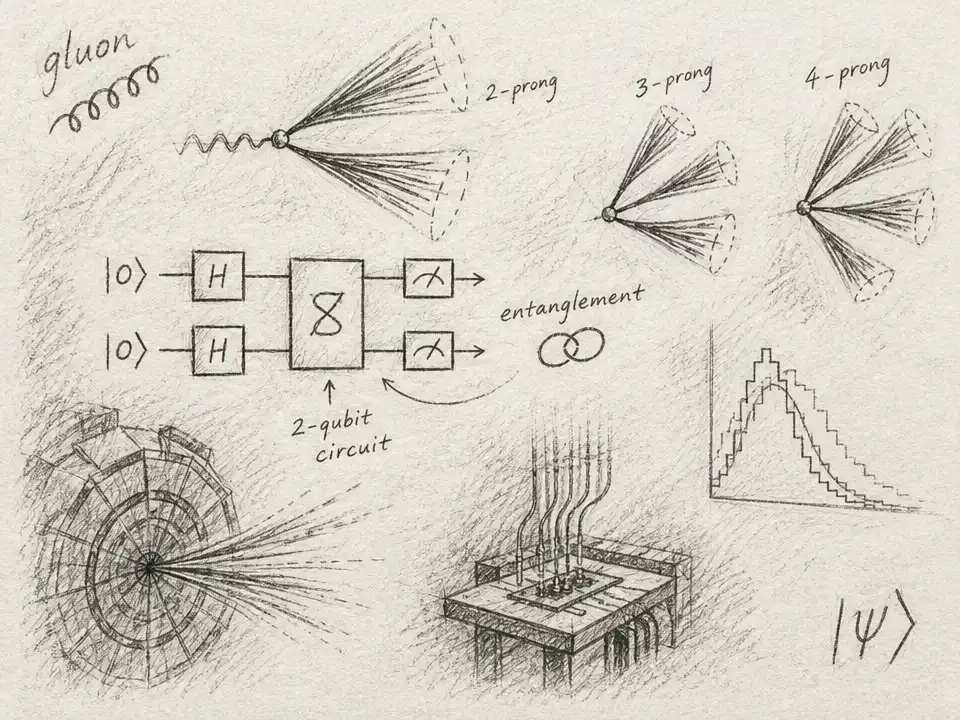
The researchers’ strategy begins with a calculated feature of a gluon splitting: how entangled the outgoing pair should be for a given sharing of momentum. Their circuit gives each outgoing gluon a qubit. Measurements of the qubits stand in for the daughters’ momentum shares, while a two-qubit correlation carries information about their entanglement. The circuit’s adjustable settings are chosen so both features line up with the QCD calculation.
This is not a miniature collision unfolding inside a chip. The circuit’s state is engineered to reproduce the relevant entanglement measure, not to be identical in every detail to the full quantum state of the gluons. That distinction is central to the approach: instead of asking a small quantum processor to reproduce all of QCD, the researchers build a focused component that preserves a specific quantum relationship while also tracking momentum.
They then asked whether the component could be connected to itself. A first split creates two daughters; a later circuit can split one of them again. In the model, the measured momentum shares combine in the same way that a daughter’s share divides between its own offspring. The construction preserves the total momentum assigned at each step, and it can be repeated to build patterns with three or four final prongs.
To set the circuit’s parameters, the team turned to reconstructed jets in AspenOpenJets, a dataset derived from 2016 CMS Open Data. They extracted two-prong structures and used the observed momentum-sharing distribution to tune the circuit. The next test was more revealing: could those settings, without a fresh fit, reproduce the broader patterns in jets with more prongs? In simulations, the resulting three- and four-prong distributions followed much of the measured data’s central range. Differences grew near the edges, especially where one prong carries almost all the momentum.
The researchers also ran the three-prong circuit on IBM’s Marrakesh superconducting processor. Each circuit was executed 1,024 times to collect measurement samples, and the study reports 600 independent executions. The compiled circuit used seven two-qubit gates and had a depth of 33. The team applied error-mitigation procedures, then used a separate set of 100 executions to estimate and correct a hardware bias in the measured momentum shares.
That correction did not make the hardware data pristine: 28.8% of executions were discarded because the corrected momentum estimates fell outside the physically allowed range. Even so, the retained results tracked the three-prong data reasonably well after processing. The hardware test is therefore best read as a proof of feasibility for a small, carefully handled circuit—not as evidence that a quantum computer has already beaten classical jet simulation.
The limits are informative. The model assumes that successive momentum shares can be sampled independently from the same two-prong distribution, and it favors further splitting of the harder daughter. The paper’s own analysis finds those assumptions are not exactly true in the data: successive splittings can be correlated, and their distributions change as the shower develops. The simplified circuit still captures much of the middle of the multi-prong distributions, but it misses some tail behavior. It also does not yet model the shower’s full evolution, all kinds of quarks and gluons, or the color dynamics needed to describe hadronization.
There is another important boundary: the multi-prong distributions produced here can also be generated by classical sampling and multiplication of momentum fractions. The immediate promise is not a demonstrated speed advantage. It is that the circuit carries an entanglement feature as part of its design, rather than adding quantum correlations as an afterthought. That could give future simulations a way to study information hidden in the relationships among particles, not just the particles’ separate momenta.
For now, the achievement is a carefully drawn first outline: a quantum circuit small enough to run on today’s hardware, tuned to collider data, and built to remember something a classical branching picture discards. Making that outline into a full particle shower will require more physics and more capable circuits. But the basic move—turning a known quantum feature of a gluon split into a reusable computational building block—offers a concrete new route into one of particle physics’ most intricate cascades.