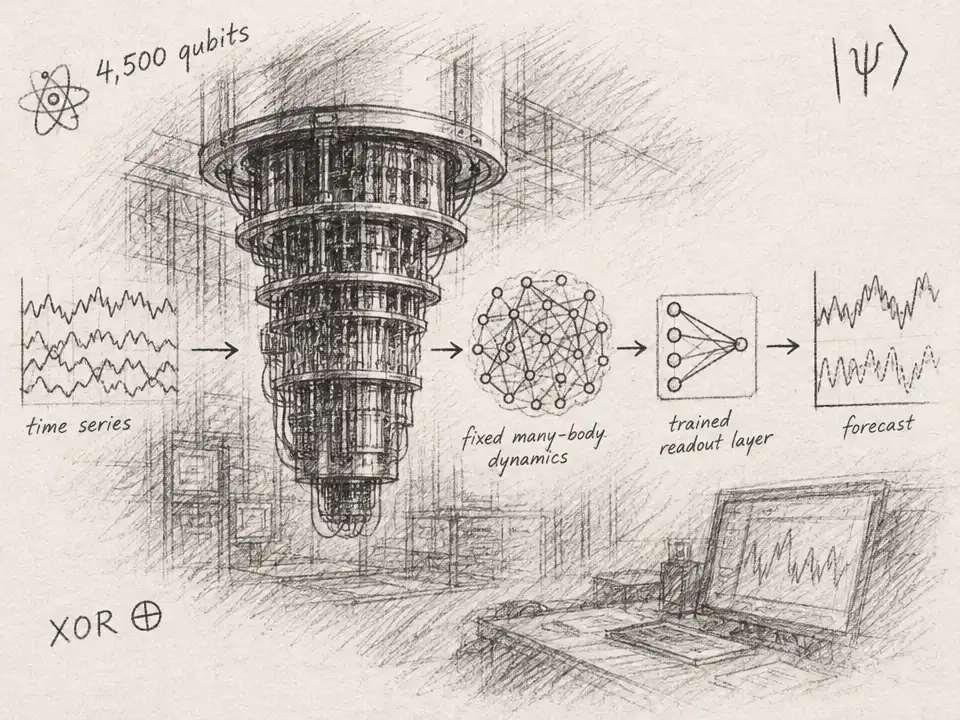
Imagine trying to find out what is going wrong inside a quantum computer. The trouble is not just that its tiny components are delicate. The system’s behavior comes from many parts interacting, while stray influences—noise—can blur the patterns a calculation depends on. To diagnose that noise, researchers would like to reconstruct how the whole system changes over time. But tracking every detail of a large quantum state quickly becomes a computational mountain.
A new method takes a different route: instead of rebuilding the entire state again and again, it follows many plausible histories of how the system evolves, then asks which model of noise best reproduces the system’s simpler, local signals.
The method, developed for an Ising spin chain, tackles a practical question: Can researchers infer not just that a quantum system is noisy, but what kinds of noise are acting and how strongly? The answer matters because a good noise model can help researchers assess a device and guide future error-correction strategies. The work is a computational proof of principle, not a demonstration using data from a quantum computer.
The challenge begins with an awkward trade-off. A complete description of a quantum system can contain far more information than experiments can conveniently collect. Full quantum-state tomography—the painstaking effort to reconstruct that description—becomes prohibitively demanding as the system grows. Measurements of individual sites are more accessible, but those scattered readings still have to reveal what invisible disturbances are shaping the whole system.
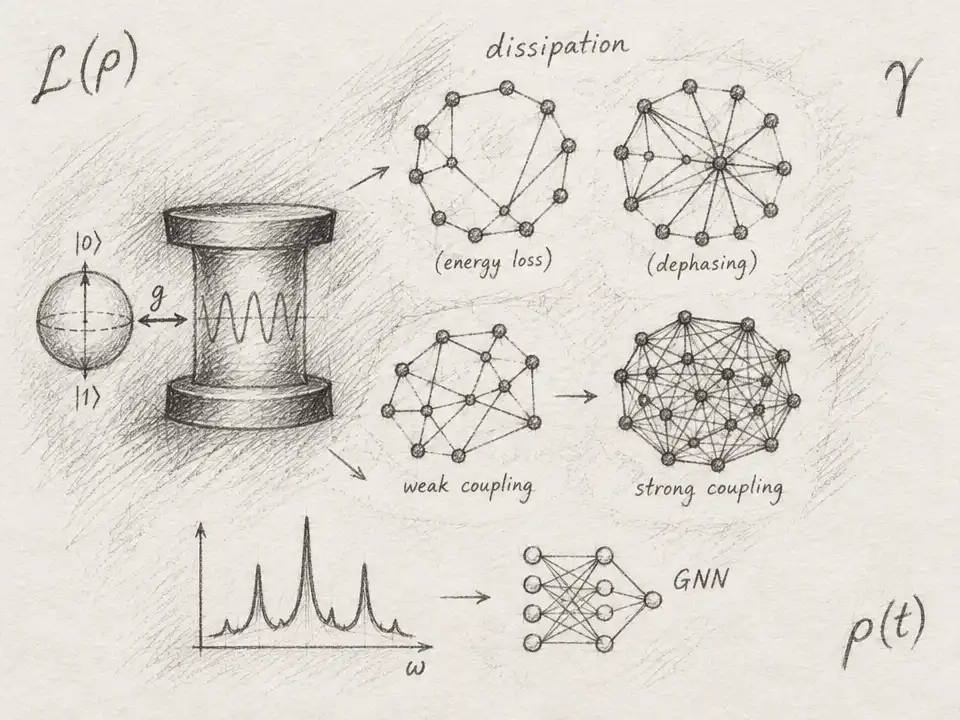
Here the researchers use a framework called the Lindblad equation, a way to describe quantum evolution when a system is open to its surroundings. Its noise terms can represent, for example, disturbances affecting individual sites or correlated errors that reach across pairs of sites. The unknowns are the strengths of those effects: the rates that say how often, or how powerfully, each kind of noise acts.
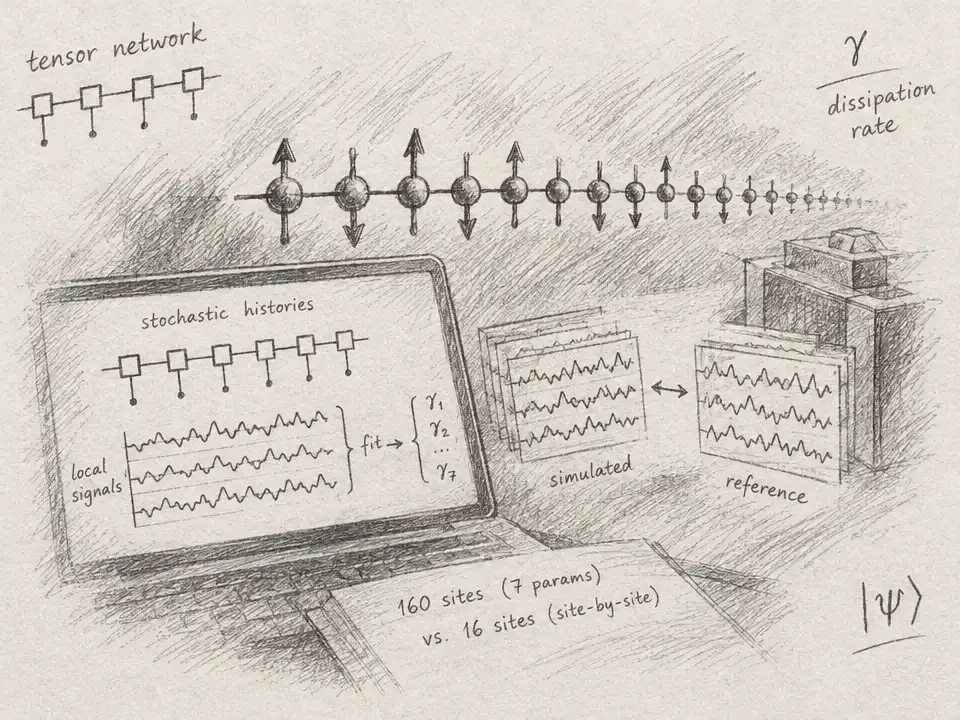
The new approach turns that inference problem into a loop. First, researchers specify a candidate set of noise rates and simulate what the spin chain would do. Next, they compare the simulation’s time-dependent local signals with a reference set. Then an optimizer adjusts the rates and tries again, looking for a better match. In an eventual experiment, those reference signals could come from measurements; in this study, they were generated by simulations using known rates.
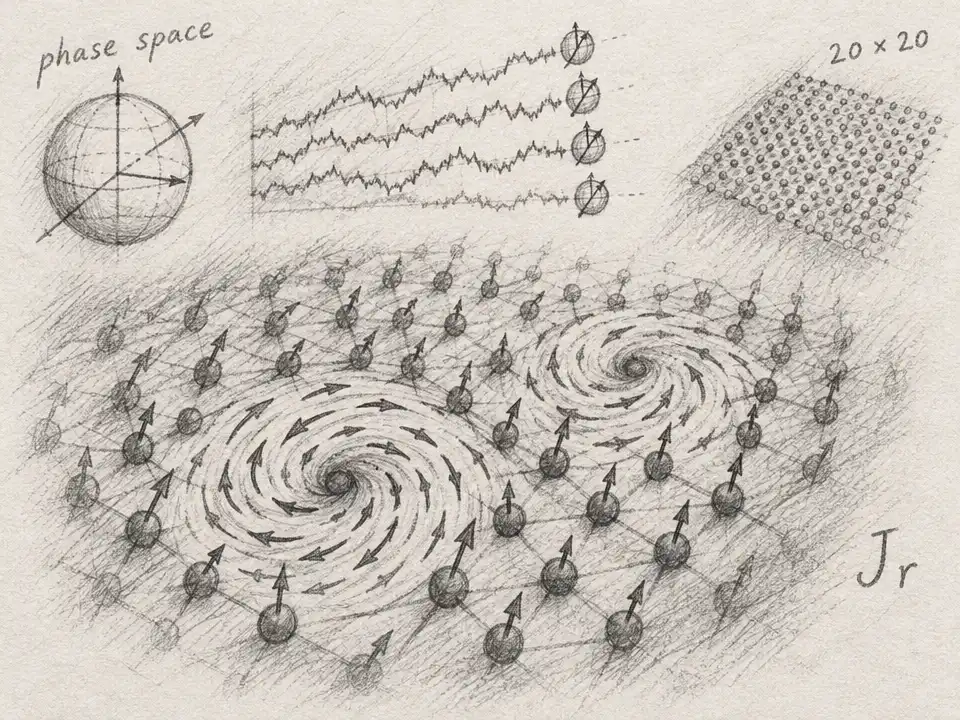
The computational shortcut is in how each candidate simulation is represented. The Tensor Jump Method combines a stochastic picture of quantum evolution with tensor networks, compact mathematical representations that can describe many interacting sites without storing every possible detail separately. In this picture, the system follows one possible history at a time, with random jumps standing in for dissipative events. Averaging over many such histories estimates the local signals the model predicts.
It is a little like estimating a crowd’s movement by watching many sampled journeys rather than recording the position of every person at every instant. The analogy has limits—quantum states are not crowds, and the trajectories are computational tools—but it captures the strategy: use a tractable collection of histories to recover the large-scale pattern. The researchers pair this simulator with gradient-free optimizers, which can search for good noise rates without needing a smooth, exact map of how every small parameter change affects the result.
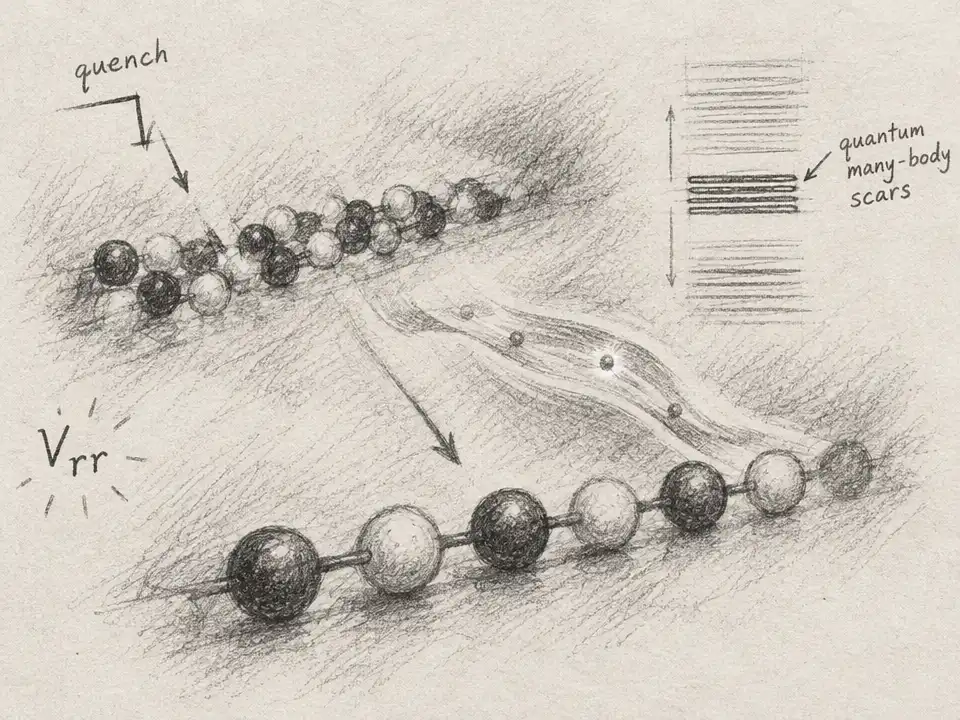
The noise model includes two layers. One allows independent disturbances at each site, including noise associated with the Pauli X, Y, and Z directions. The other allows correlated ZZ dephasing: a disturbance involving two sites at once. The team considered pairs as far as four sites apart, a way to represent crosstalk rather than assuming every error stays neatly confined to one location.
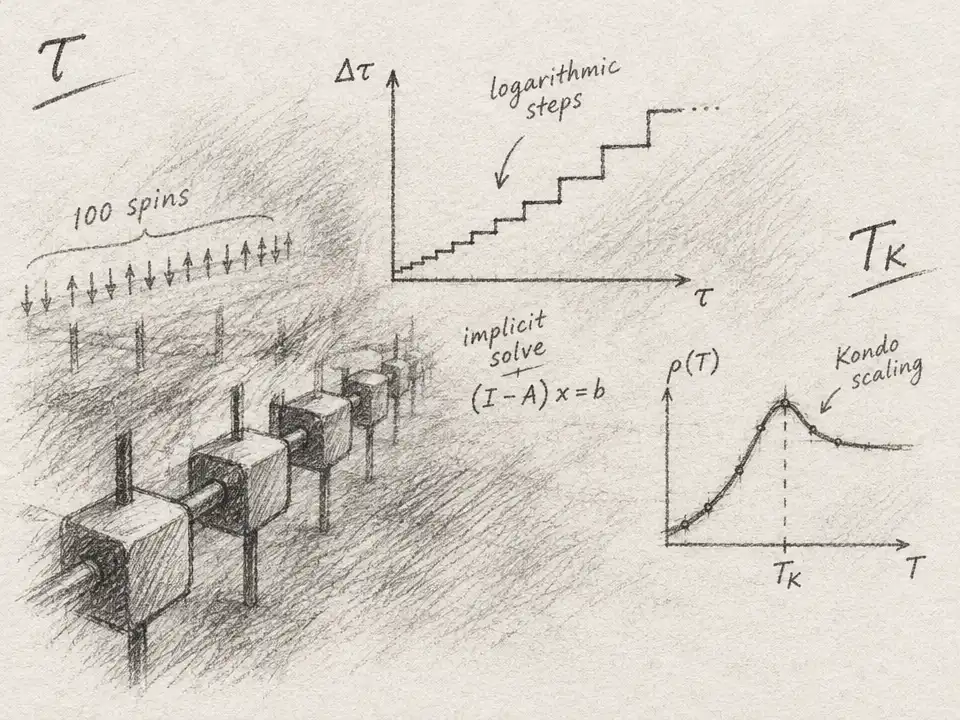
The scaling test produced a striking contrast. When the model allowed each site to have its own rates, the team learned those parameters for chains up to 16 sites. That is a demanding search, because the number of adjustable rates grows as the chain gets longer. In a second version, they assumed the noise was spatially uniform: the same three rates for single-site disturbances everywhere, plus one correlated-noise rate for each of four separation distances. That left just seven parameters, no matter how large the chain became. With that simplified model, their simulations reached 160 sites.
One result turns the usual expectation about scale on its head. To achieve the same target precision for the fitting score, the 10-site global model used 2,186 simulated trajectories, while the 160-site model used 137. This does not mean every larger quantum system is automatically easier to simulate. The researchers’ argument depends on correlations between local signals remaining limited in range. In a 40-site numerical example, those correlations fell rapidly beyond about four sites. Under that finite-correlation condition, adding more sites supplies more local information to average over, helping steady the overall score.
There is a second, subtler lesson: matching the system’s behavior does not always reveal a unique explanation for it. In the site-by-site model at 16 sites, the fitted rates did not settle cleanly; many values could vary while the predicted time series still matched the reference closely. The method could reproduce the dynamics even when it could not pin down every individual rate. That is not a failure of arithmetic so much as a limit on what the chosen observations can identify. A successful diagnosis may describe the system’s behavior without uniquely identifying every underlying cause.
For now, the method still has a bridge to cross. Its reference data came from simulations, and the authors identify realistic experimental measurements, incomplete observations, and measurement noise as important next tests. The largest-chain result also relies on a spatially uniform noise model, while more flexible, site-specific learning remains a harder optimization problem. Still, the approach offers a fresh way to make large-system noise diagnosis computationally approachable: trade a prohibitively complete reconstruction for many sampled histories and a careful comparison of local signals. The ambition is not to make quantum noise disappear. It is to get a clearer map of what the noise is doing.