At the Large Hadron Collider, a collision lasts an instant. Its aftermath is a cascade of particles, tracks, and detector readings—an intricate record physicists must sort into meaningful events. Neural networks can help: they sift through those measurements to distinguish one kind of collision from another, or to reconstruct quantities that the detector cannot observe directly.
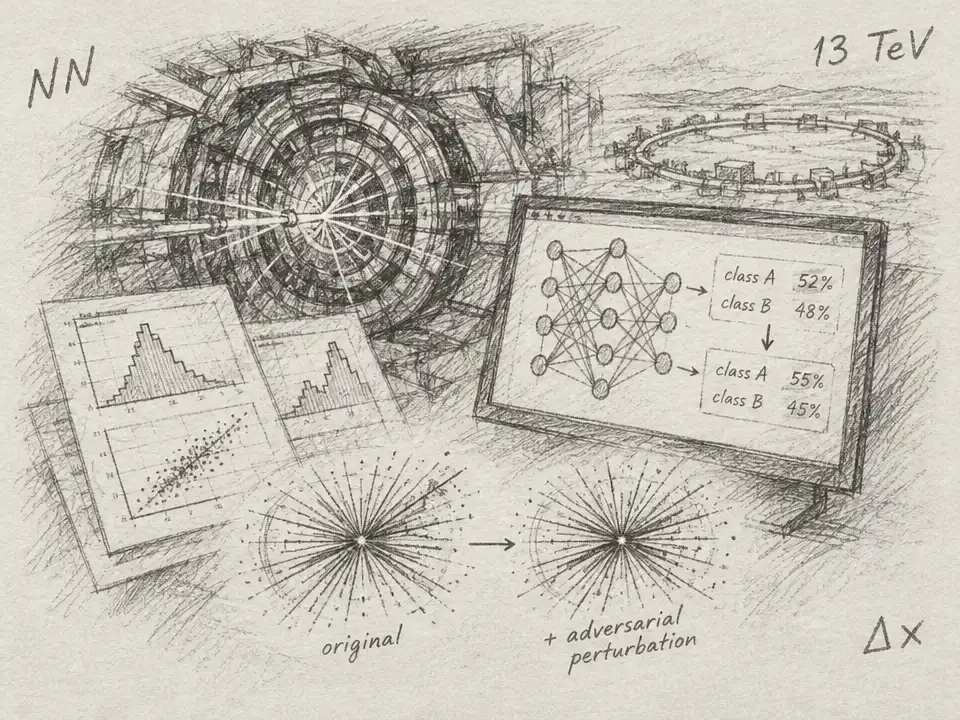
But there is a catch. A network can make a confident choice for reasons hidden in the tangle of its inputs. Physicists commonly test their simulations by comparing familiar plots: how often a particular measurement takes each value, and how pairs of measurements relate. If those checks look good, the model may seem trustworthy. Yet a classifier can rely on subtler patterns that do not show up in those views.
A new study borrows a way to probe that problem from a seemingly distant field: adversarial attacks in machine learning. In computer vision, researchers use carefully chosen changes to an image to see whether a neural network will misclassify it. Here, the same basic idea becomes a diagnostic—not an attempt to fool a real detector, but a controlled stress test of particle-physics classifiers.
The researchers made small changes to simulated collision data, keeping each within an assumed range of experimental uncertainty. They also constrained the changes so they would not create obvious shifts in individual measurement plots or a preferred direction across the sample. The test was designed to ask a pointed question: could a network’s decision change even when the usual checks could not distinguish the altered data from the original?
They tried the method on three tasks using fast simulations of proton-proton collisions at 13 TeV. One network distinguished top-quark pair production from a different process that produces two W bosons. Another identified jets—narrow sprays of particles—as more likely to have come from a quark or a gluon. A third classified events according to whether their missing transverse energy, a clue to particles escaping detection, was above or below 60 GeV.
The answer was yes. Across the three benchmarks, the study reports a 2–3% fooling ratio: that share of events changed classification under the constrained perturbations. In one test, a separate classifier asked to tell original simulated events from altered ones performed no better than chance, with an area under the receiver operating characteristic curve of 0.495 ± 0.002. The standard views looked steady, but the networks’ decisions did not.
The clearest performance change came in the top-quark-versus-W-boson task. At a fixed rate of rejecting background events, the network’s signal efficiency fell by 0.020 ± 0.005 on perturbed examples; its area under the curve fell by 0.027 ± 0.001. The graph network for quark-versus-gluon jets and the transformer used for missing-energy classification also showed measurable, percent-level shifts. Simple cut-based comparisons, which use a few explicit thresholds rather than learning many interacting patterns, were much less sensitive.
Why can small changes matter when the plots barely move? Imagine a map that marks every street correctly when examined one at a time, yet misroutes you because of a subtle relationship among several turns. Neural networks can learn relationships across many inputs at once. A slight, coordinated change may nudge events near a model’s decision boundary into the other category, even if no single measurement looks unusual. The study’s perturbations altered these higher-order patterns while leaving individual distributions and linear correlations largely unchanged.
The size of a network was not a simple predictor of its vulnerability. The largest relative performance drop appeared in the smallest model, which relied on a more compact set of features. The authors suggest that a model leaning heavily on a few dominant measurements may have less redundancy to absorb a shift than one whose decision draws on information spread across many inputs.
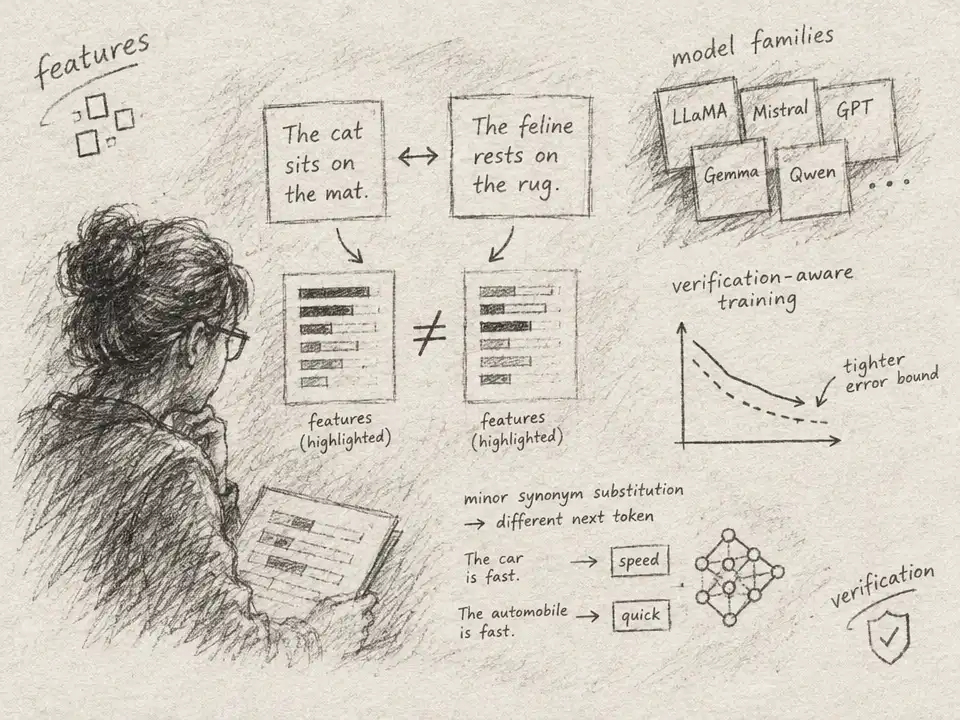
There is also a practical response. When the researchers trained models using both original and perturbed examples, the classifiers generally became more stable under the same test. That does not mean adversarial training eliminates every weakness; the results vary by task. But it suggests that a probe borrowed from AI security can help expose where a scientific model needs more careful testing.
The caution matters as much as the finding. These were simulated events, and the perturbations explored an envelope defined by assumed uncertainty limits. The exercise does not show that a real collider measurement is biased, or that nature produces the particular adversarial changes constructed by the researchers. The authors describe it as a robustness check—a way to estimate sensitivity that conventional plots may miss, not proof of an actual error in a physics result.
That distinction is what makes the crossover useful. In AI security, an attack can reveal where a system’s confidence exceeds its resilience. In particle physics, the same kind of probe can test whether a classifier is robust to plausible variations in the data it is asked to interpret. The goal is not to replace the standard checks, but to ask a harder question beside them: what patterns is the model using that the usual plots never show?