When a disturbed system settles down, the expectation is often straightforward: it either relaxes quickly or gets stuck for a while in a recognizable, temporary state. A two-dimensional quantum magnet did both. But between those familiar behaviors, researchers found something harder to explain: relaxation slowed down, without settling into a stable plateau.
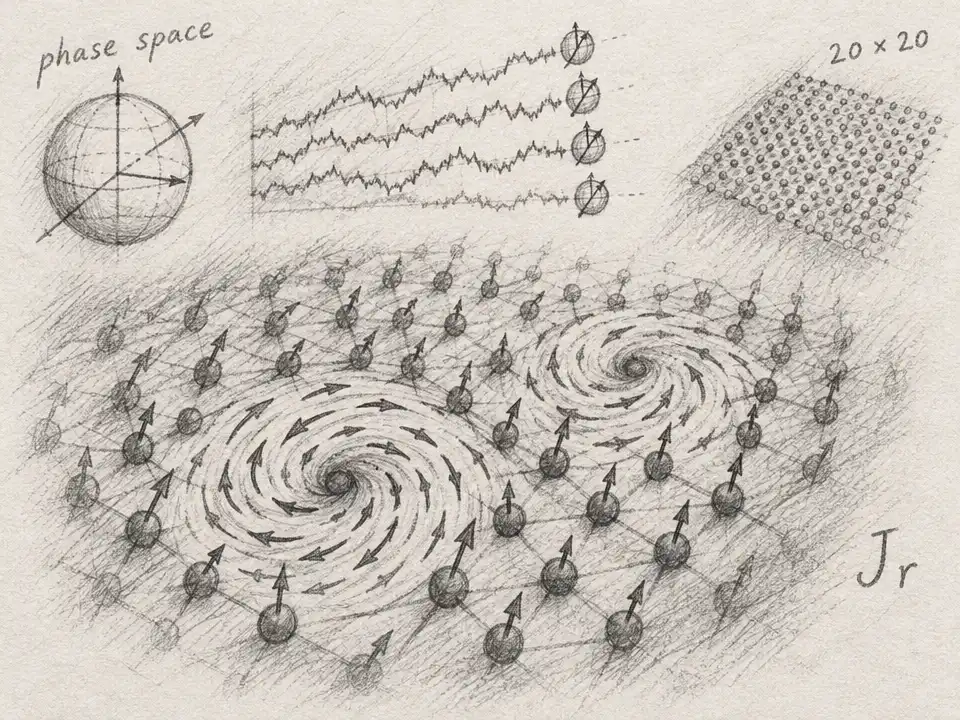
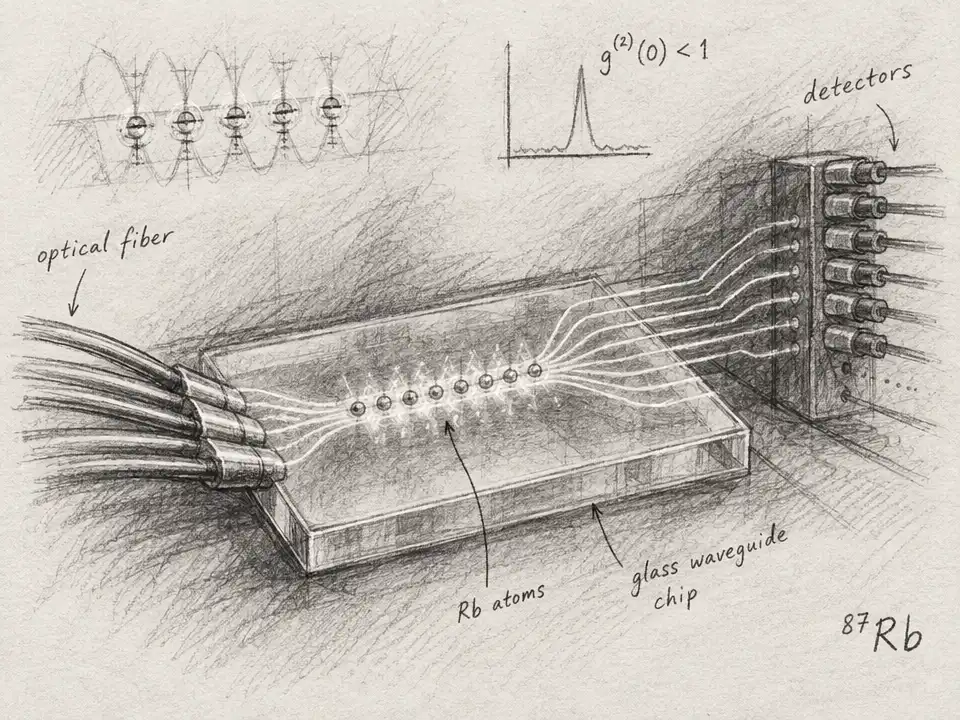
The result came from a programmable array of 256 rubidium atoms. Each atom acted as a qubit, a tiny quantum system that could represent a spin pointing in one of two directions. By controlling how the qubits interacted, the researchers made the array behave like an artificial magnet. Then they abruptly changed the conditions and watched how the magnet’s pattern evolved.
That sudden change is called a quench. The team began with all the simulated spins pointing the same way, then turned on a transverse field that nudged them away from their starting alignment. By changing the field’s strength relative to the interactions between neighboring spins, they could explore different routes toward equilibrium—the state in which a system’s large-scale properties have stopped changing.
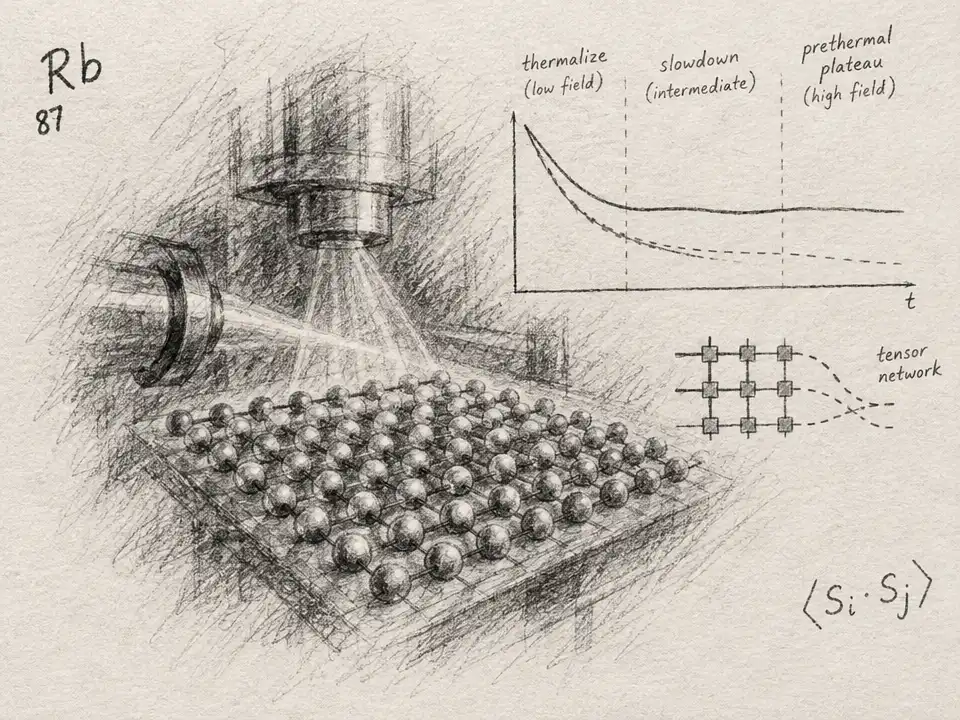
The experiment used a square array, 16 atoms on each side. The team measured the spins and their correlations repeatedly as the system evolved. In each time step, they collected 300 experimental shots and kept those with less than 1.5% defects, leaving about 250 usable measurements. The challenge was to identify what the system was doing from the way its patterns changed over time.
At a field-to-interaction ratio of 2.5, the magnet’s correlations spread rapidly. Its behavior was consistent with quick thermalization: the system approached the pattern expected for a heated quantum magnet, while retaining a memory of its initial alignment. At the other end of the range, a ratio of 6.0 produced a different kind of delay. The strong field drove rapid oscillations, and the system settled into a long-lived prethermal state—a temporary arrangement that resembles equilibrium but is not the system’s final destination.
Neither outcome was the surprise. The unexpected behavior appeared between them. At a ratio of 3.5, the correlations moved toward their thermal values much more slowly. They did not quickly settle into the prethermal plateau seen under the stronger field, either. Instead, the system seemed to spend an extended stretch in between: changing, but at a reduced pace.
To make sense of the difference, the researchers tracked connected correlations—signals showing how the behavior of one spin relates to another beyond what their individual averages would predict. At the high-field setting, those correlations oscillated strongly. The field was changing the spins faster than their interactions could readily organize them, helping create an effective description that resembles an XY spin model. The resulting prethermal state could even support correlations extending across comparatively large distances.
The middle setting lacked that clean separation of speeds. At 3.5, the field still mattered, but not strongly enough to lock the system into the same prethermal behavior. Meanwhile, the correlations approached their thermal values more slowly than the rapid-relaxation case would suggest. The pattern looked less like a system that had stopped and more like one working its way through a complicated traffic jam.
That interpretation matters because two-dimensional quantum systems are exceptionally difficult to simulate on conventional computers as they evolve. The researchers compared the atom-array results with several classical tensor-network methods, which approximate the quantum state using structured networks of numbers. Those calculations agreed with the experiment at early times. Later, the different methods began to disagree with one another, especially for the 16-by-16 array. The calculations had lost reliable control of the evolving system, as growing quantum entanglement made the state harder to represent within their limits.
The comparison does not mean classical computers cannot describe the magnet at all. The methods worked well for early evolution, and small-system calculations reproduced the same qualitative regimes. But in the slow-relaxation region, their long-time predictions no longer provided a dependable guide. The experimental results remained consistent between 8-by-8 and 16-by-16 arrays, giving the team a way to examine behavior where those particular classical approaches struggled.
There is an important caveat: the cause of the slowdown remains unknown. The researchers suggest two possibilities, and they may both matter. One is that the approximation describing the high-field prethermal state starts to break down as the field weakens, allowing additional dynamics to enter. Another is critical slowing down—the tendency of a system near a phase transition to change more sluggishly. Their small-system analysis also found that noise and system size can affect the measured rate, so the exact pace of relaxation needs further study.
That uncertainty is part of what makes the observation interesting. The experiment did not reveal a neat new rule that explains every delay. It showed that the journey toward equilibrium can have an unexpected middle ground: not fast relaxation, and not a clear-lived plateau, but a slow drift whose origin is still under investigation.
By mapping the magnet across different field strengths, the researchers turned a quantum processor into a kind of field station for nonequilibrium physics. The atoms offered a view of a regime that classical simulations could not confidently follow for long. The next task is to learn why the system slows there—and whether the same in-between behavior appears in other quantum materials and models.