Imagine following a single row of atoms until the familiar picture of electrons hopping from site to site starts to fray. The model has just one orbital per unit cell. Yet, in its lowest-energy behavior, it appears to contain two different kinds of activity: a charged stream that can keep moving, and a neutral pattern of spins that can fluctuate without carrying charge.
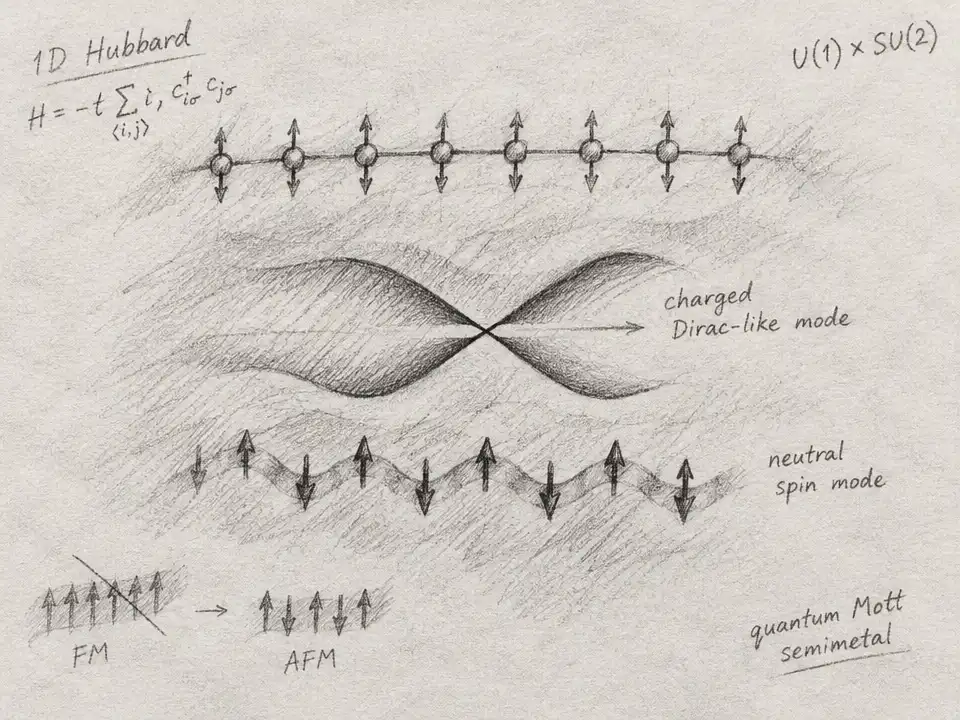
That unlikely pairing is the central result of a theoretical study by Boran Zhou, Taige Wang, and Ya-Hui Zhang. Using numerical calculations on a one-dimensional Hubbard model, they find evidence for a quantum Mott semimetal: a state where strong interactions create local magnetic moments without eliminating every gapless route for electrons. The work is a model study, not a laboratory observation. Its surprise is that the two low-energy worlds emerge from the same electrons in a system with only one effective orbital.
The story begins with a band that is unusually flat. In a flat band, electrons have little energy incentive to move in one direction rather than another, so interactions can take center stage. The authors build their model by starting with two orbitals on alternating parts of a chain and projecting the interactions into one active band. In the resulting description, there is one orbital per unit cell—but its spatial character is less tidy than that phrase suggests.
The band’s Wannier orbitals, the mathematical wave patterns used to describe where electrons reside, are centered on one sublattice even though much of their weight lies on the other. In other words, the apparent center of an electronic state and the places where its presence is most strongly felt do not neatly coincide. Projecting the interaction through this band geometry makes it reach across neighboring sites rather than stay entirely local. A chain that looks simple when counted by orbitals carries a more intricate pattern of connections underneath.
At first, that hidden structure points toward a familiar outcome: with the Hubbard interaction alone, the model favors ferromagnetism, a state in which spins align. The researchers then add an antiferromagnetic exchange interaction between spins on neighboring sites of the other sublattice. Past a threshold, that exchange melts the ferromagnetic order into a spin-singlet state, where the overall spin balances to zero.
That change does not simply leave the chain inert. Exact diagonalization and density-matrix renormalization group calculations—two numerical approaches for studying quantum systems—support a state with a gapless, linearly dispersing electronic excitation at the center of the model’s momentum range. It has the structure of a Dirac crossing: two energy bands meet rather than separating by a gap. At the same time, the calculations indicate that local moments continue to fluctuate in a separate, electrically neutral spin mode.
These are not two populations of electrons hiding in the material. They are two ways the same electrons organize themselves at low energies. One collective mode can carry electric charge; the other carries spin without charge. The authors describe the state as having one charge mode and two spin modes, with a central charge of about three—a technical measure of the system’s gapless low-energy content, not a count of three particles or three orbitals.
There are numerical clues for both sides of the picture. The calculated spin correlations decay roughly as the inverse of distance, consistent with spin activity that remains gapless rather than quickly fading away. Separately, the electron and pair excitation gaps extrapolate to zero as the simulated chain grows, supporting the semimetallic part of the proposal. The combined evidence matters: a gapless electron signal alone would not establish that neutral local moments coexist with it.
Symmetry helps keep the charged crossing open. Inversion symmetry and particle-hole symmetry constrain which terms can appear in the low-energy description; together, they protect the Dirac point in the model. The researchers also explore what happens when they break particle-hole symmetry by adding hopping. The crossing gaps, and the system becomes a Mott insulator. In one set of model parameters, their calculations show two distinct insulating phases, distinguished by a quantized polarization of zero or one-half, with a continuous transition between them.
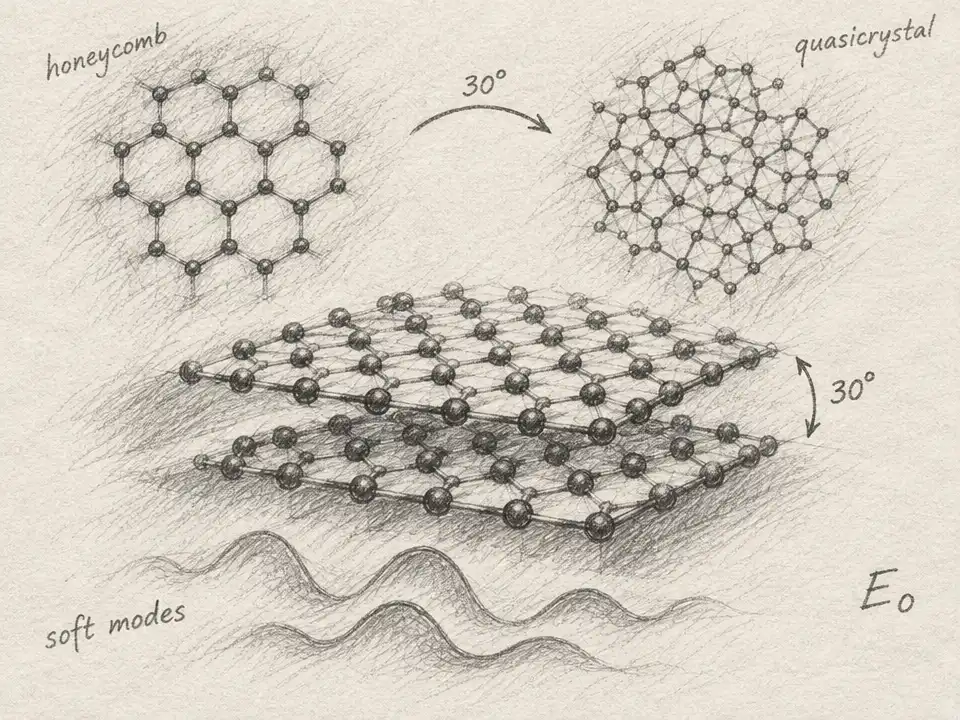
The shift in scale is the point: zoom out from individual orbital labels, and a one-orbital chain can behave as though it has an extra set of actors. The local moments and the mobile Dirac-like excitation are not added by hand as separate species; they emerge through the interaction and the band’s geometry. The authors argue that this provides a useful framework for thinking about Mott physics in more complex topological materials, including twisted bilayer graphene. It does not show that graphene has this exact state. Instead, the stripped-down chain offers a controlled setting in which to ask how an apparently single electronic world can divide into distinct collective modes.