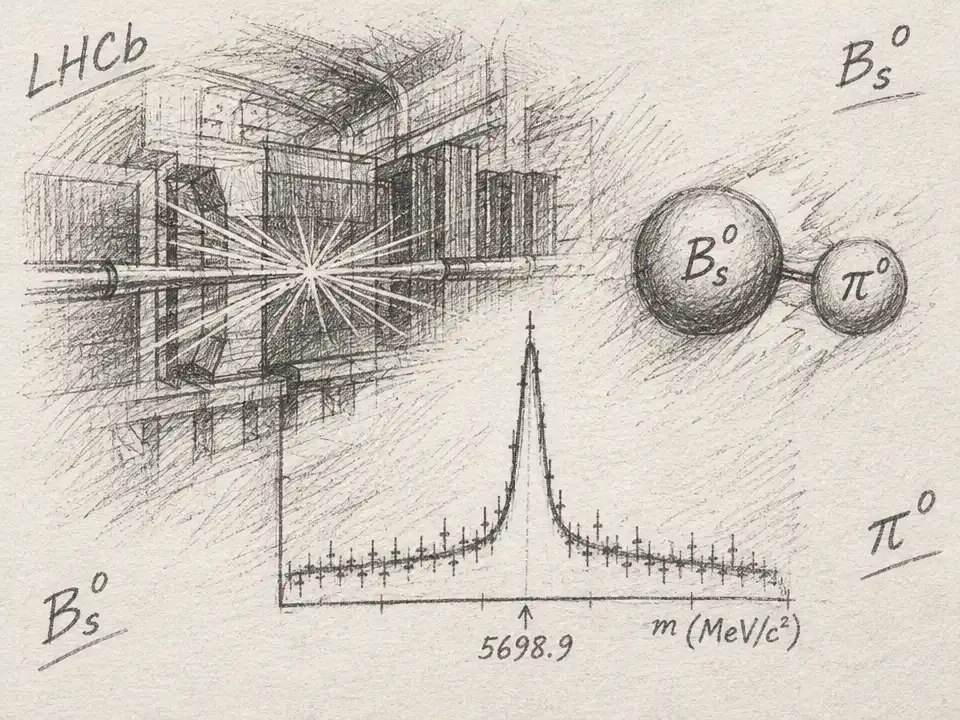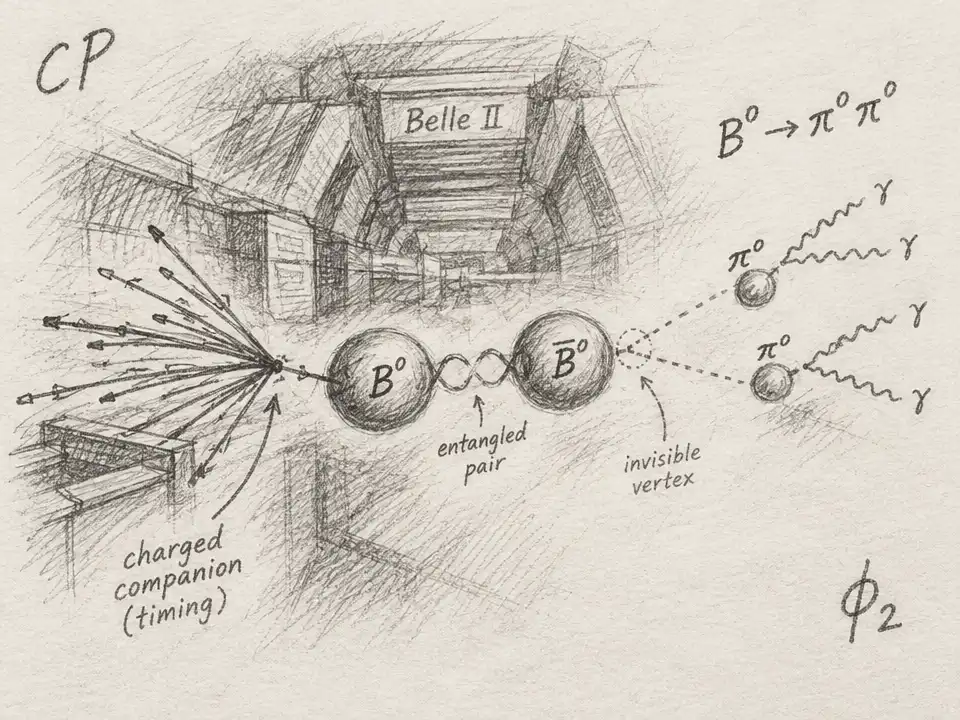
Imagine trying to time an event when the event leaves no clear mark of where it happened. In one Belle II measurement, a B meson decayed into two neutral pions. Each pion quickly became two photons: four flashes of energy in the detector, but no charged-particle tracks leading back to the decay point. The particles were visible. Their usual timestamp was not.
That missing timestamp matters because physicists wanted to compare how matter and antimatter behave in this decay. The question concerns CP violation: whether the laws of physics look the same when particles are swapped for antiparticles and the spatial arrangement is mirror-reversed. In the Standard Model, this violation is tied to quark mixing, but its deeper origin remains unknown. A particular kind of CP violation appears when a neutral B meson first changes into its antimatter partner and then decays.
Usually, researchers follow the timing by finding where each of two B mesons decayed. Their difference in decay times reveals a changing imbalance between matter and antimatter decays. But the signal channel here, B0 decaying into two π0 mesons, produces four photons in its common decay pattern. With no charged tracks from that point, the signal’s decay vertex cannot be reconstructed in the usual way. The paper notes that conventional time-dependent measurements of this channel would require about 10 billion Υ(4S) decays or more.
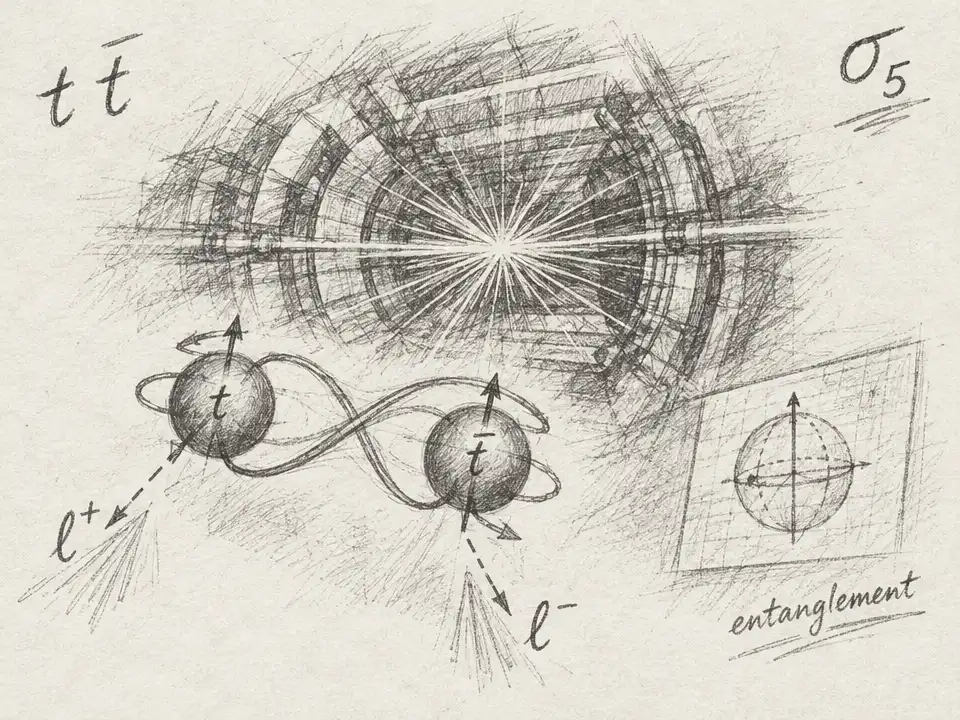
The Belle II team tried a different clock. At the SuperKEKB collider, an Υ(4S) particle can produce a pair of neutral B mesons in a quantum-entangled state. The pair is not simply two unrelated particles flying off on their own: their linked properties carry information about the pair’s shared history. Researchers can reconstruct the decay point of the other B meson, called the tag, from the charged particles it leaves behind. The tag’s flavor—whether it is a B meson or its antimatter partner—and the time it takes to decay then provide a handle on the signal’s CP-violation pattern.
This does not recover the missing signal vertex, or measure the signal B’s individual decay time directly. Instead, the researchers use the tag’s decay-time and flavor distribution. Because of the original entanglement and the B mesons’ ability to change into their antiparticles, that distribution still depends on the signal decay’s CP-violation parameters, even though the signal’s own decay time is not measured. The missing measurement is replaced by a different one, not guessed at.
For the substitute clock to work, the team had to estimate when the tag decayed relative to the collision point. SuperKEKB’s compact interaction region and Belle II’s precise vertex detector help make that possible. The paper reports a per-event tag-time resolution of about 1.5 picoseconds. The researchers calibrated the timing model with 36,000 B0 decays to a D− meson and a π+ meson, then checked the method on a separate, well-studied decay channel. In that check, measurements from about 6,900 B0 decays to J/ψ and KS0 were consistent with established values and with the conventional timing analysis.
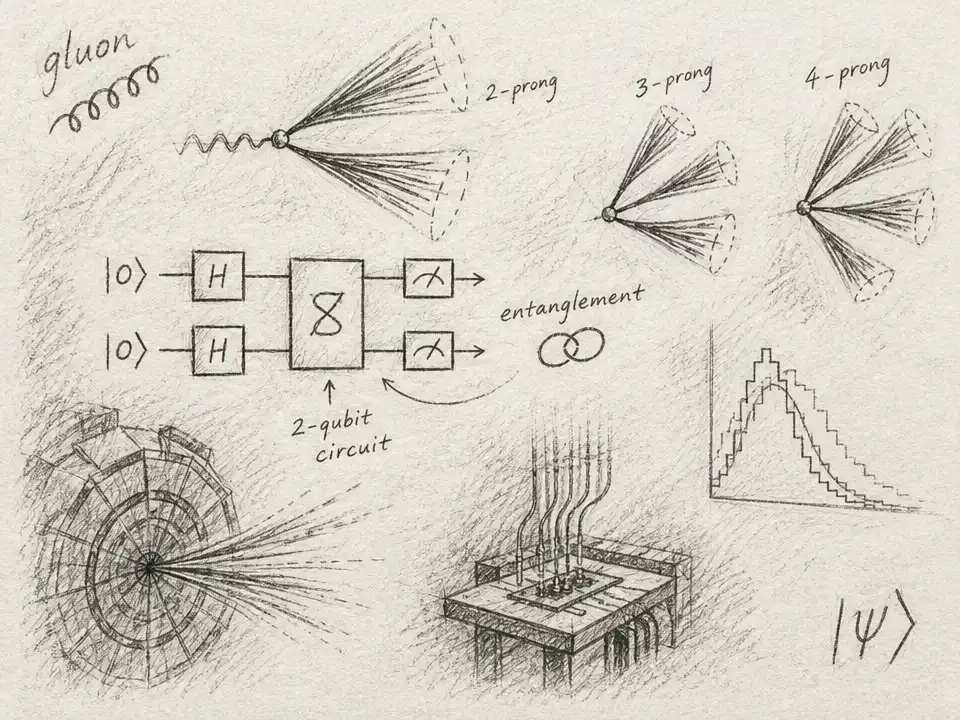
Finding the signal amid other events was another obstacle. After reconstruction, the background from ordinary quark production exceeded the expected signal by roughly a thousand to one. The team trained a classifier on 27 event features to tell the more jet-like background from the more isotropic B-meson events. Their chosen selection rejected 98% of that background while retaining 80% of the signal. They then fit the timing, flavor, and other event information together rather than relying on a clean-looking handful of candidates.
The analysis used 190 million Υ(4S) decays collected between 2019 and 2022, corresponding to 365 inverse femtobarns of data. Belle II reported the first measurement of the mixing-induced CP-violation coefficient for B0 decaying to two π0 mesons: 0.61, with a statistical uncertainty of +0.75 and −0.79, and a systematic uncertainty of ±0.11. The result for direct CP violation was 0.05, with uncertainties of ±0.28 statistical and ±0.07 systematic.
Those broad statistical uncertainties are important: this is a first measurement, not a precise verdict about how strongly CP is violated in this particular decay. Still, the team says the precision they achieved would require a data set twenty times larger with a conventional time-dependent analysis. When the new measurements were added to an analysis of related B-to-ππ decays, they reduced the number of possible solutions for a key quark-mixing angle from eight to six and shortened its allowed interval by 40%.
The advance is less about making photons reveal a point they never marked than about changing what counts as a clock. In this entangled pair, the measurable history of one B meson can carry clues about the decay of the other. The method has not erased the statistical limits, and it depends on precise knowledge of the collision region and detector response. But it makes an otherwise inaccessible kind of timing measurement possible with far fewer events than the conventional route would need.