Imagine a chain of tiny quantum spins, paired like partners in a dance. At first, a single local change leaves a clue in just one pair. Then the chain evolves, and the clue appears to spread: far-apart pairs begin carrying evidence of what happened at the start. In a new theoretical study, researchers show how one classical bit of information might become readable in many places at once—without copying an unknown quantum state.
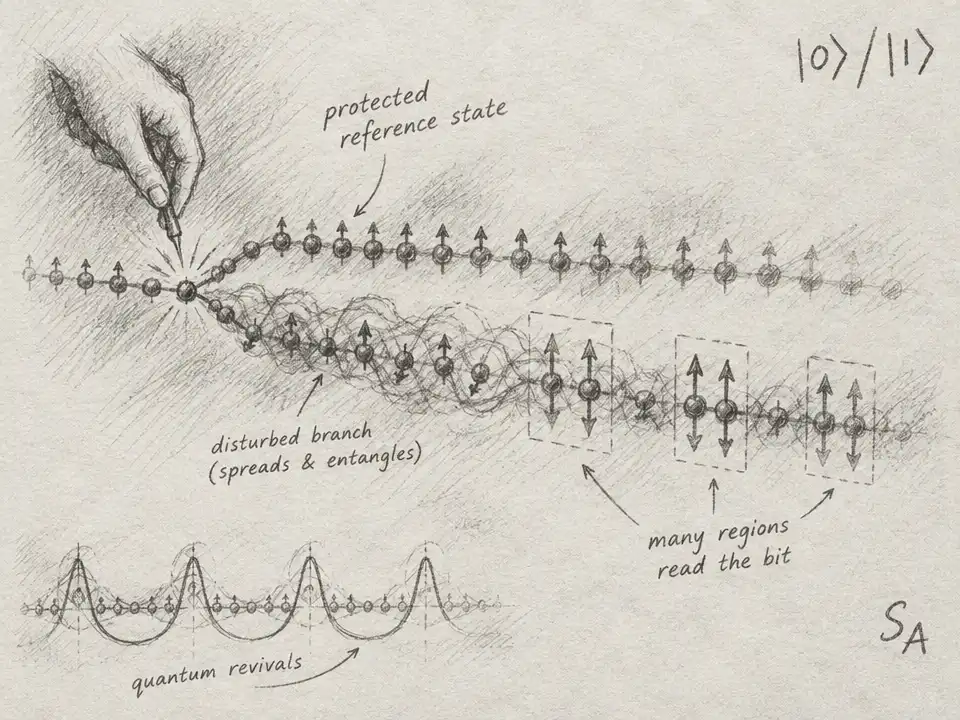
The setup begins with a quiet, carefully arranged reference. Each neighboring pair forms a singlet: a special entangled state in which the pair’s total spin is zero. A local operation changes one pair from a singlet into a triplet. That change encodes a simple choice: was the operation applied, or not? At the start, even inspecting either spin by itself cannot reveal the answer. The distinction lives in the pair.
Now both possible preparations evolve under the same local rules. The unaltered reference remains remarkably still, preserving its pattern of singlets. But the disturbed version does not. The initial triplet can help activate changes on neighboring pairs, and those changes can spread farther along the chain. The original detail of the first disturbance need not travel intact. Instead, many locations can acquire a simpler clue: their local state no longer matches the untouched reference.
That difference is what the researchers count as a record. At each pair, a fixed test asks whether it is still a singlet. The test does not need to identify every detail of the many-body state; it only needs to offer statistical evidence about the initial choice. A single measurement may be ambiguous. The information is measured across repeated preparations, and different pairs can provide noisy, mutually correlated clues about the same classical bit.
In simulations of a ring containing 20 spin sites, the researchers found that all 10 pairs could each carry more than 0.50 bits of information at the same observation time. The same simple two-outcome test was used across the chain. This is not a tiny particle simply carrying one conserved mark from one end to the other: in the model, the number of triplet pairs can grow. The changed region can leave evidence behind in multiple places.
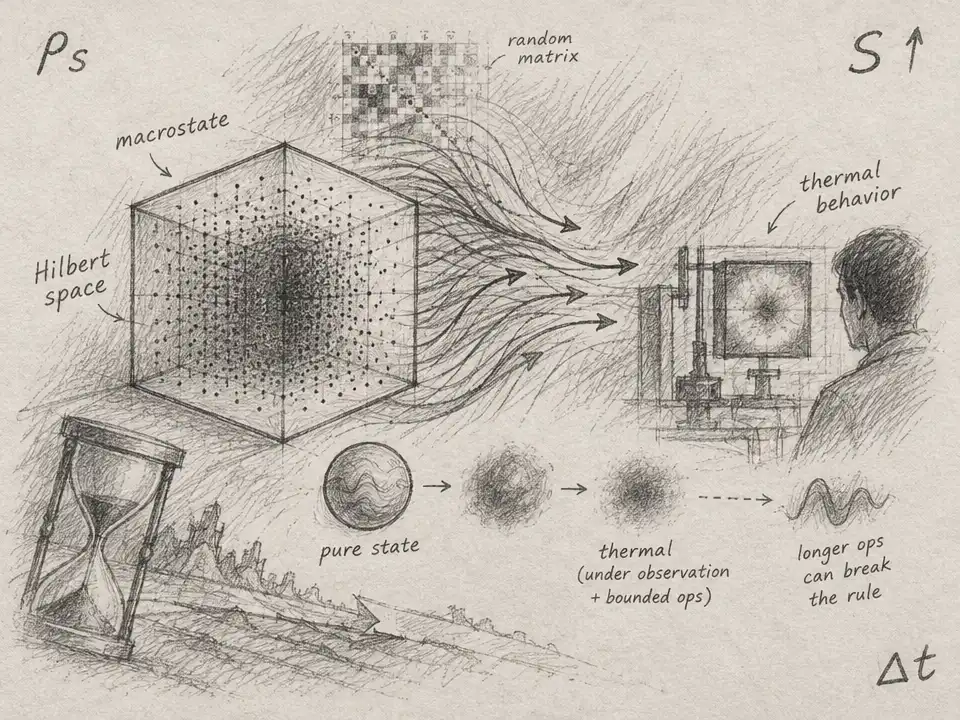
Why should a spreading disturbance leave clues instead of dissolving into the quantum equivalent of static? The paper offers an answer in the contrast between the two branches. The untouched reference has a tightly constrained structure and low entanglement across cuts between pairs. The disturbed branch develops much more entanglement. The researchers prove a general criterion: when a reference obeys an area law for entanglement while its perturbed counterpart has volume-law entanglement, many separate, fixed-size regions must be able to distinguish the branches above a nonzero information threshold.
Put less technically, the reference has limited room to vary locally. The disturbed state spreads its possibilities across the chain. That mismatch means the change cannot be hidden everywhere: many small regions must depart from the reference pattern. The theorem does not say that every quantum disturbance will make a crowd of records. It says that when this particular contrast in entanglement is present at a shared readout time, many local records follow.
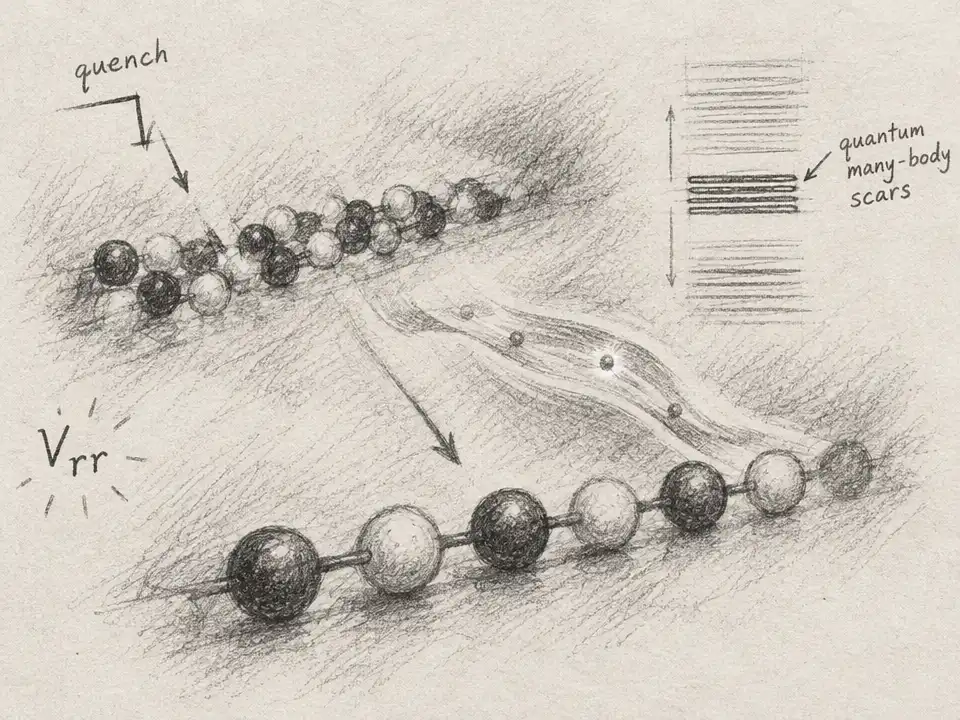
The team tested the idea in a second setting, a model of atoms subject to Rydberg blockade. There, a recognizable pattern of alternating spins can return in recurring waves called scar revivals. A local defect is introduced, and the question becomes whether distant sites can reveal it when the reference pattern comes back. The result depends on how the model is tuned: in a stabilized version, a 24-site chain supported 12 simultaneous local readouts, each carrying at least 0.25 bits, at later revivals. In the ordinary version, that level of readable evidence disappeared after the seventh revival in the same-sized chain.
The picture is intriguing, but its edges matter. These are theoretical results and numerical simulations on finite systems, not a laboratory demonstration that one bit has been recorded across a real chain. In the dimer model, the researchers also note that the observation time lets the disturbance wrap around the periodic chain, and some of the most reliable readout blocks occupy a substantial fraction of the small system. Whether the effect persists in the thermodynamic limit remains an open question. The Rydberg-atom experiments that could test the proposed readouts are a future possibility, not a result of this paper.
Nor does the work evade the quantum no-cloning rule. The information being spread is a classical label—whether a particular local operation occurred—not an arbitrary quantum state. The records can be incomplete and correlated; no observer gets a perfect independent copy. The deeper shift is in what counts as information spreading. A disturbance may do more than travel outward or become scrambled beyond reach. Under the right dynamics, it can leave a trail of local evidence, so that many separated observers can infer the same small piece of history.
In this chain, the hidden world is not a secret message preserved perfectly at every site. It is a pattern of differences: one branch stays recognizable while the other explores what the reference cannot. Whether nature can sustain that contrast at much larger scales is still to be learned. But the simulations suggest a striking possibility: sometimes a quantum system remembers an event not by keeping it in one place, but by letting many places remember a little.