A time series is a trail of clues. To predict what comes next, a machine must keep enough of the past to recognize a pattern, even when the signal looks noisy or chaotic. Researchers have now enlisted an unlikely memory aid: the restless dynamics of a quantum device with 4,500 superconducting qubits.
The idea brings two fields together. Machine learning needs ways to turn streams of data into useful patterns. Quantum physics offers a system whose interacting parts can produce complicated responses. In a September 2026 arXiv study, researchers used those responses as the working material for a machine-learning method called reservoir computing.
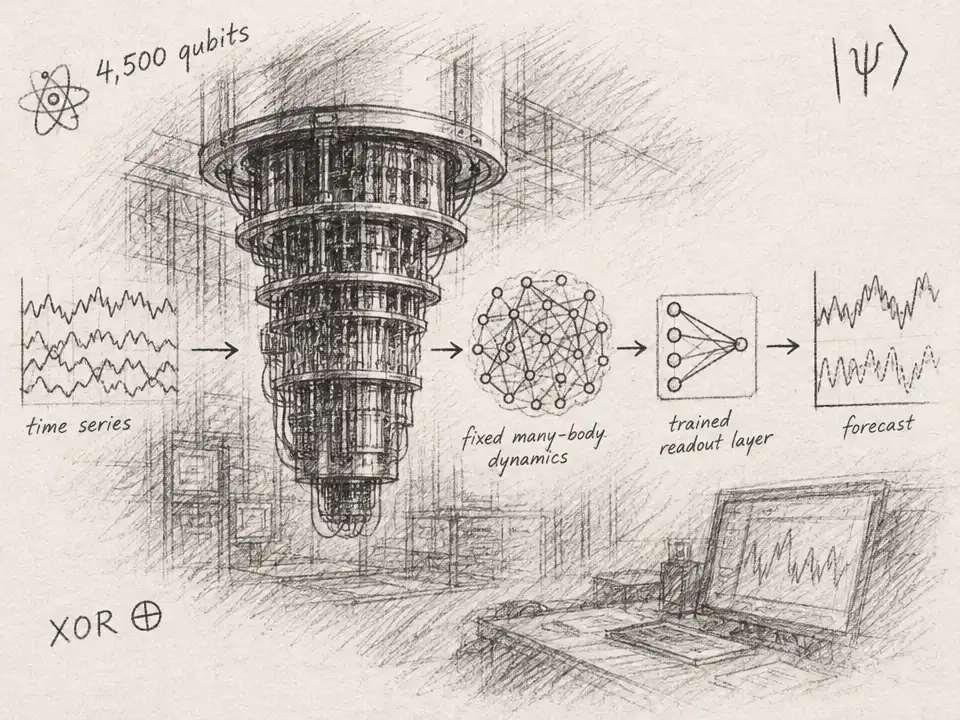
In ordinary reservoir computing, an input is sent through a complex system, and the system’s changing state is measured. Instead of teaching every part of that system, researchers train a simpler layer to read the results. The system acts a little like a pond: drop in a pebble, and ripples spread and overlap. A small number of measurements of those ripples can help distinguish what went into the water.
Here, the pond was a quantum annealer. The team fed each new value in a time series into the device by changing local magnetic fields on its qubits. They also fed back information from its earlier responses. Then came the unusual step: the device was reverse-annealed. It began in a relatively classical state, moved into a regime where quantum fluctuations were stronger, paused, and returned. The researchers measured its response and used that result as part of the next step.
This was not a quantum state holding a perfect record of everything that had happened. The process repeatedly measured the device and passed information forward through feedback. To prepare the machine for its next run, the researchers converted parts of its measured state into a pattern of on-or-off spin values. The device’s interactions then transformed the incoming signal and that carried-over information into new responses.
The scale was striking: measurements from 4,500 physical qubits were grouped into 45 reservoir signals, with each signal combining 100 qubits. The researchers took 103 measurements to estimate each response. Only the final readout was trained; the reservoir’s underlying settings remained fixed. In other words, the researchers did not tune thousands of quantum components to perform each new task. They let the hardware generate a complicated response, then learned how to interpret it.
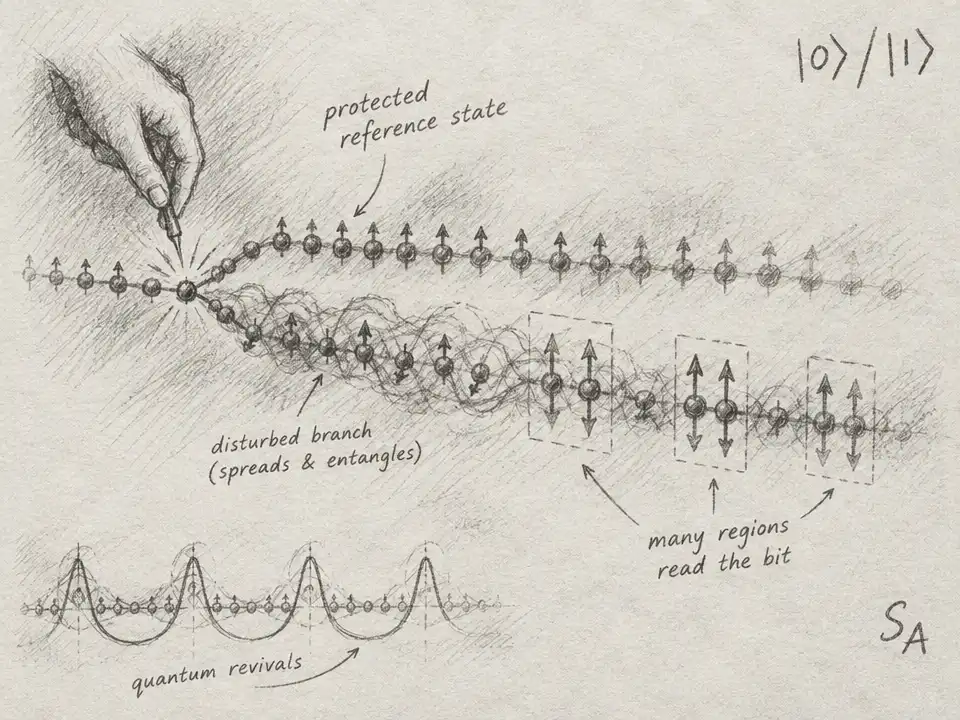
First, the team tested whether the device could remember. They gave it random numbers and asked it to recover values from earlier in the sequence. With delayed feedback, its ability to recall some past inputs did not simply fade away; at certain delays, memory capacity showed revivals. The researchers interpret these as signs that information can become accessible again after seeming to disappear. When they removed the interactions between qubits, the reservoir essentially lost its memory. The interactions were not decoration: they helped make the device useful.
The researchers then tried a classic nonlinear challenge: XOR. The machine had to combine two recent binary inputs and report whether exactly one was on. A simple linear readout cannot solve this task from the raw inputs alone, so success would show that the reservoir had made the information easier to separate. Across five independent realizations, it reached an accuracy of 0.989 ± 0.008, with the uncertainty reported as one standard deviation.
Next came two familiar test signals from the study of chaos: the Mackey–Glass series and the double-scroll system. These are benchmark time series, not weather records or measurements from a newly discovered physical event. The device forecast their next values, and for Mackey–Glass it also tackled a seven-step-ahead prediction. The team reconstructed the characteristic shapes, or attractors, of the benchmark systems from the predicted signals. In supplementary tests, the reservoir also outperformed a linear autoregressive model given the same delayed feedback.
The crossover is more than an unusual hardware demonstration. Usually, a machine-learning system’s useful behavior comes from parameters carefully adjusted during training. Here, the researchers made the quantum device’s own interactions do some of the processing. That could offer a different way to handle sequential data, where yesterday’s input may still matter several steps later. It also avoids some of the costly parameter-tuning loops used by other quantum machine-learning approaches, though the repeated measurements and feedback remain part of the method.
There are important limits. The paper does not show that the quantum machine beats the best conventional machine-learning systems, nor that it can forecast real-world events. The researchers’ classical spin-vector Monte Carlo comparison did not reproduce the observed performance, but that result does not prove that no classical computer could simulate the device. The authors say determining the resources needed for a faithful classical simulation remains an open question. For now, the achievement is a proof of concept: a large quantum system can turn its own dynamics into a working reservoir for remembering and forecasting benchmark signals.