A flock of birds, a school of fish, a swimming bacterium: active matter usually brings to mind things that move by spending energy from within. Now shrink the idea until the “particle” is a single atom. In a recent experiment, physicists gave cesium atoms a temporary burst of activity—not with tiny propellers or a laser shove, but by letting quantum spin energy turn into motion.
The experiment joins two fields that rarely meet at this scale. Active-matter researchers study how local energy inputs make particles move out of equilibrium. Quantum physicists control atoms so precisely that their internal states and collisions can be measured and tuned. Here, the first field supplied a way to describe the motion; the second supplied its fuel.
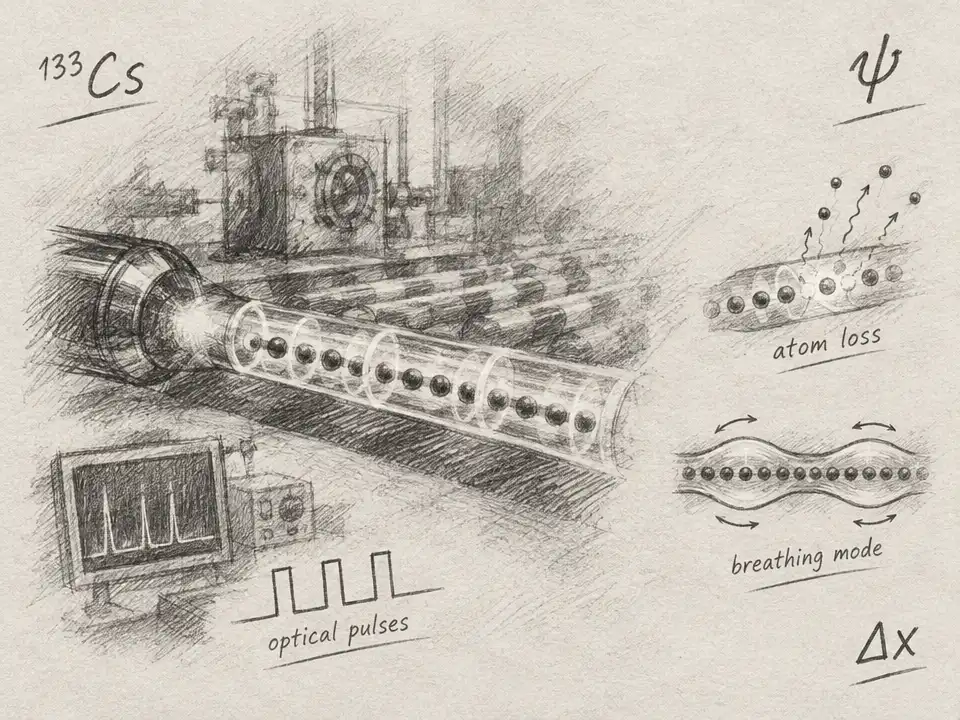
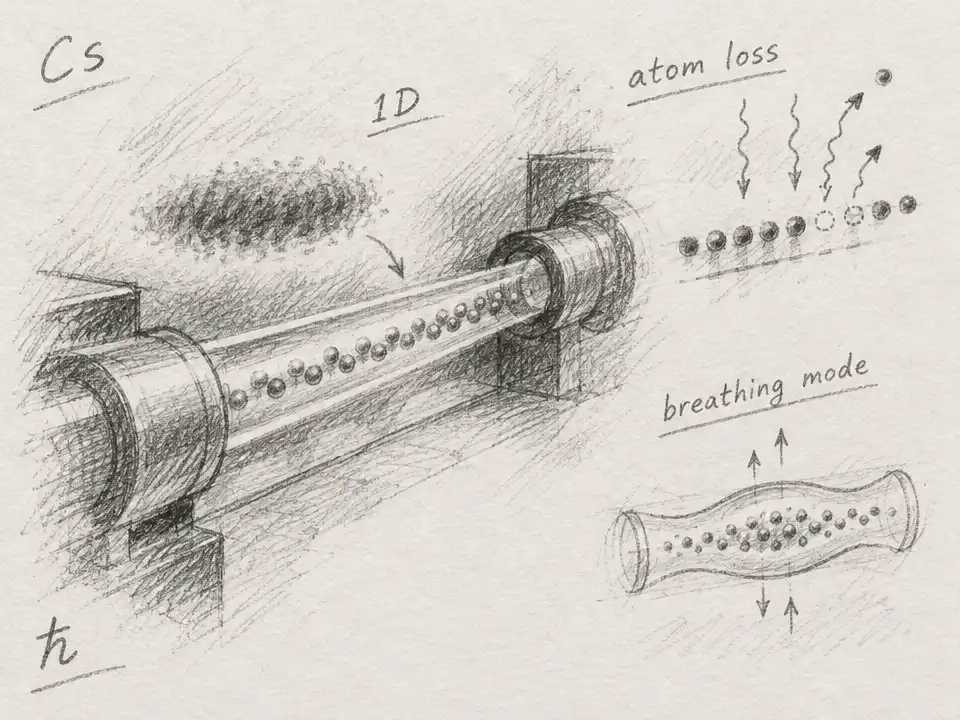
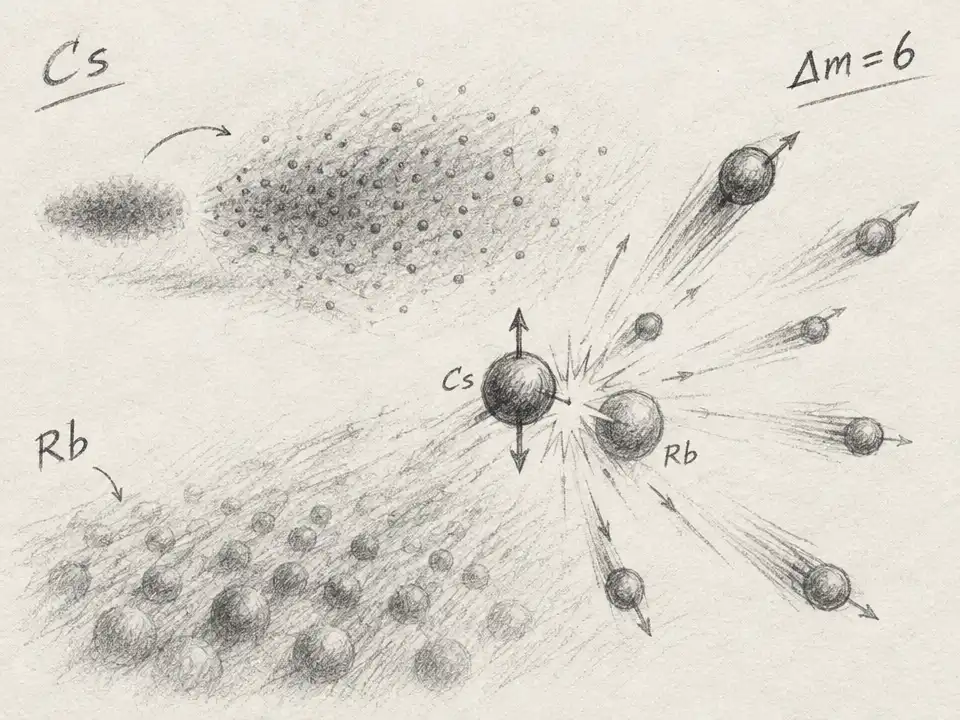
The team placed 68(2) cesium-133 atoms in an optical trap alongside a much larger cloud of about 7.7(1) × 103 rubidium-87 atoms. The rubidium cloud was ultracold, at 463(10) nK. A weak magnetic field set the spacing between the atoms’ internal spin-energy levels. The researchers could then compare an active arrangement, in which spin-exchange collisions were possible, with a passive one that allowed only elastic collisions.
Think of a collision as more than two atoms bouncing. Each atom also carries an internal quantum state, labeled by its spin. In certain encounters, the atoms exchange a unit of angular momentum and change those states. The energy released as their spins rearrange can become kinetic energy: a sudden, quantized kick that sends the cesium atom in a random direction.
That randomness matters. These atoms do not swim toward a goal, and the experiment did not produce a miniature flock. Instead, the activity shows up statistically: spin-changing collisions keep injecting energy into the cesium atoms, while ordinary collisions with rubidium spread that energy away. In the language of active matter, the cesium atoms are particles driven by local energy input and dissipation. Their quantum-scale engine is a change in spin.
The engine has a built-in limit. At the ultralow collision energies in the experiment, the reverse, energy-consuming spin changes were practically inaccessible. The spin exchange therefore proceeded mostly one way. But cesium has only a finite ladder of spin states, so an atom can undergo at most six such exchanges before reaching the top and running out of room for further activation. This makes the motion a burst, not a permanently running motor.
The researchers saw the burst by tracking the spread of the cesium cloud. With spin exchange turned on, the cloud widened markedly; with the active collisions blocked, that transient broadening was absent. At the largest applied magnetic field, 3 G, the active cloud’s measured width reached nearly four times that of the passive cloud. The energized atoms could travel well beyond the rubidium cloud before returning to it and losing energy through further collisions.
Turning up the magnetic field increased the energy available from each spin change, and made the widening stronger. Yet the spread did not grow forever: as atoms climbed the finite spin ladder, activation slowed and eventually stopped. The details of the cloud’s motion also depended on how often the atoms collided and how much the energetic cesium atoms overlapped with the rubidium bath. The picture is less like a motor pushing at a steady speed than a series of unpredictable kicks, followed by a long coast and a gradual slowdown.
To test whether that picture held together quantitatively, the team compared measurements with two models: a detailed simulation of individual collisions and a simpler Langevin model, the kind often used to describe particles buffeted by random forces. Both captured the observed dynamics. The researchers built the models from kinetic theory and quantum-scattering calculations, rather than tuning them with free parameters to fit the data. Crucially, the quantum calculations mattered: at these low energies, the atoms’ wave-like scattering behavior boosts the activation beyond what a classical collision picture would predict.
There is an important boundary to the result. The energy source is quantum, but the measured motion is effectively classical: the atoms spread through the trap rather than displaying a new, fully quantum form of collective movement. The experiment demonstrates an atom-sized active particle, not quantum flocking or a quantum swarm. The authors point to further cooling as one route to making matter-wave effects more prominent, and to ways of resetting cesium’s spin states as a possible way to extend the active period.
The crossover is already useful. Active-matter concepts give physicists a compact way to think about how an atom takes in energy, moves, and gives that energy back to its surroundings. Quantum control, in turn, offers an unusually clean way to tune the mechanism producing that activity. The result is a new laboratory for asking how motion emerges when the fuel is stored not in a chemical battery or a living cell, but in the discrete spin states of an atom.