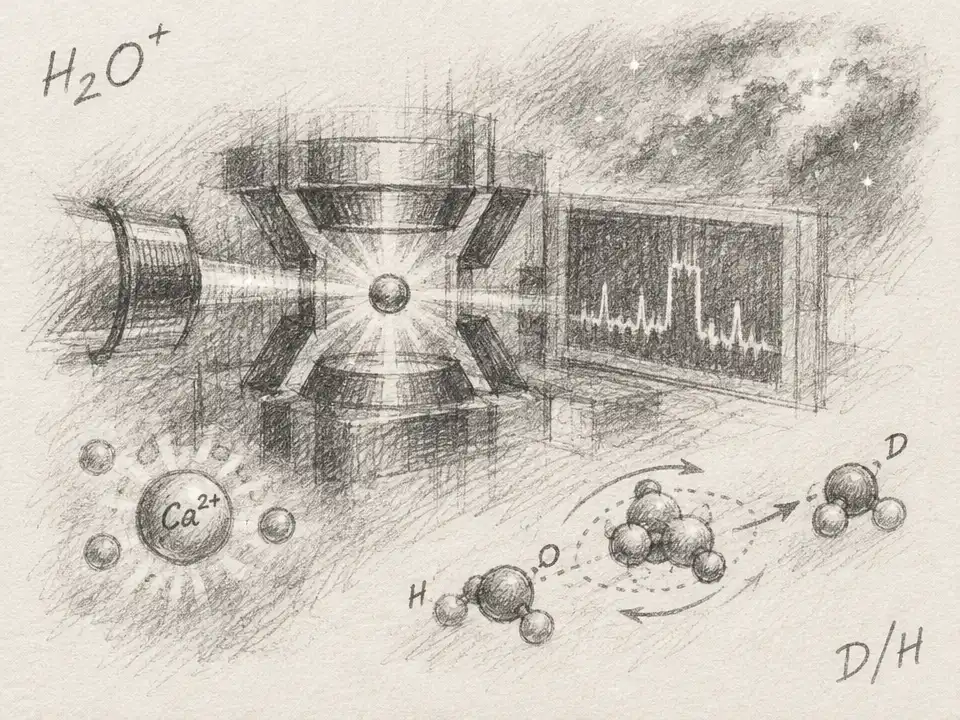
In a cryogenic trap, a water ion waits in the dark beside a glowing calcium ion. A faint gas of hydrogen deuteride drifts in. When the two molecules meet, one atom moves—and the calcium ion’s fluorescence blurs, then settles into a new pattern. From that small change, researchers can tell which product formed.
The scene is a long way from an interstellar cloud, but the collision happens at an energy relevant to chemistry in such cold places. The experiment offers a close-up of a question that matters across cosmic distances: when water ions meet a molecule containing both ordinary hydrogen and its heavier cousin deuterium, which atom gets transferred?
The two possible outcomes differ by that one choice. Transfer hydrogen, and the product is H3O+. Transfer deuterium, and it is H2DO+. The balance between them can help shape how deuterium is distributed among molecules in cold space. But earlier measurements of this reaction had not reached the few-kelvin energy range found in the coldest interstellar environments. Extrapolating downward was risky: as a reaction cools, subtle effects can change which route it takes.
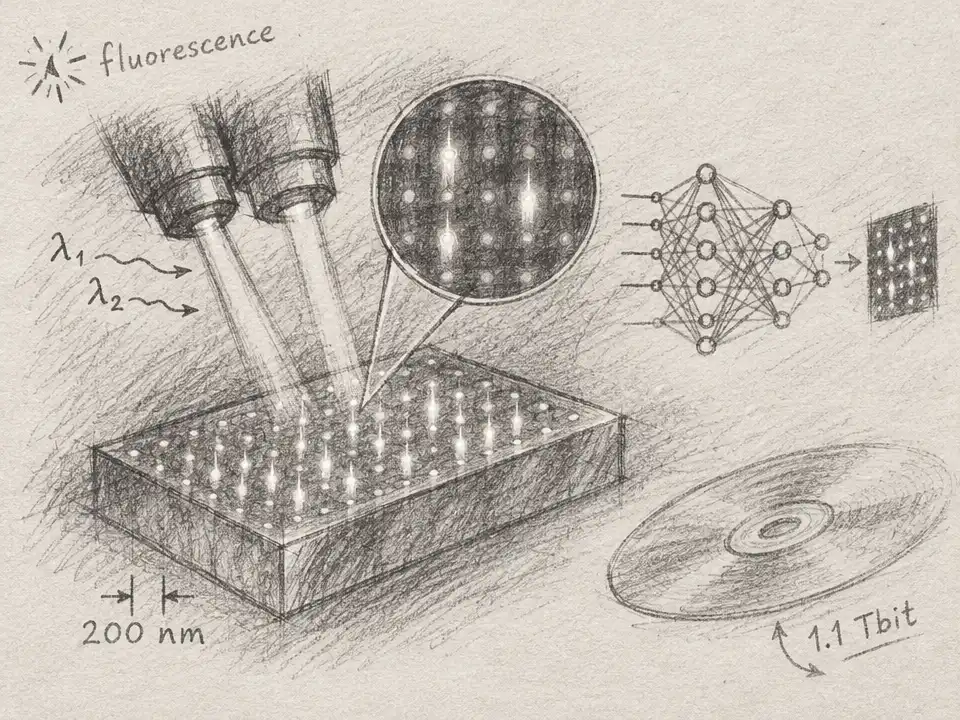
To approach that regime, the researchers confined a single H2O+ ion in a radiofrequency trap held at 5.4 K. Laser-cooled calcium ions acted as a refrigerator: through their shared motion, they brought the water ion’s movement down to a few millikelvin. Neutral HD molecules, meanwhile, cooled through repeated encounters with the trap’s cold walls. The resulting mean collision energy was 7 K, or 0.6 meV.
The team did not watch the molecules touch. Instead, they listened to the trapped ions’ motion. A weak electric drive made the calcium and water ions move together at a particular resonant frequency. When the water ion reacted, its mass changed; the old frequency no longer matched. That shift disrupted the calcium ion’s motion and altered its fluorescence. By testing the new resonance, researchers could identify the product. A tiny molecular exchange had left a readable fingerprint in light.
Across 441 reaction events, measured over 16 days, hydrogen transfer was more common. After correcting for a small amount of ordinary hydrogen in the HD sample, the researchers found an H3O+-to-H2DO+ branching ratio of 1.50 ± 0.15. In other words, the hydrogen-transfer product appeared about one and a half times as often as the deuterium-transfer product. The preference persisted at these low collision energies, though it was less pronounced than at some higher energies.
What happens between approach and product is harder to see. The researchers compared the measurements with quasi-classical trajectory calculations—simulated paths for the reacting atoms. Those calculations suggest the cold collision takes a detour. Rather than exchanging an atom in a brief, direct encounter, the partners can become temporarily caught in a molecular complex. While it lingers, energy can spread among the complex’s internal motions, a process called intramolecular vibrational redistribution. In the calculations, this indirect route becomes more important at low energies.
That shift offers a reason not to treat a reaction as a simple collision followed by a predictable swap. The partners may briefly form a shared, reconfiguring system before separating into products. The calculations put the measured branching ratio in qualitative agreement with theory: they predict a ratio of 1.15 at 0.9 meV, compared with the measured 1.50 ± 0.15 at 0.6 meV. The agreement is not exact, and the authors note possible explanations, including quantum effects such as hydrogen tunneling, inaccuracies in the modeled energy landscape, and isotope-dependent behavior of gases on the cold chamber walls.
Those caveats matter because this is a laboratory model, not a miniature interstellar cloud. The experiment isolates individual reaction events and reaches a relevant collision-energy range, but it does not reproduce every condition in space. Even so, it replaces a long extrapolation from warmer measurements with direct observations at the cold end of the scale. That can give astronomers and chemists better-grounded clues about how reactions contribute to deuterium-rich molecules in space.
The new view comes from making the reaction small enough to count: one trapped molecular ion, one recorded change of mass, one product at a time. With further control over collision energy and molecular states, this approach could reveal more than which product wins. It could help untangle how a reaction’s route changes with temperature—and expose the hidden choreography behind chemistry in the coldest corners of the universe.