Imagine trying to separate two crowds without building a wall. One group moves quickly through a doorway; the other takes much longer to respond. If you open and close the door at the right moments, the fast group gets through while the slow one is left behind. Researchers have now used a version of that timing trick to separate superfluid atoms from ordinary thermal atoms in an ultracold gas.
The idea echoes a device known from liquid helium: the superleak. Its narrow pores let superfluid flow while strongly suppressing the normal, viscous component. But making a material sieve inside an ultracold atomic gas is difficult. Instead, the team built a filter out of different response times. Their experiment uses an optical superlattice, a pattern of light that arranges atoms into neighboring wells and creates weak links between them.
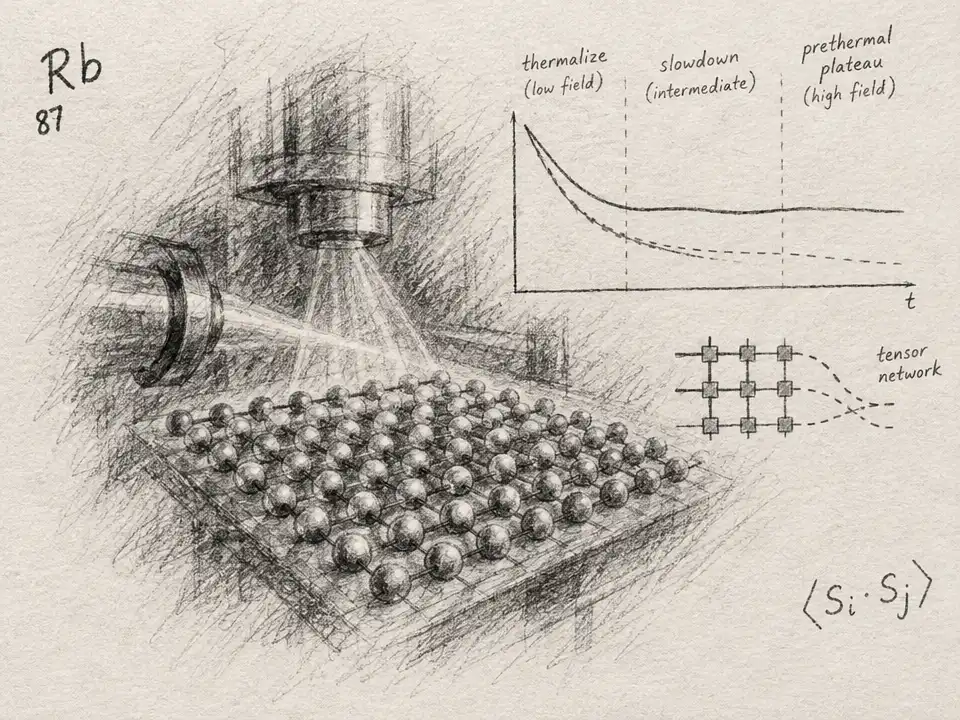
The atoms were rubidium-87, cooled and arranged in about 30 layers of quasi-two-dimensional gases. By changing the energy offset between neighboring wells, the researchers could encourage atoms to move toward the lower-energy side. The crucial difference was not which atoms fit through the link. It was how each part of the gas moved.
In a superfluid, atoms share a coherent quantum phase. That shared behavior supports rapid, coordinated transport through a weak link, much like Josephson flow between two superconductors. Thermal atoms do not share that phase coherence. Their transport depends on slower, incoherent processes, including the redistribution of energy between motion along the lattice and motion within each layer. In the tight-binding regime used here, that cross-dimensional thermalization is strongly suppressed.
So the optical lattice became a kind of time-domain sieve. When the team slowly changed the energy offset, the coherent superfluid moved promptly, while the normal component responded much later. In a sample that was 97(3)% condensate, the superfluid transferred to neighboring wells within milliseconds; a thermal sample moved over hundreds of milliseconds. A mixed sample, with a condensate fraction of 50(1)%, showed a fast response followed by a slower one.
The researchers measured how quickly atoms shifted between the two sets of wells and found a flow-rate contrast of 500(49) between the superfluid and normal components. The contrast depended on the lattice conditions: at the largest tunneling strength explored, with J/h = 206(2) Hz, the measured rates differed by a factor of 5791(601). These are experimental contrasts in this setup, not a claim that thermal atoms are completely blocked. They lag; the superfluid gets a head start.
To check that the fast flow really came from coherent superfluid motion, the team measured both the population imbalance and the relative quantum phase between neighboring sites. They also abruptly changed the energy offset and watched the two quantities oscillate together, about a quarter-cycle out of step. The measured oscillation frequency was 992(5) Hz, in agreement with the researchers’ numerical simulations. That phase-sensitive response supplied a direct signature of Josephson dynamics, not merely a quick redistribution of atoms.
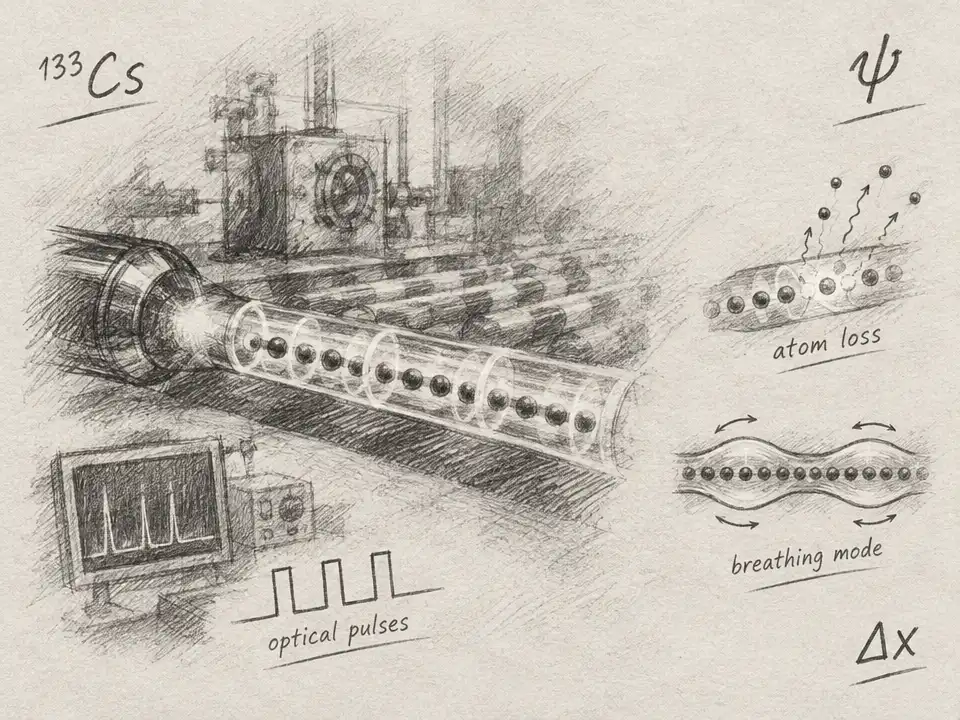
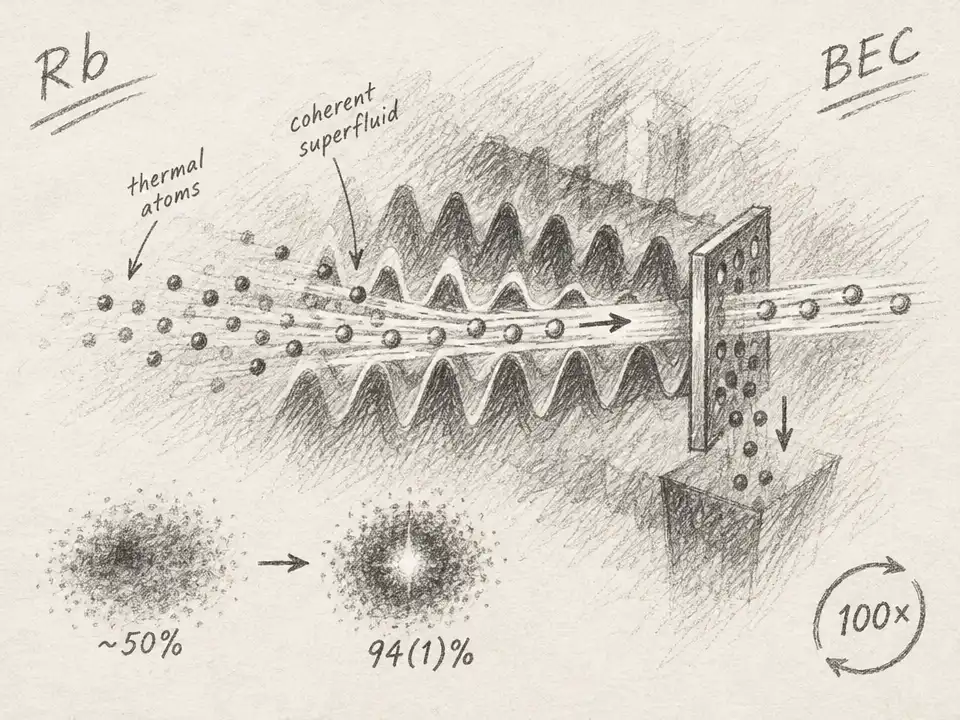
Next came the filtering step. The team drove the superfluid from odd-numbered wells into deeper even-numbered wells, then lowered the transverse trap so atoms remaining in the odd wells could spill away. The even wells had extra confinement from the long-wavelength lattice, which helped protect their atoms during removal. Transport followed by selective removal could then be repeated: each round preferentially retained the coherent component while carrying away much of the normal one.
After four cycles, the condensate fraction rose from about 50% to 94(1)%, while 57% of the starting superfluid remained. The result matters in both halves: the gas became much purer, but the process did not preserve every superfluid atom. Unlike ordinary evaporative cooling, the selection here depended first on how the two components moved and responded to the drive.
The same filter also helped keep driven motion going. Without repeated purification, excitations built up and the Josephson oscillations damped. With the transport-and-removal cycle running during a periodic drive, the team observed coherent oscillations for up to 100 cycles with no detectable decay. In effect, the gas could shed some of the thermal excitations that would otherwise blur its coordinated motion.
This is a controlled laboratory demonstration, not a ready-made device for separating fluids in everyday settings. Its broader significance is a new way to tackle a familiar problem in quantum physics: rather than trying to distinguish components by building a finer barrier, make their different dynamics do the sorting. The researchers’ superlattice turns a quantum gas into its own filter, using the slow response of thermal atoms and the swift, phase-coherent flow of the superfluid to prepare and sustain a cleaner quantum state.