A chain of atoms is pushed out of its orderly pattern. For a moment, the crystal seems gone. Then a different pattern forms—and the original one returns. In a 2017 experiment, a line of laser-controlled atoms did just that, repeating the transformation several times after a sudden change in the rules governing their motion. The surprise was not simply that the atoms oscillated. It was that a complex, interacting quantum system held on to a memory it was expected to lose.
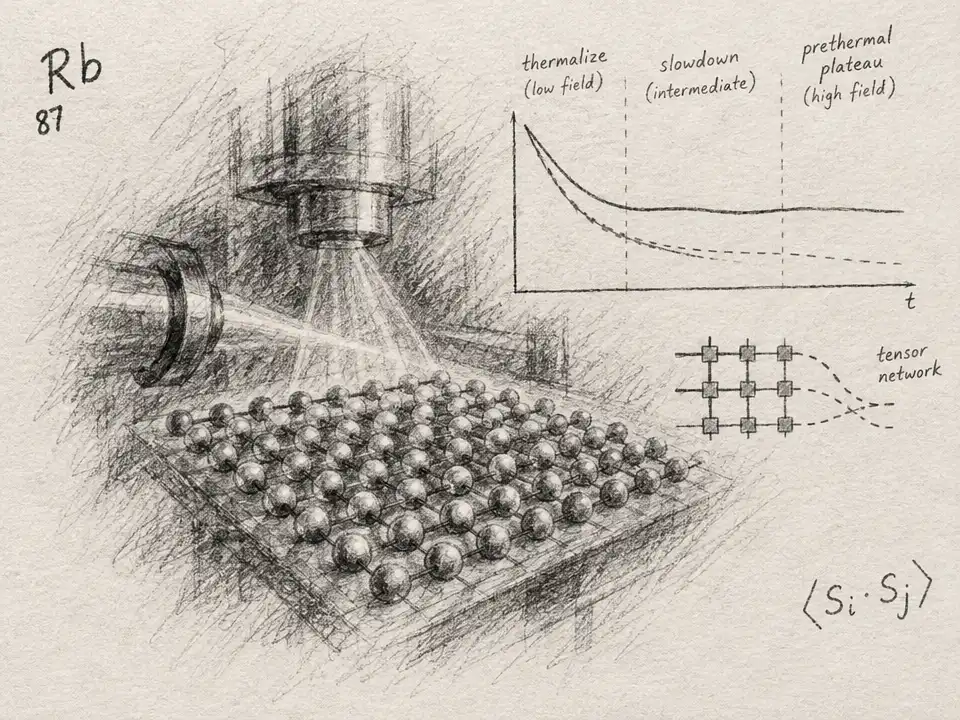
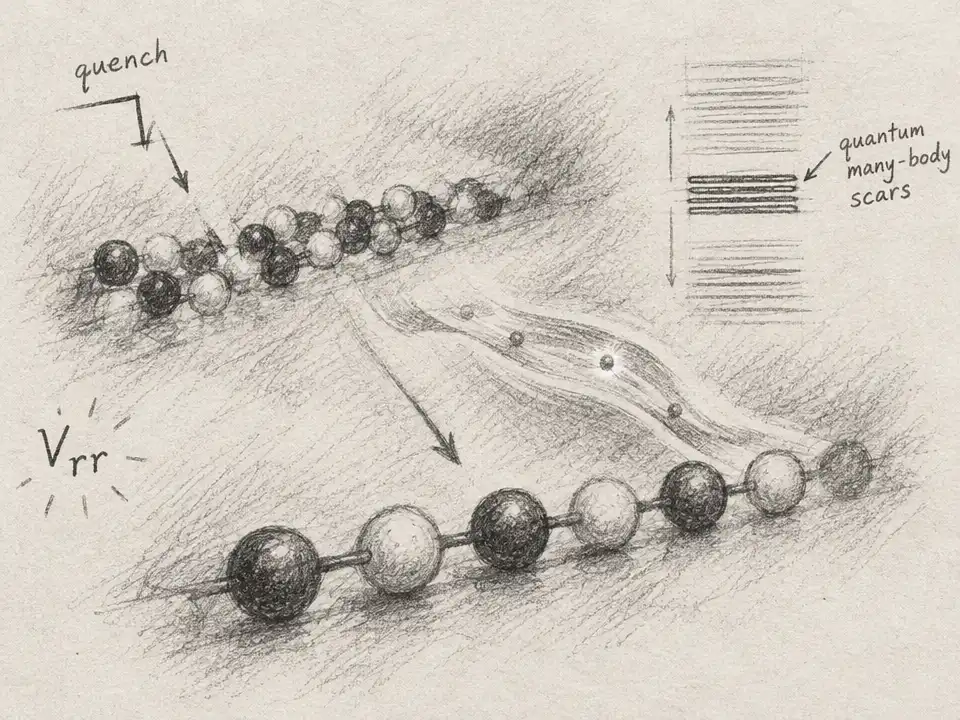
The experiment used rubidium atoms arranged one by one in a row. Lasers could drive an atom into a highly excited state called a Rydberg state. In that state, atoms strongly repel one another, making it energetically difficult for nearby atoms to be excited at the same time. This “blockade” acts like a rule on the chain: neighboring sites cannot both be occupied by Rydberg excitations.
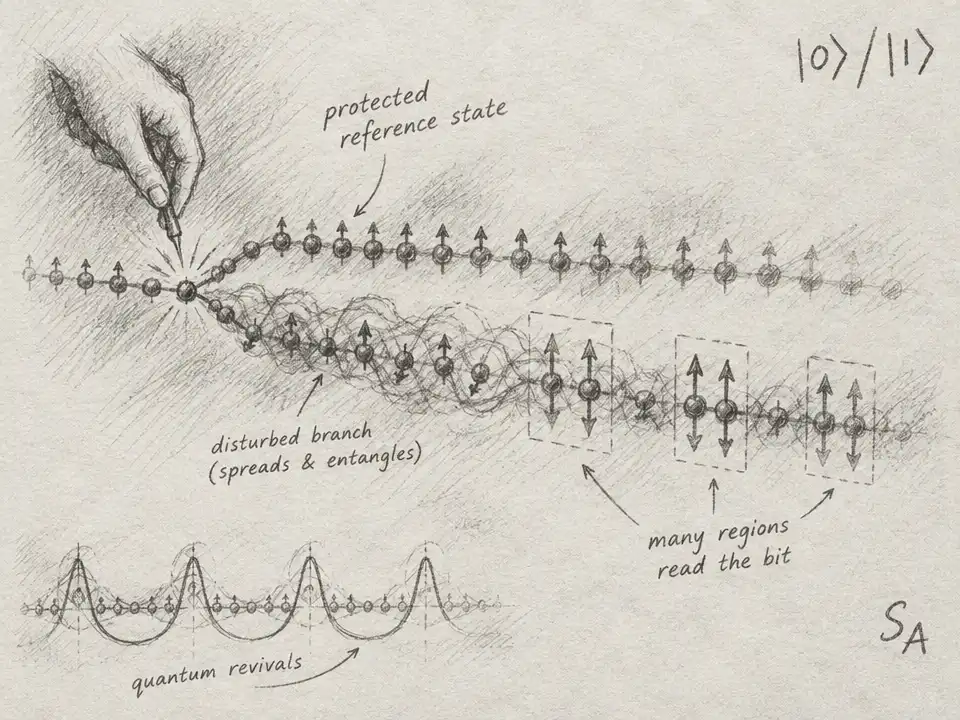
Researchers first prepared an alternating arrangement, with every other atom excited. Then they abruptly changed the laser setting, a process physicists call a quench. The orderly pattern faded, and its opposite—excitations on the sites that had been empty—began to appear. Later, the original pattern re-emerged. The oscillation showed up in chains as short as nine atoms and as long as 51, with a frequency that changed little with chain size. It ran about 38% slower than the Rabi oscillation expected from independent atoms. The revival was not perfect or eternal: the measured dynamics faded over time, but the pattern returned several times before doing so.
That behavior seemed to defy a basic expectation. In a generic interacting quantum system, energy can spread among many possible arrangements. The system’s local details tend to blur, and its measurable properties settle toward thermal values. This chain had no disorder to pin its atoms in place, and it was not a textbook integrable system with a large set of hidden conservation laws. So what kept the crystal’s rhythm alive?
A theoretical study of the same constrained chain pointed to a small set of unusual energy states. A quantum system’s possible configurations can be pictured as points in a vast map; the Hamiltonian—the rulebook for how the system evolves—connects configurations that can turn into one another. The Rydberg blockade removes many possible moves. In this reduced map, the alternating starting pattern has an unusually strong connection to a narrow family of states that leads toward its complementary pattern and back.
Those states are called quantum many-body scars. The name borrows from “scars” in quantum chaos, where some wave functions concentrate near a classical system’s unstable paths. Here, the scar is not a visible mark on the atoms. It describes special many-body energy states that put unusually large weight on simple arrangements—in this case, the alternating pattern. The theory found that these states sit inside a spectrum otherwise populated by typical, thermalizing states.
Their energy spacings are approximately regular. That matters because quantum states with nearly evenly spaced energies can keep their phases aligned for a while. When the system begins in the right pattern, the contributions from the scarred states can reinforce one another again, rebuilding the initial arrangement. It is a bit like a crowd of runners taking different routes but arriving at the finish line together—except the “runners” are quantum amplitudes, and their routes are possible configurations of the whole chain.
To study the structure, the theorists recast the many-body problem as a single particle hopping on a graph whose nodes represent allowed configurations. This is a mathematical shortcut, not a claim that one actual particle travels through a maze. It helped them approximate the special states and connect their structure to the observed revivals. The model’s level statistics and entanglement growth also argued against ordinary integrability as the explanation: the chain showed hallmarks of complex, nonintegrable dynamics even as the special oscillations persisted.
The key is how rare the scars are. In the theoretical model, their number grows roughly in proportion to chain length, while the total number of allowed configurations grows exponentially. Most energy states remain typical; the system has not escaped thermalization altogether. Yet a carefully prepared starting pattern overlaps strongly with the rare states, letting them steer the motion. The original experiment’s researchers also noted that the quenched state had an energy density corresponding to an infinite-temperature ensemble within the blockade-allowed configurations—a strikingly hot place for a crystal-like rhythm to survive.
That selectivity makes the phenomenon both a puzzle and an opportunity. A random starting arrangement does not necessarily produce the same revivals; the initial pattern matters. And the revivals eventually weaken, leaving open questions about how robust the effect can be as systems grow or conditions change. But the central lesson is already clear: thermalization is not always an all-or-nothing rush toward disorder. Even in a system where most states behave conventionally, a small, structured corner of the quantum spectrum can preserve a remarkably simple memory—and bring it back into view.