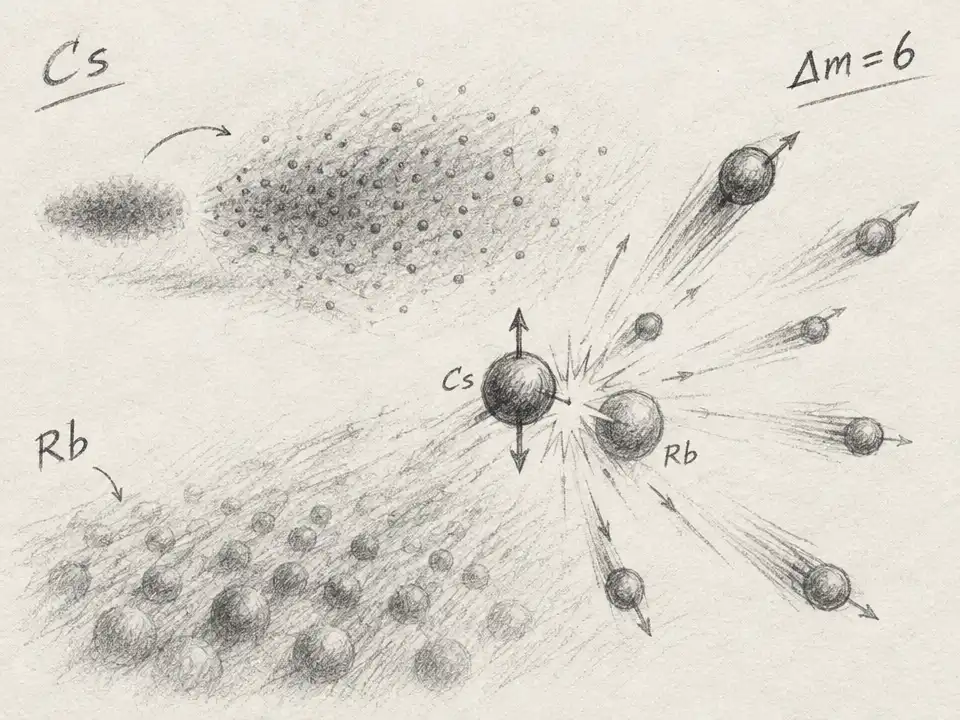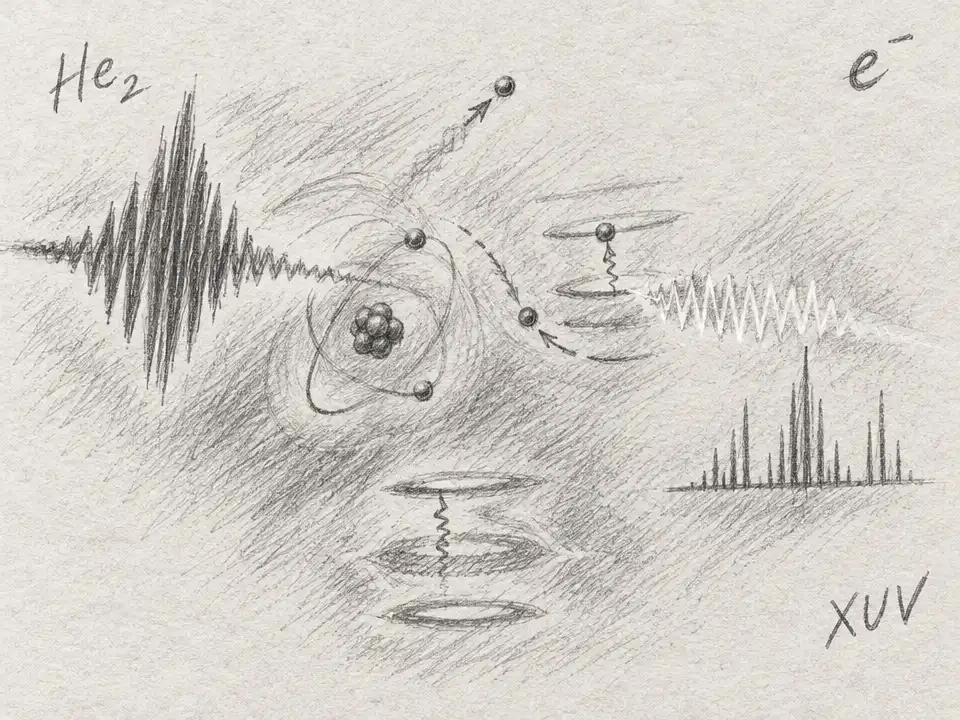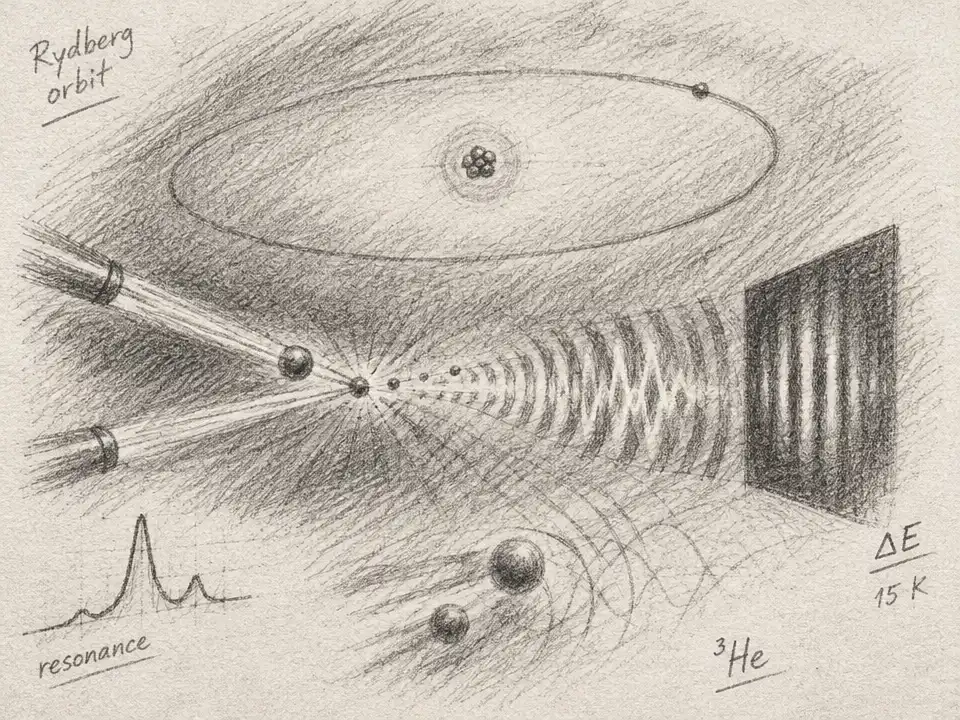
Picture a collision taking place inside an atom. Not at its nucleus, but inside the vast, hazy region traced by an excited electron—an orbit so enlarged that it can hold a second atom passing close to the first atom’s tiny, charged core. In a new experiment, that hidden encounter became a place to watch matter behave unmistakably as a wave.
The oversized atom is a Rydberg helium atom. One electron has been excited into a very high-energy state, leaving it loosely bound and far from the compact helium ion at the center. The research team excited helium to a state with principal quantum number 70. At that scale, the distant electron mostly watches while the positively charged core collides with a neighboring neutral helium atom. The authors estimate that below principal quantum number 27, the electron’s influence would become important; at 70, the encounter can be treated as an ion–atom collision.
This arrangement offers an unusual advantage. The Rydberg atom can shelter the ion from troublesome external fields, while letting researchers study how an ion and a neutral atom scatter. Earlier experiments in this area could generally be explained by classical trajectories: particles followed paths, and many possible routes blurred away the delicate patterns of quantum motion. The new work aims at a different view—one collision at a time, with the outgoing ions mapped onto a detector.
To make the encounter, the researchers merged two helium beams moving at nearly matching speeds. They used a curved magnetic guide to slow one beam relative to the other, then illuminated metastable helium with 260 nm light to create the Rydberg atoms just before the collision region. By adjusting the beams, they explored collision energies from 0.8 K to 50.0 K in the 4He+–4He system. The detector recorded the directions and speeds of the charged products, turning scattering into a pattern that could be compared with quantum calculations.
At low energies, the pattern did not look like a collection of tiny billiard balls. The team saw diffraction oscillations: bright and dim angular bands produced when matter waves from different parts of the collision interfere. They also found sharp peaks in the measured reaction rate. These are shape resonances, fleeting states in which colliding particles become temporarily caught behind an angular-momentum barrier. In effect, the pair lingers as a short-lived molecular configuration before separating.
Five such peaks appeared for 4He+ colliding with 4He, at (1.53 ± 0.06) K, (3.2 ± 0.1) K, (6.1 ± 0.1) K, (16.6 ± 0.2) K, and (31.5 ± 0.2) K. Their alternating pattern of allowed quantum states reflects a fact that seems simple but has far-reaching consequences: the two helium-4 nuclei are identical. There is no experimental label that can tell which nucleus was the incoming ion and which was the neutral atom after the collision.
That indistinguishability makes two outcomes interfere. In one, the ion scatters and stays the ion; in the other, an electron transfers and the incoming neutral helium leaves charged. Because the nuclei are identical, the detector cannot distinguish these pathways. Their quantum amplitudes combine, changing not only the angles at which particles emerge but also the overall scattering rate. This is a striking twist on Mott interference, usually discussed as angular ripples in high-energy collisions. Here, at energies around 10 K, the interference survives even when the scattering is summed over angles. The researchers found that calculations omitting it failed to reproduce the measured rate.
A second set of collisions revealed an even subtler scale hidden in the atom. The team replaced one helium-4 atom with helium-3. The isotopes have the same number of protons and electrons, but different nuclear masses. That tiny difference shifts their ionization energies by 15.0 ± 0.1 K. The offset is small beside the atoms’ ionization energies, which are about 285,000 K, yet large enough to make the two directions of charge transfer behave differently.
This isotope experiment also probes a foundational approximation in molecular physics. The Born–Oppenheimer picture treats nuclei as slow and electrons as fast, so the electrons can be thought of as adjusting smoothly as the nuclei move. For these helium isotopes, the charge-transfer process couples the two possibilities strongly enough that this separation breaks down. The researchers compared their observations with calculations that include those beyond–Born–Oppenheimer effects. Without them, the theory missed the low-energy measurements.
In the energy-releasing direction, 4He+ colliding with 3He, the reaction could be studied at an incoming collision energy of 0.09 K. The reaction releases about 15 K into the particles’ motion, so even a very slow approach produces faster outgoing ions. At the lowest energy, the team observed a resonance at (90 ± 11) mK. In the reverse direction, the collision must supply energy to overcome the isotope offset. The measured threshold was 15.0 ± 0.1 K.
The point is not that helium has become a miniature chemical factory. It is that an enormous atomic orbit can provide a quiet window onto events at a much smaller scale: two nuclei approach, their matter waves interfere, and the assumptions used to describe their motion can fail. The experiment brings quantum scattering into view in a system where the ion itself would be difficult to study so cleanly.
The authors see this as a platform that could be extended to collisions involving molecules, including species that cannot readily be cooled with lasers. For now, helium offers a remarkably legible case: a distant electron frames the experiment, identical particles alter the total rate, and a slight isotope shift changes the rules of the collision. Inside the roomy outline of one excited atom, the researchers found a much smaller world where waves, temporary bonds, and the mass of a nucleus all leave visible marks.