Quantum mechanics works extraordinarily well. But some physicists still ask whether its familiar rules are the whole story—or whether tiny deviations might help explain how the quantum world gives way to the everyday one. A new proposal turns that deep question into a laboratory hunt: make an ultracold gas sensitive to faint disturbances, then see whether its response follows a pattern ordinary experimental noise should not.
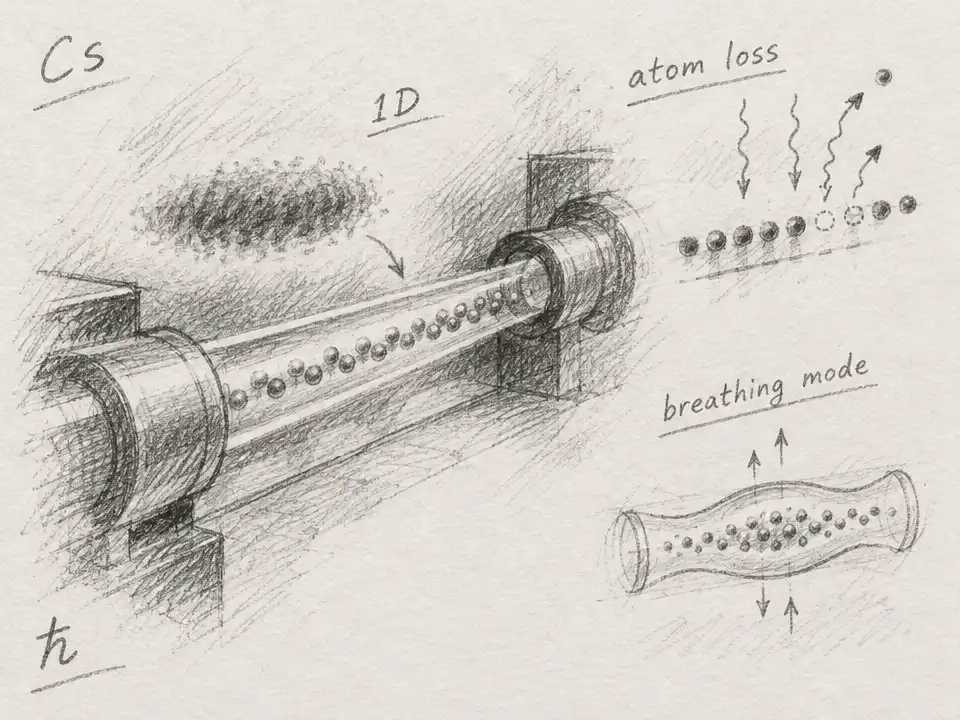
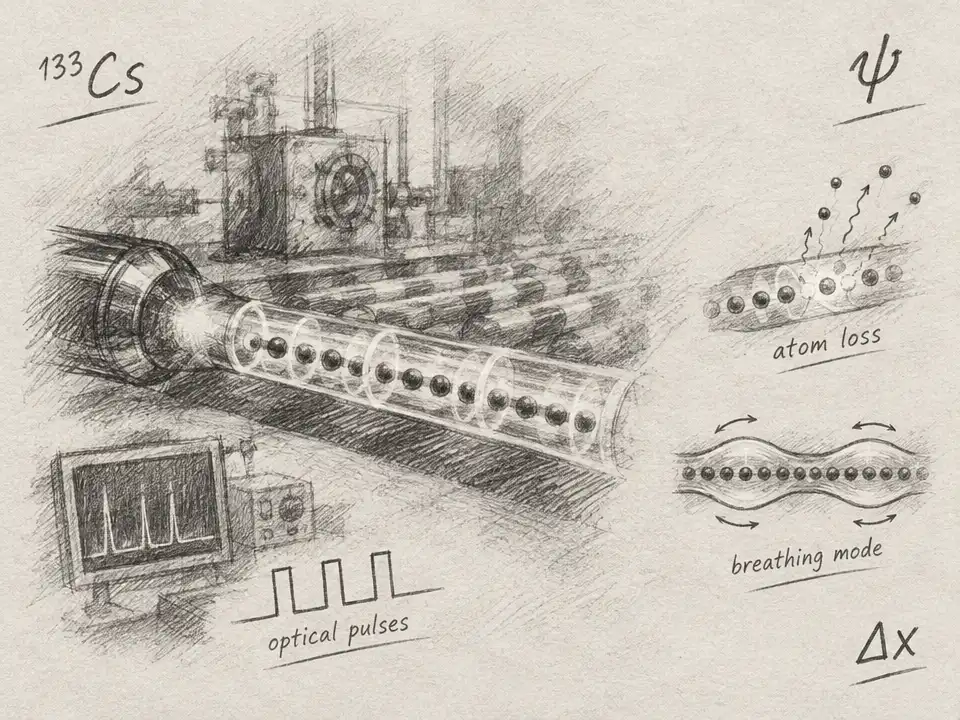
The proposed detector is a gas of cesium atoms arranged in about 104 narrow, effectively one-dimensional tubes. The researchers would use two unusual states of the gas to look for two different kinds of change to quantum mechanics. One state could amplify random noise into atom loss. The other has a remarkably predictable breathing rhythm that might reveal a subtle change in the particles’ rules.
The first target is a family of proposed “collapse” models. In these theories, a faint universal noise field would gradually disrupt quantum behavior, with effects that become more consequential for larger systems. The noise has not been observed. The challenge is to distinguish any real signal from heating and other disturbances that a laboratory produces on its own.
The team’s proposed amplifier is a super-Tonks–Girardeau gas. It begins with atoms in a strongly repulsive regime, where they behave in some ways like particles that cannot pass through one another. The researchers then rapidly change the interactions, creating a strongly attractive but metastable state. It is not the gas’s lowest-energy arrangement, but it can persist: the paper notes earlier experiments that maintained the state for more than 5 seconds.
That precarious stability is the point. The state depends on strong correlations between atoms. If a noise field injects energy and disrupts those correlations, the gas may decay toward clustered states, registering the disturbance as atom loss. Instead of trying to measure an almost imperceptible energy increase directly, the proposed method reads out a more practical consequence: fewer atoms remain.
The researchers add a second lever: control over the spacing between atoms. In their design, the atoms sit in a uniform box-shaped trap, and the team can vary the gas’s density. The idea is that the hypothetical noise has a characteristic spatial scale, while the correlated gas responds especially strongly to disturbances at particular momenta. Adjusting the spacing could bring those scales into alignment, producing a resonant response. A resonance that shifts predictably with spacing would be more distinctive than a general rise in heating.
Crucially, the team has tested part of this measurement chain, not the proposed search for collapse. In a calibration experiment on its existing cesium setup, it applied weak optical-lattice pulses at pseudo-random intervals. Those artificial kicks mimicked energy injection from a noise source. The atoms’ loss followed the expected trend, letting the researchers estimate the smallest heating rate their current arrangement could resolve: about 2.9 × 10⁻³² J/s at 95% confidence.
From that calibration, the authors project that a redesigned experiment could probe a collapse rate of approximately 1.8 × 10⁻¹¹ s−1 at a correlation length of 10−7 m. That is a projection, not a measured limit from a completed search. It depends on several planned improvements, including more precise preparation, many more experimental repetitions and a longer measurement window. The paper also treats the conversion of resonant excitations into extra atom loss as plausible but not yet quantitatively established; the projected sensitivity does not count on an additional boost from that resonance.
A second measurement uses a different kind of quiet baseline. In the Tonks–Girardeau regime, strongly repelling bosons in an ideal harmonic trap have a breathing motion—expanding and contracting at a frequency exactly twice the trap frequency. This value follows from a symmetry of the system. If a proposed deterministic nonlinearity in quantum mechanics were present, it could shift the rhythm. The experiment would track the breathing frequency against the trap’s own frequency and look for a mismatch.
Small mismatches can also come from mundane imperfections: a trap that is not perfectly harmonic, or atoms whose interactions are not quite in the ideal regime. The proposal’s answer is to vary atom number and density. The candidate quantum effect and leading experimental errors are expected to scale differently as those settings change. With that comparison, the researchers estimate they could test a benchmark nonlinear model at a precision of 10−4 in the frequency ratio. Again, this is an experimental target, not a result already achieved.
Together, the two measurements make the proposal more than a search for an unexpected blip. One asks whether a fragile many-body state turns a faint random disturbance into a density-dependent loss signal. The other asks whether a symmetry-protected rhythm departs from its exact value in a way that survives changes to the apparatus and gas. The atoms become both amplifier and reference clock.
The appeal is control: the experiment could tune how many atoms share a tube and how far apart they sit, giving researchers a way to scan the system’s response and test whether a signal follows the predicted scaling. If nothing unusual appears, the measurements could still tighten constraints on proposed departures from standard quantum mechanics. If a pattern does appear, its dependence on spacing, atom number and trap frequency would help determine whether the trail leads to new physics—or to a laboratory imperfection that only looked like it.