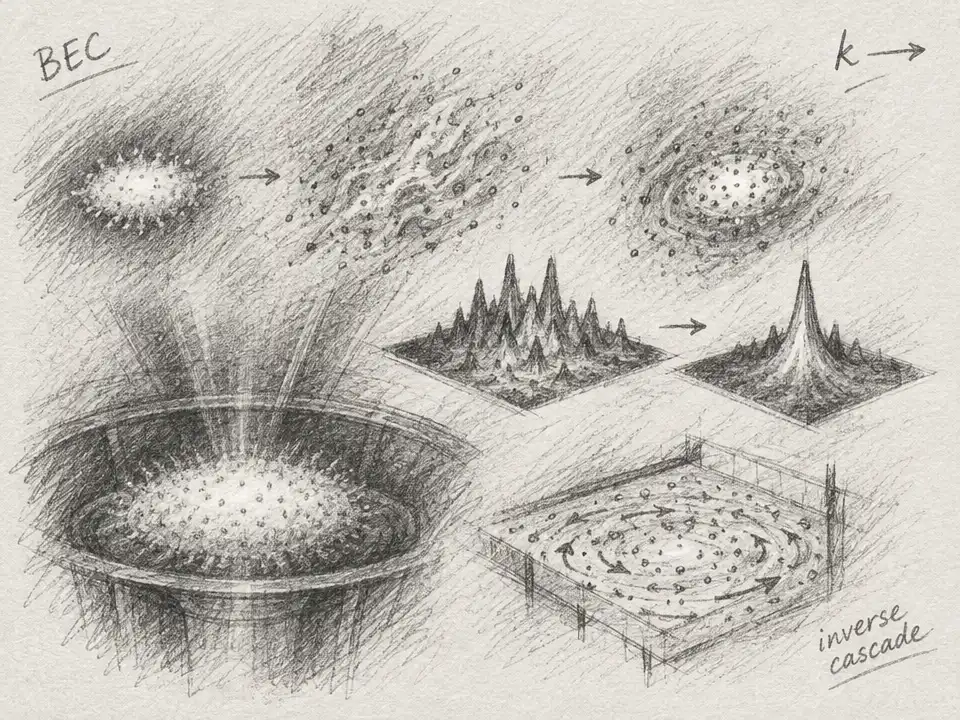
A cloud of ultracold atoms was shaken until its most orderly state began to fade. Then, after a pause, that state started to return. The atoms were not retracing their steps or reversing time. Instead, researchers saw evidence of a surprising reversal in how activity spread across the gas’s possible motions: a cascade that had carried population away from the condensate gave way to one that helped refill it.
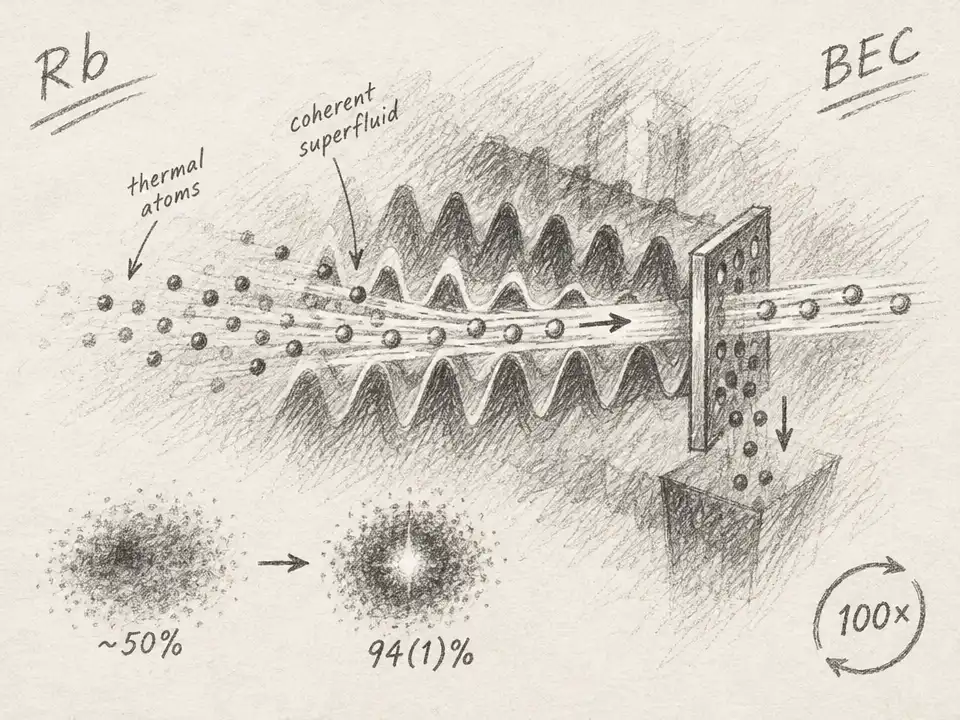
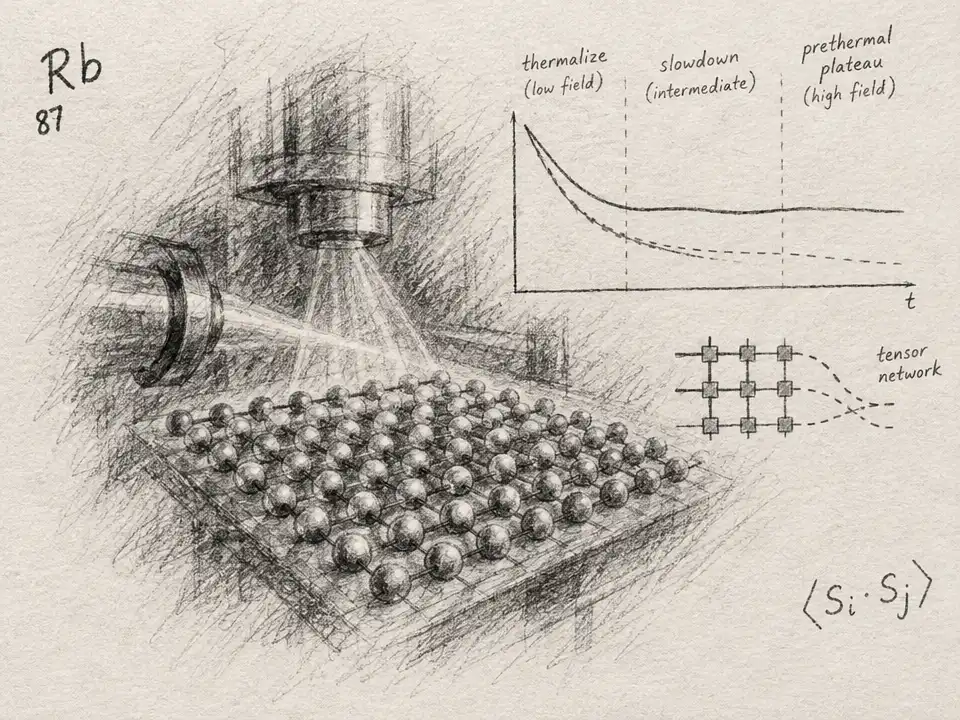
The experiment began with about 200,000 rubidium atoms, cooled to roughly 50 billionths of a degree above absolute zero. More than 80% occupied a shared, coherent state called a Bose-Einstein condensate. To disturb this unusually orderly cloud, the researchers applied an oscillating magnetic field gradient. Its deliberately misaligned pull deformed and rotated the trap, stirring up collective motion.
Then the researchers switched off the disturbance and let the gas evolve. They could not watch individual atoms trading energy in real time. Instead, they released the cloud, let it expand for 30 milliseconds, and photographed it. The expanded cloud revealed a momentum distribution: a map of how many atoms occupied different kinds of motion. Low momentum corresponds to long-wavelength motion, while high momentum corresponds to shorter-wavelength motion. A large population at the lowest momenta is one sign that the condensate is present.
The first clue was a decline in that low-momentum population. In the researchers’ interpretation, atoms were being redistributed toward higher-momentum modes. In turbulence, this kind of transfer is called a cascade. The word can suggest water sloshing through space, but here it describes changes among the gas’s possible motions—not atoms streaming from one side of the trap to the other.
The momentum map revealed a sequence, not a single smooth fade. For one moderate level of shaking, the low-momentum population first declined gradually. For roughly the next 90 milliseconds, its changing distribution followed a scaling pattern associated with a direct cascade. Then came a quieter interval: for about 100 milliseconds, the lowest-momentum population changed little. The researchers suggested this could be a stage of prethermalization, in which the gas’s modes become temporarily almost steady without reaching ordinary thermal equilibrium.
After that pause, the trend changed. The low-momentum population rose, reaching a peak about 370 milliseconds after the shaking stopped. The team identified this as an inverse particle cascade: a redistribution toward lower momentum that repopulated the condensed mode. The reversal did not mean the gas had recovered its original state. It meant one part of its momentum distribution was building again, while the system as a whole continued its complicated evolution.
The amount of shaking mattered. Too little, and the researchers did not see the power-law momentum distribution they used as evidence of turbulence. Too much, and the condensate depleted more quickly without showing the same clear repopulation. The reversal appeared in a middle range of excitation, making it less like an automatic rebound and more like a route the gas can take under particular conditions.
A separate experiment offers another view of that route. There, researchers studied a flatter, two-dimensional gas while continuously driving it at a chosen wavelength. Rather than letting a stirred cloud relax, they watched how a steady, far-from-equilibrium distribution formed. They found evidence of an inverse cascade toward longer wavelengths alongside a direct cascade toward shorter ones. When they changed the drive to excite motion in just one direction, the developing population showed how the inverse transfer spread through the gas. This was not the same process as a condensate rebuilding after the drive stopped: the geometry, dimension, and continuous forcing were different. But it showed a related large-scale transfer in a different setting.
The connection between the experiments is a useful one. In the trapped gas, the researchers inferred the transfers from snapshots of momentum distributions; they did not follow each atom’s path. In the continuously driven gas, the population settled into a persistent nonthermal pattern, though some atoms were lost at high momenta. Neither result says that a quantum gas simply runs backward toward order. Rather, the experiments show that different kinds of redistribution can happen at once, or in sequence, as waves interact.
Wave-turbulence theory provides a framework for describing both directions with different self-similar patterns. In everyday terms, self-similarity means that a changing distribution can keep a recognizable shape as its scale and height shift. The measured patterns broadly matched theoretical predictions, though the trapped experiment showed small differences from predictions for an ideal, uniform system. Its trap and finite size matter, and the researchers say more work is needed to understand how geometry and the strength of the disturbance determine whether all the stages appear.
The puzzle, then, is not why the gas magically recovers. It is how a far-from-equilibrium quantum fluid chooses which scales to fill next. By tracking the changing momentum map, researchers found a quiet interval between depletion and return—and evidence that a turbulent gas can send population in more than one direction on its way toward equilibrium.