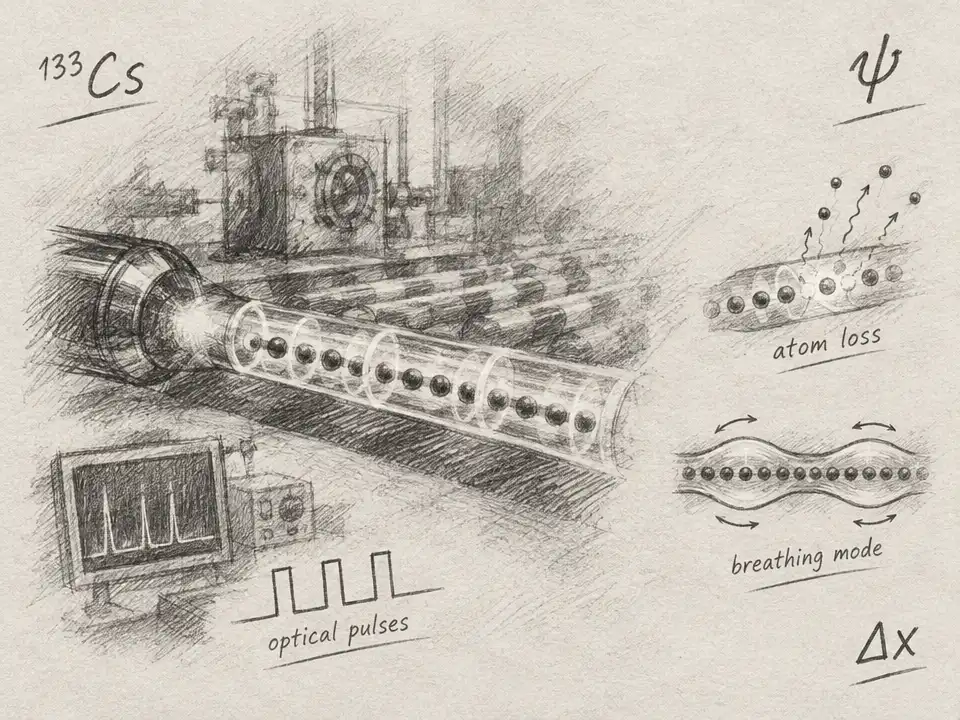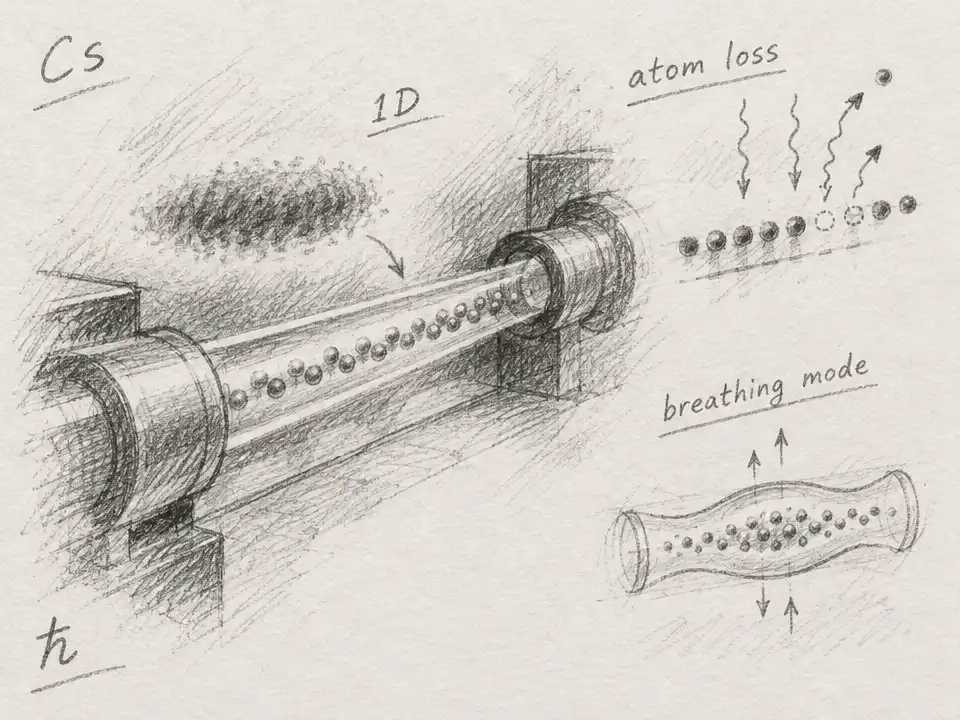
Imagine a narrow corridor holding a cloud of ultracold cesium atoms. The atoms are free to move along the corridor, but tightly confined from side to side. Now imagine that some tiny, universal noise is acting on matter—quiet enough to leave individual atoms almost untouched, yet able to disturb a sufficiently large quantum system. Could this unusually orderly gas make that noise visible?
That is the possibility in a proposal by Yi Zeng and colleagues. They outline experiments that would use one-dimensional cesium gases to test ideas that go beyond the standard Schrödinger equation. The researchers do not report discovering a failure of quantum mechanics. Instead, they describe a platform that could search for two kinds of departures: random collapse-like disturbances, and a deterministic nonlinearity that would alter the gas’s motion.
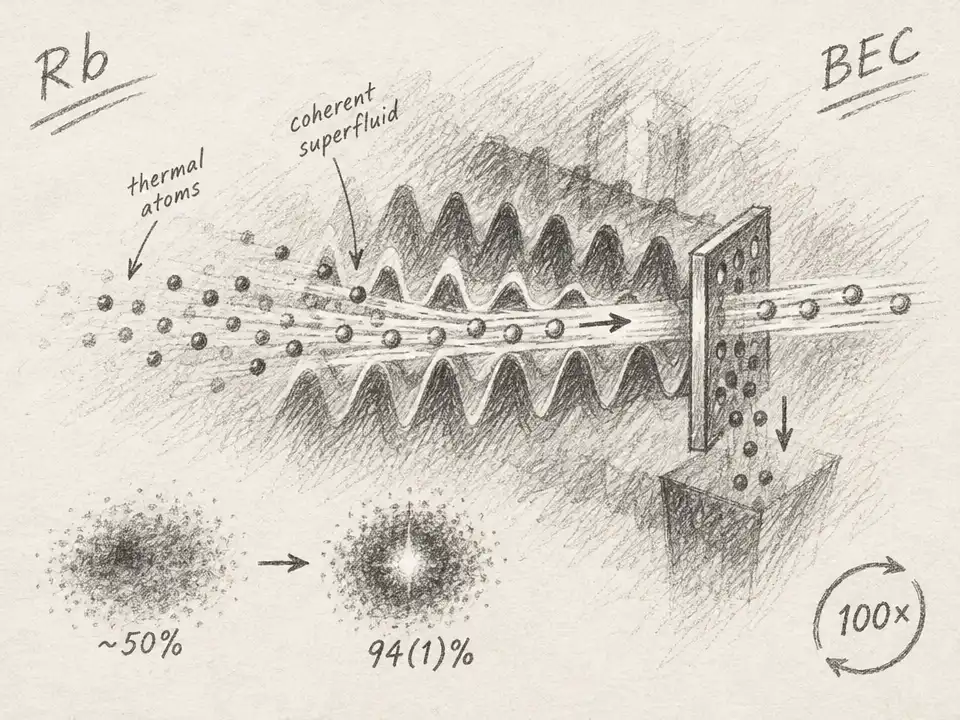
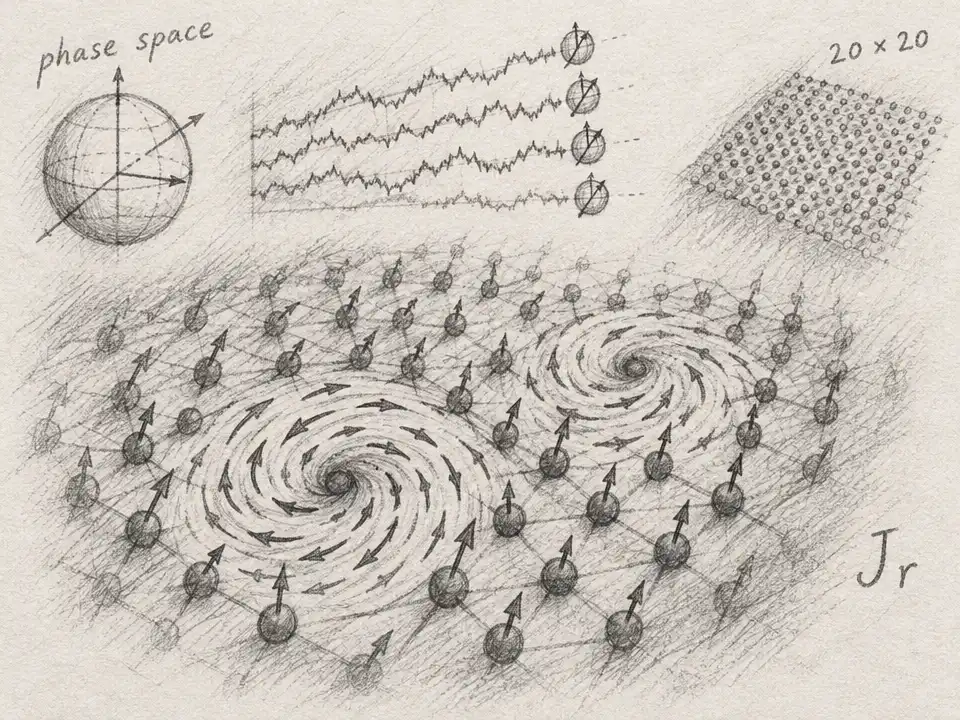
The proposed apparatus is an array of roughly 104 narrow tubes, formed with an optical lattice. Each tube could contain a carefully chosen number of atoms, from about 3 to 50, while the gas’s density is adjusted independently. That control matters: the experiment is not simply looking for any unexpected warming or motion. It is designed to vary the gas in ways that a genuine new effect should respond to differently from ordinary experimental imperfections.
One target is the continuous spontaneous localization model, or CSL. In this family of theories, a universal noise field would gradually collapse quantum states. Its influence is expected to grow with the amount of matter involved, offering a possible bridge between delicate quantum behavior and the familiar, apparently definite world. The proposal focuses on a particular sign of that noise: heat deposited in the gas.
To make a whisper of heating easier to hear, the team would use a super-Tonks-Girardeau gas. This is an unusual, highly excited state of strongly interacting atoms. Despite its attractive interactions, it can persist because the atoms’ strong short-range correlations keep it metastable rather than letting it immediately collapse into clusters. Those same correlations make the gas sensitive to disturbances: if they are disrupted, the state can decay and atoms can escape.
In the proposed test, the researchers would look for atom loss caused by noise-induced heating. A key twist is that they would scan the distance between atoms. The gas has a strong response to disturbances with particular spatial patterns; CSL noise is also characterized by a length scale. If the two line up, the disturbance could drive the gas especially effectively, producing a resonant rise in atom loss. Everyday background heating should not show the same distinctive resonance as the density is changed.
The group has already taken one practical step, though not a CSL measurement. In an existing, nonuniform optical-lattice setup, they used weak, irregularly timed lattice pulses to mimic a small source of heating and calibrated how much atom loss they could resolve. From that calibration, they estimate a baseline sensitivity corresponding to a CSL collapse rate of about 4.3 × 10⁻⁷ s−1 at a correlation length of 10−7 m. The more carefully controlled experiment is projected to reach about 1.8 × 10⁻¹¹ s−1 at that same reference length—roughly four orders of magnitude beyond the calibration.
That projected reach would matter because the sharpest existing constraints depend on assumptions about the noise at very high frequencies. Against the strongest bound that remains robust even if the noise spectrum has a cutoff, the proposed measurement could improve the limit by about a factor of ten. Its density scan could also do more than set a limit: if a signal appeared, the position of the resonance could help reveal the noise’s characteristic length.
But the numbers are a forecast, not a result. The upgraded experiment must deliver uniform tubes, precise atom counts and density control, and enough repeated measurements to distinguish a small effect from ordinary loss. The projected sensitivity also uses a conservative simplification of the many-body response. A more complete account of how the correlated gas absorbs energy could change the reach, in either direction. And a rise in atom loss, by itself, would not be evidence for new physics; the telling clue would be the predicted pattern across a controlled density scan.
The proposal has a second route to the same broad question. In a different regime, the atoms form a Tonks-Girardeau gas in a harmonic trap. Its breathing motion—the repeated expansion and contraction of the cloud—has an exactly fixed relationship to the trap’s oscillation frequency in the ideal limit. That makes the frequency a kind of reference mark. A particular proposed logarithmic nonlinearity would shift it; ordinary effects such as imperfect trapping or interactions could shift it too, but in different ways as atom number and spacing change.
For a benchmark of three atoms in a trap oscillating at 2π × 100 Hz, and an assumed frequency precision of 10−4, the paper estimates a possible limit of 1.2 × 10⁻¹⁶ eV on the nonlinear term. That would improve on an existing neutron-interferometry limit. Just as with the collapse search, the promise lies not only in sensitivity but in the chance to separate a genuine change in quantum dynamics from the lab’s own fingerprints.
The frontier here is not a dramatic claim that quantum mechanics is about to fall apart. It is a careful attempt to make its most basic rules answerable to new kinds of tests. A tiny gas, constrained to a line and tuned with unusual precision, might let researchers ask whether nature adds a faint noise to quantum behavior—or whether the familiar equation holds even under a more exacting examination. Before it can ask, though, the experiment must first make its quiet corridor controlled enough to hear.