Imagine a row of bells tuned so evenly that their notes fall into step. Strike them together and, after a pause, their vibrations line up again: an echo made not by one bell, but by the pattern among them. In a quantum system, a similar kind of reassembly can occur among energy levels. The surprising part is what happens when noise enters. A new theoretical study finds that a particular kind of decoherence can blur the pattern without wiping out its echoes as quickly as expected.
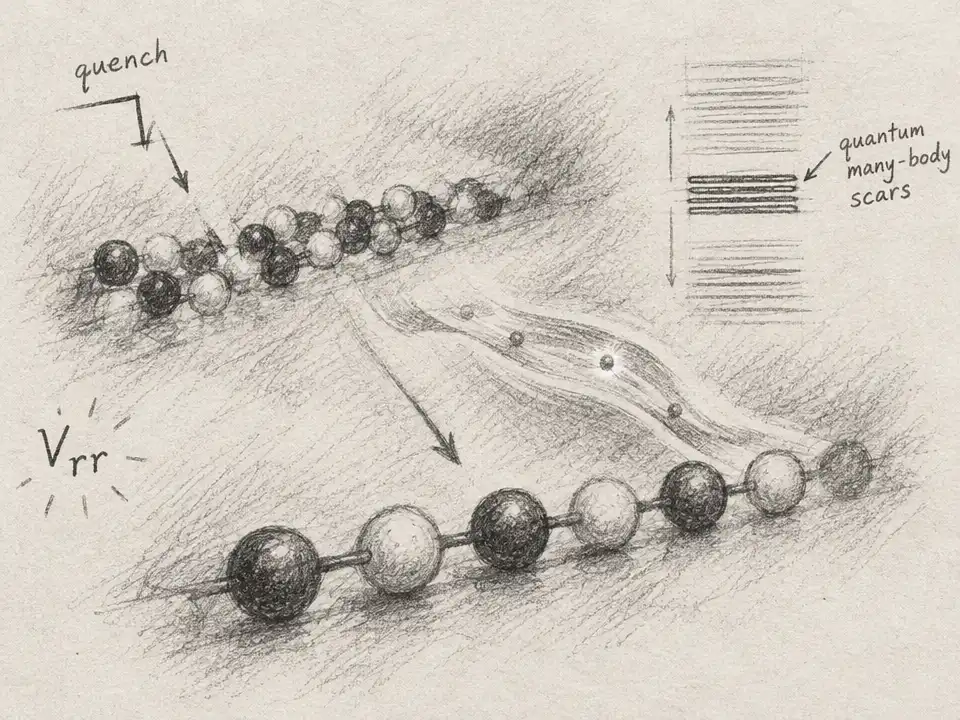
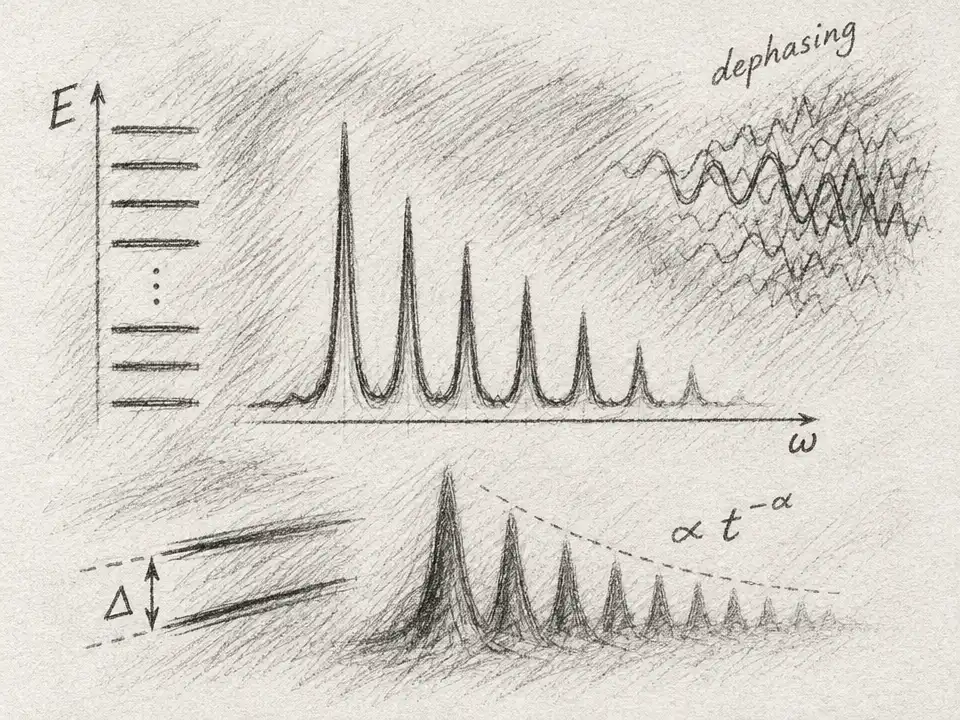
The pattern in question is not a row of atoms in space. It is an arrangement of energy levels: a nearly regular ladder, sometimes compared to a picket fence. Researchers can study that hidden arrangement through a quantity called the spectral form factor. In accessible terms, it tracks whether quantum phases that have spread apart can later line up again. For a perfectly regular ladder, they periodically do. The resulting peaks resemble the bright spots of a diffraction pattern, which is why the researchers call them Bragg revivals.
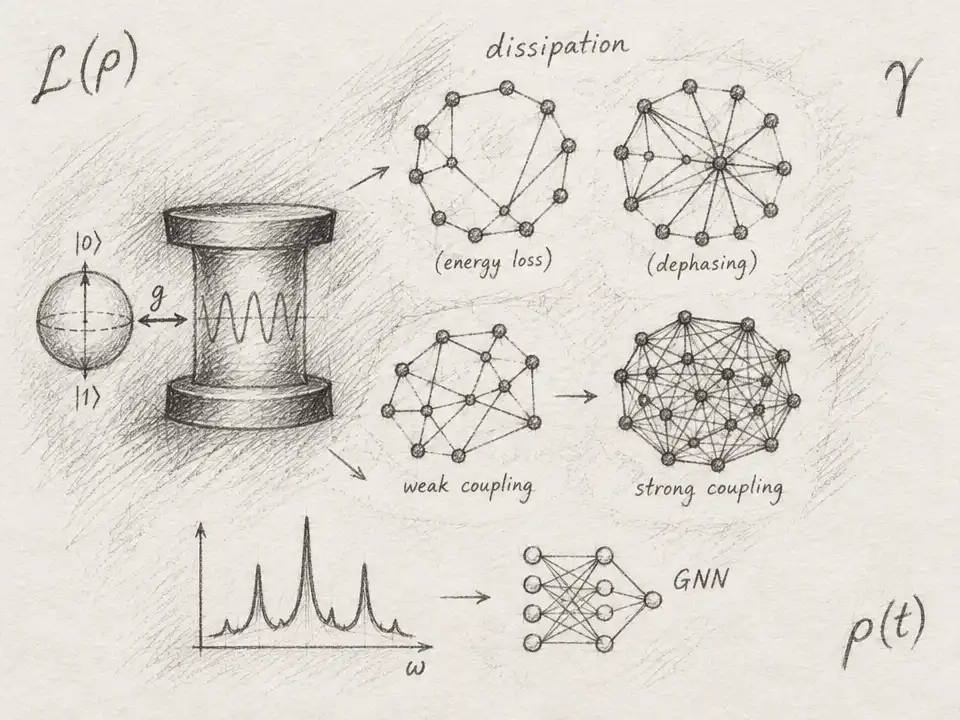
Those revivals seem fragile. In an open quantum system, the environment can scramble relationships between energy levels, a process called dephasing. The usual expectation is straightforward: lose coherence, lose the pattern. The paper by Preethi Gopalakrishnan and Adolfo del Campo asks how this melting unfolds when the spectrum is unusually orderly—and finds that the answer depends on which pieces of the pattern the noise reaches first.
The authors studied energy dephasing, a model in which the environment damps quantum coherence according to the energy separation between two levels. Coherence between widely separated levels fades faster than coherence between neighbors. In their model, the decay rate grows with the square of that separation. So the far-flung connections that help knit together the full spectral pattern are the first to weaken.
At first glance, that sounds like a quick route to erasure. For a system with a large number of possible quantum states, the overall decoherence rate can become very large. But the spectral form factor does not need every connection to survive equally. Nearby levels can remain coherent after distant pairs have lost their alignment. That leaves enough of the pattern intact to produce revivals long after the system has begun to decohere.
The calculation reveals three stages. With very weak dephasing, the spectrum behaves almost like a rigid crystal: its Bragg peaks remain strong. At intermediate times, the peaks fade algebraically, more gradually than a simple exponential collapse. In the idealized case, their height falls roughly with the inverse square root of the dephasing strength times the revival number. Only later, when even the coherence between neighboring levels has decayed, does the peak pattern give way to a much smaller background.
This middle stage is the unexpected one. The system can have an extremely short overall decoherence time and still retain useful spectral echoes. The key is that those two clocks measure different things. The first is dominated by coherences spanning large energy gaps, which are easily disrupted. The longer-lived clock is set by neighboring levels, whose relationship survives until a time of about one divided by the dephasing rate. Between those limits, the quantum system is neither pristine nor featureless: it carries a thinning but readable trace of its original order.
The authors also examined spectra that were not perfectly regular. Their model lets energy levels fluctuate around evenly spaced positions, with a parameter controlling how rigid the arrangement is. These intrinsic imperfections compete with environmental dephasing. The noise limits how many neighboring levels can contribute to a revival; the built-in fluctuations determine how well those levels’ phases line up in the first place. In this way, the fading peaks can reveal something about the spectrum itself, not just the strength of the environment.
Then comes a second twist: noise that changes quickly can sometimes help. The researchers modeled time-varying fluctuations with a tunable correlation time. If the fluctuations are slow, their influence accumulates in much the same way as a static detuning. If they change rapidly, the phase errors can partially cancel over time, a phenomenon known as motional narrowing. In the calculations, faster fluctuations extended the revivals to higher orders. Rather than simply adding more disorder, rapidly changing noise could make the spectral echoes last longer.
That does not mean noise is generally protective, or that the study has demonstrated a new laboratory effect. This is a theoretical analysis, supported by calculations and simulations of model spectra. The authors point to quantum simulators as a possible setting for exploring the predicted behavior. There, researchers could vary dephasing and the timing of fluctuations, then watch how the peaks change.
The broader lesson is about what it means for quantum order to disappear. A single measure of decoherence can suggest that a system has lost its organization, while a more focused signal still carries its fingerprint. Here, the fading is selective: long-range connections go first, and near-neighbor coherence lingers. That makes the spectral form factor more than a record of a quantum system’s echoes. It may also become a way to investigate hidden energy-level structure by observing how the echoes yield to carefully controlled noise.