A secure message usually comes with a quiet cost: to check whether someone has listened in, the sender and receiver set aside some of their raw key bits and publicly compare them. What if the warning could travel through a different part of the quantum signal—leaving every potential key bit untouched? A recent photonic experiment explores that possibility by making the order of two operations part of the quantum system itself.
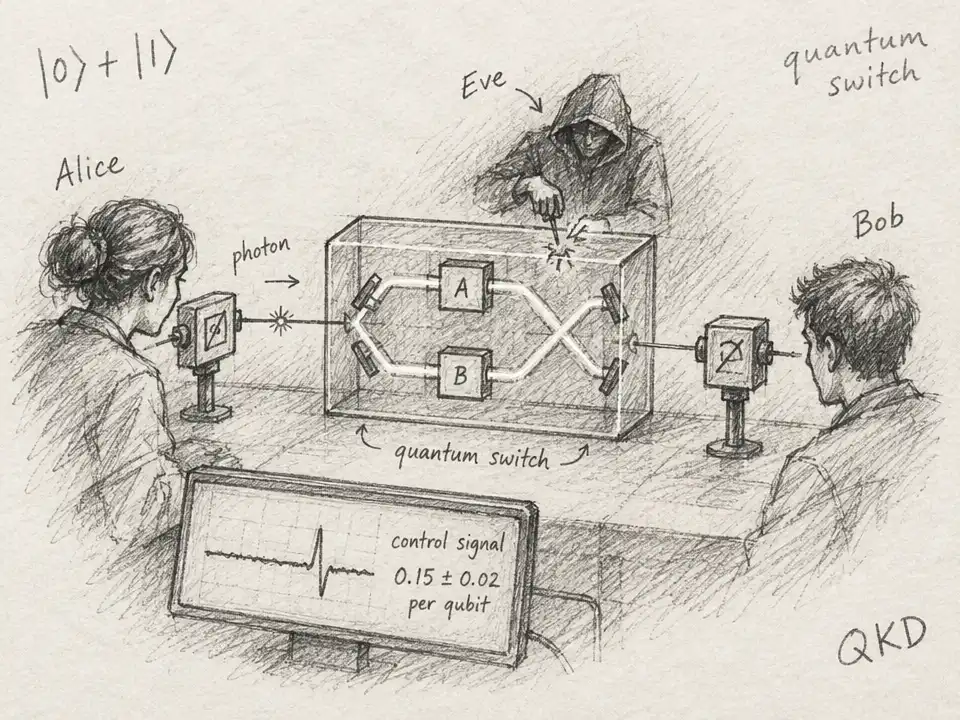
The setup begins with a single photon carrying two kinds of information. Its polarization acts as the message-bearing target; its path acts as a control. In an ordinary sequence, Alice’s operation would come before Bob’s, or Bob’s before Alice’s. In a quantum switch, the photon’s path coherently combines both possibilities: Alice-then-Bob and Bob-then-Alice. This is not a photon traveling backward in time. The two routes are physical branches of an interferometer, and the experiment preserves the phase relationship between them.
The team adapted this arrangement to a protocol inspired by BB84, a familiar method of quantum key distribution. Alice and Bob each choose a measurement basis. When their choices match, their polarization outcomes can form a shared secret bit. In standard BB84, they check for an eavesdropper by revealing a random sample of those bits and discarding the sample. The switch offers a different clue: instead of inspecting the key itself, the parties can inspect what happened to the photon’s control.
Here is the delicate idea. In an honest exchange, Alice’s and Bob’s operations leave the two path branches sufficiently alike that they continue to interfere. The control signal keeps its expected pattern. But an eavesdropper who measures and re-prepares the photon can disturb the relationship between the branches. When the paths are recombined, that disturbance shows up as a change in the control outcomes. Alice and Bob can use this change as evidence of interference without publicly disclosing the polarization results that make up their key.
Making that test work required more than sending a photon through a pair of paths. Alice and Bob needed to read polarization while the photon was still inside the switch, without letting the measurement reveal which route it had taken. A measurement that exposed the route would destroy the very path coherence the protocol depends on. The researchers used an ancillary photon: interactions in the two branches wrote information about the system photon’s polarization onto the ancilla, then the ancilla’s paths were recombined to erase clues about which branch was involved. Its polarization could then carry the measurement result while preserving the switch’s interference.
The researchers first tested the honest case. After successful post-selection—the experiment’s procedure for keeping only particular measurement events—Alice and Bob obtained matching key bits with probability 0.964 ± 0.004. The system also sometimes raised a false alarm: the false-positive eavesdropper-detection probability was 0.033 ± 0.002, which the paper attributes to imperfect interference visibility.
Then came the intruder. The team used polarizers to model an eavesdropper who measures and re-prepares the photon, repeating measurements for complementary outcomes to reconstruct the attack. For this simulated attack, the average probability of detection was 0.15 ± 0.02 per qubit. The ideal theoretical prediction was 0.125. The measured excess was consistent with the experiment’s false-positive rate, rather than evidence that the setup could reliably detect every possible attack.
That distinction matters. The result is a proof of principle: it shows that, in this arrangement, an eavesdropper’s action can leave a detectable trace in the control signal while the key-bearing polarization outcomes remain private. It does not establish a secure key rate, or prove security against all strategies an attacker might use. The authors note that their protocol could reduce by up to a factor of two the number of repetitions needed to obtain a given key length compared with standard BB84. But that prospective advantage is not the same as demonstrating a practical, secure communication system.
The price is visible in the apparatus. The measurement relies on probabilistic linear-optical gates and post-selection, so the retained events do not represent a complete, unconditional communication protocol. Post-selection leaves a security loophole open, and the researchers warn that the setup’s pre-entangled photons may also create side channels. There is another vulnerability: the control and target information are encoded in the same photon, so an eavesdropper could potentially probe the photon’s path and adapt an attack. The paper says a full security analysis must consider general attacks as well as real-world effects such as channel loss, multiphoton emission and detector dark counts.
Closing those gaps could turn the experiment’s conceptual advantage into something useful. The authors point to deterministic photon interactions, such as those enabled by light-matter interfaces, as a possible route away from post-selection. They also identify keeping the control information private and completing a rigorous security analysis as essential next steps. Only then can researchers determine whether the control signal offers a practical advantage over existing key-distribution methods.
For now, the switch has not made quantum cryptography unbreakable, and the experiment does not claim that it has. It has demonstrated a more specific possibility: information about an intrusion can be carried by the coherence between two orders of operations, rather than by spending a sample of the key. The next frontier is to preserve that subtle interference while removing the loopholes built into the laboratory demonstration. If that can be done, the order in which quantum operations occur may become more than a curiosity—it may become another place to look for a spy.