Imagine trying to locate one small object from a blur of radar echoes. A plane or satellite sends out microwaves and records their reflections as it moves. Each echo carries clues about the scene, but those clues arrive tangled together: a target’s signal is spread across many measurements, and the measurements do not line up neatly like pixels in a photograph.
Synthetic-aperture radar, or SAR, traditionally untangles them by using the radar’s motion and other details of its acquisition geometry to combine the echoes into an image. A new preprint asks a different question: could a learning model make a useful decision before that image is assembled—and could the geometry itself help the model do it?
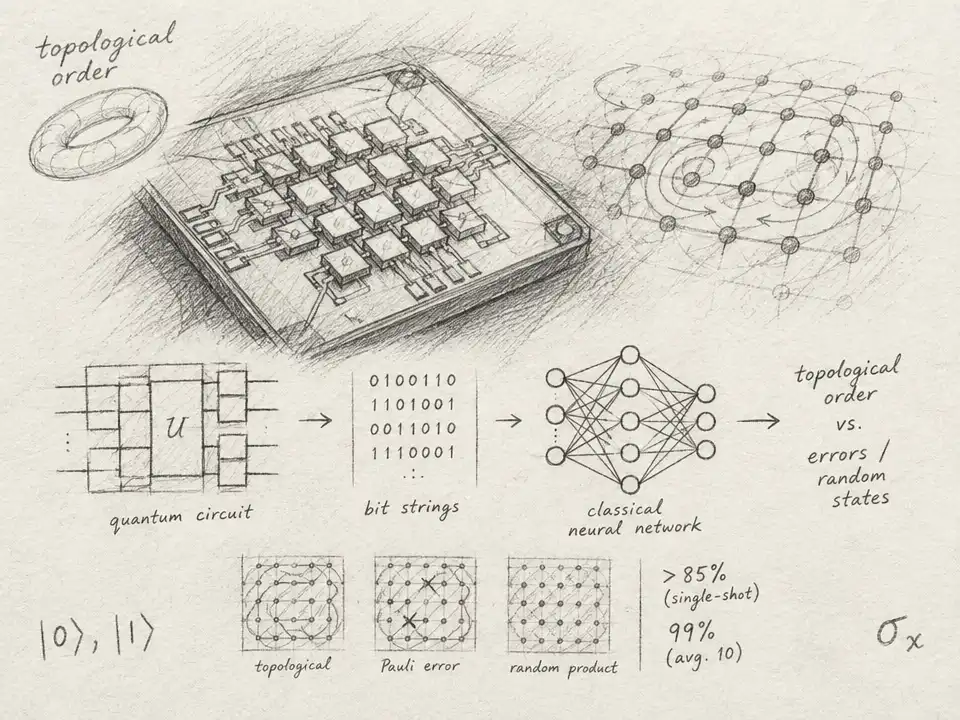
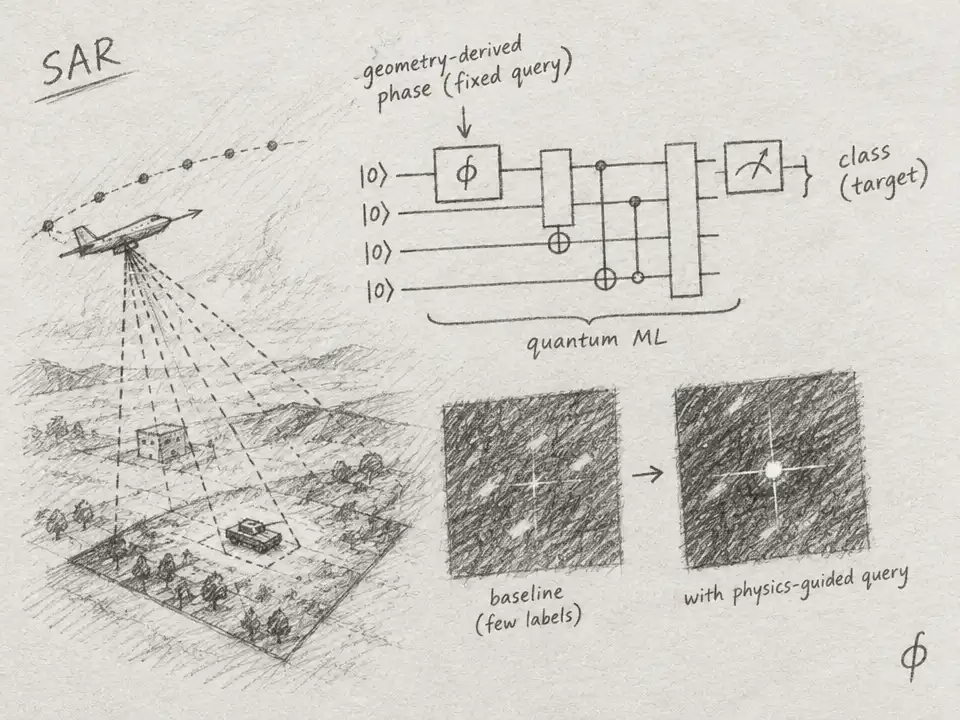
The researchers’ answer brings together two fields that might seem far apart: radar signal processing and quantum machine learning. Their central move is to give a quantum circuit a piece of known task information—a fixed “query”—that tells it how the incoming signal should be interpreted. In tests on simplified, simulated radar data, this geometry-derived hint improved classification when labeled examples were scarce.
The result is not a quantum-speedup claim, nor a demonstration of a working radar system. Its more modest, intriguing proposal is that a learning model may need less trial and error when scientists build a known physical relationship into the model from the start.
To see why, picture radar image formation as a phase-matching problem. A single point on the ground contributes to many recorded echoes. Because the radar platform moves, those echoes carry related but shifted phases. Radar processing uses the known geometry to line them up; when the phases reinforce one another, the target becomes localized in an image.
The trouble is that conventional processing can be involved, and making a clear image is not always the only useful goal. In some settings, researchers might want to identify or locate something directly from raw measurements, before a full image is formed. But raw measurements can be hard for a model to interpret, particularly when training examples are limited.
Here the researchers borrow a lesson from signal processing: the radar’s geometry already predicts part of the phase relationship among measurements. Rather than requiring the model to discover that relationship from labeled examples, they encode it as a fixed input to the quantum circuit.
The circuit also receives the signal that varies from one scene to another. The query is different: it stays fixed across scenes acquired under the same geometry and specifies how the signal should be probed. In the researchers’ design, alternating circuit operations encode these two streams. The query does not add information about where the target is in a particular scene. Instead, it changes how the circuit combines patterns it can already represent—something like giving a musician the score’s key before asking them to play the notes.
That distinction matters. An architectural hint is useful only if it matches the task. Add the wrong hint, and a model may not improve. The paper develops a mathematical account of when a query changes the functions a circuit can represent, rather than merely changing the circuit’s output in a way that its trainable parameters could undo.
The team first tested the idea in a controlled teacher–student exercise. A “teacher” circuit produced labels, and student circuits tried to learn them with limited examples. Students given the matching query reached a mean balanced accuracy of 0.941 in one experiment, compared with 0.734 for students given no query and 0.906 for a deliberately mismatched query. The students had the same circuit size and training budget. This is a useful test of the mechanism, but not an independent real-world benchmark: the teacher was built from the same family of circuits being studied.
Then came the radar-inspired test. The researchers generated small patches of simulated measurements. Each scene contained a target assigned to one of eight possible azimuth cells, along with four additional scatterers, measurement noise, and a shared phase offset. The nominal signal-to-noise ratio was 10 dB. The classifier received phase-only data rather than a formed image.
From the acquisition geometry, the team calculated a query intended to correct the leading phase coupling between range and azimuth. They then compared circuits using that geometry-aligned query with circuits using no query, a query with the opposite sign, or a query learned from labeled examples. The circuits had the same 48 trainable parameters in the fixed-query comparisons. Across the training-set sizes they tested, the geometry-aligned version outperformed the zero-query and wrong-sign controls. It also modestly beat the learned-query version at several small and intermediate training sizes; at the largest size, the uncertainty interval for that difference included zero.
That pattern points to the crossover’s key idea: radar physics can supply a useful bias for a quantum learning model. The circuit does not have to rediscover every relevant phase relationship from scarce examples. It starts with a physically motivated way to combine the signal, then learns how to use what remains.
But the boundaries of the evidence are important. The radar experiment used small synthetic point-scatterer patches, not measurements collected by an operating radar. It left out features such as the transmitted pulse, antenna response, platform errors, extended-scene speckle, and a complete image-forming pipeline. The circuit evaluations assumed ideal phase encoding and noiseless operation; the study does not establish how the method would fare on imperfect quantum hardware. Nor did it show that a quantum circuit is faster or more accurate than a strong classical system receiving the same information.
There is also a subtle limit in how the geometry result was checked. The simulated scenes and the query both came from the same underlying radar relation. The fact that the geometry-derived query matched the circuit’s preferred query across several simulated acquisition settings is therefore a consistency check, not independent evidence from real-world data.
So this is less a new radar tool than a design experiment: when a scientific task comes with known structure, represent that structure inside the model rather than leaving it for training to uncover. The preprint, posted October 16, 2026, makes that proposal concrete by linking radar’s phase geometry to the way a quantum circuit combines signal patterns. Whether the idea survives larger datasets, real radar measurements, hardware noise, and direct comparisons with classical methods remains open.
That open question is part of the appeal. The researchers are not asking physics to disappear inside an opaque model. They are asking whether the model can learn better when physics gets to show it, in advance, what to look for.