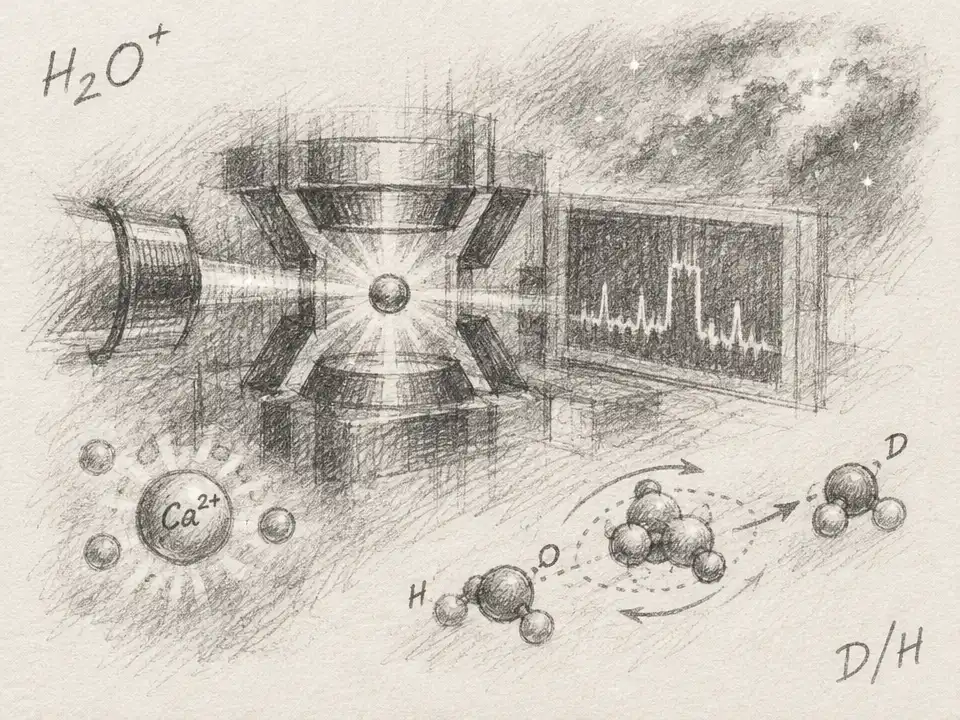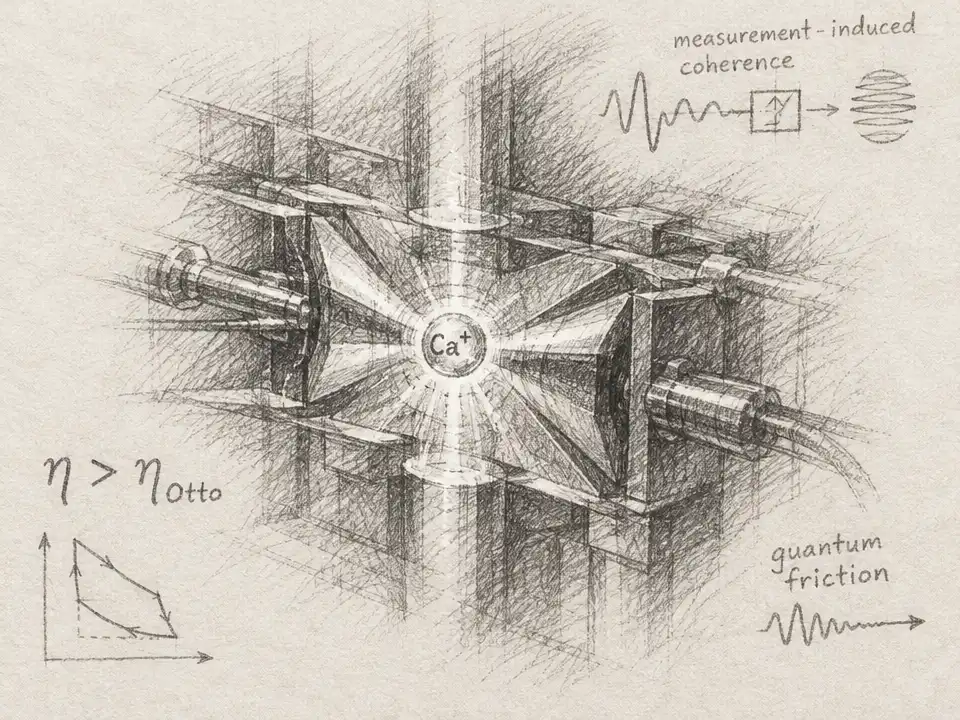
Picture an engine with no piston, no flywheel and no hot tank. Its working part is a single calcium ion held in a trap, and one of its fuel sources is a measurement. In a recent experiment, researchers measured the ion, used the result to choose what happened next, and found a surprising twist: quantum “friction,” usually treated as wasted energy, could help the tiny engine produce work.
The machine’s moving part is the ion’s quantum state. The team encoded two energy levels in a calcium-40 ion with a single positive charge, held in a vacuum trap. A measurement tilted at a chosen angle did more than reveal information. It changed the state, sometimes leaving the ion in a combination of energy levels that also carried quantum coherence—a relationship between those levels that can affect what the system does next.
Then came the feedback. One measurement result sent the ion through a controlled compression-and-expansion sequence: researchers changed its energy spacing with microwave pulses, then brought it back. The other result sent it through a brief interaction with an engineered cold reservoir, implemented with lasers. The measurement took the place of the hot reservoir in a conventional engine cycle, supplying energy through its effect on the ion rather than through ordinary heating.
That setup created a puzzle about speed. To make useful power, an engine must finish a cycle in finite time. But drive a quantum system quickly and it may make transitions between energy levels instead of following the slow, orderly path expected in an ideal cycle. Those transitions are commonly called quantum inner friction because they can impose an energetic penalty. The usual instinct is to suppress them.
Here, the system was not in the passive, thermal state that makes such transitions a straightforward loss. The measurement had prepared an energy-biased, coherent state, and the feedback sequence acted on that state. As the researchers varied the timing of the driven strokes, the resulting transitions could add to the extracted work. Within a finite range of timings, efficiency and the engine’s intrinsic cycle power rose together—the familiar trade-off between doing a cycle quickly and doing it efficiently was softened, not abolished.
The numbers make the result concrete, but their scope matters. Once the repeated protocol settled into a stable operating cycle, the team reported an efficiency of 59.1(1.6)%, close to a theoretical value of 59.9%. They reported that this exceeded the corresponding Otto-cycle benchmark by 18.2%. That is a comparison within the engine model and its chosen energy accounting, not a claim that the apparatus is a practical generator or that it beats thermodynamic limits.
A companion theoretical paper helps explain why the “friction” label can mislead. The measured state’s energy populations and its coherence can interfere with the transitions caused by the drive. In effect, the same kind of rapid transition that costs work for a passive state can release energy from a specially prepared one. The coherent contribution depends not just on how much coherence the measurement creates, but on how that coherence lines up in phase with the driven evolution. More coherence by itself does not guarantee better performance.
That is the possibility: instead of treating every source of irreversibility as a defect to eliminate, engineers might learn when a controlled departure from the ideal path can be useful. The experiment offers a way to investigate that question in a system simple enough to track cycle by cycle. The theoretical work goes further, predicting how coherence can leave a signature in the statistics of work and how correlations between successive measurement outcomes affect the engine’s operation.
But the price tag is not a footnote. A measurement can inject energy into the ion, yet the measurement apparatus and the lasers and microwaves that drive the cycle are physical equipment, not free sources. The experiment includes an energetic ledger for the measurement and for resetting the controller’s outcome record, using a minimum reset cost in its efficiency accounting. That record reset, however, was not performed as a separate physical step.
Nor did a tiny autonomous demon watch the ion and instantly choose its next move. Fluorescence readout heats the ion, so the team first collected measurement statistics, then recooled and reprepared the ion in the appropriate postmeasurement state before applying the selected feedback branch. The demonstrated feedback was implemented at the level of an ensemble of experimental runs. This is a careful test of the engine’s physics, not yet a self-contained machine that measures, decides, resets its memory and delivers useful power in real time.
The companion theory identifies one possible way to make the information bookkeeping more efficient: because one outcome can influence the next, a buffered sequence of outcomes may cost less to erase reversibly than resetting every result as an isolated bit. That is a theoretical accounting of a possible memory strategy, not a demonstrated reduction in the experiment. It also does not make erasure disappear; it shows that the organization of a controller’s memory matters to the bill.
The next frontier is therefore not simply to make the ion’s cycle faster. Researchers would need to bring measurement, feedback and memory reset into a physical loop, account for the energy used by that loop, and connect the engine to a load that can store or use its output. The single-ion result does not promise a new power source for everyday devices. It does reveal a subtler opportunity: at quantum scales, the very disturbances that look like losses may sometimes be shaped into part of the work-producing process—if the control system’s own costs can be brought into the same frame.