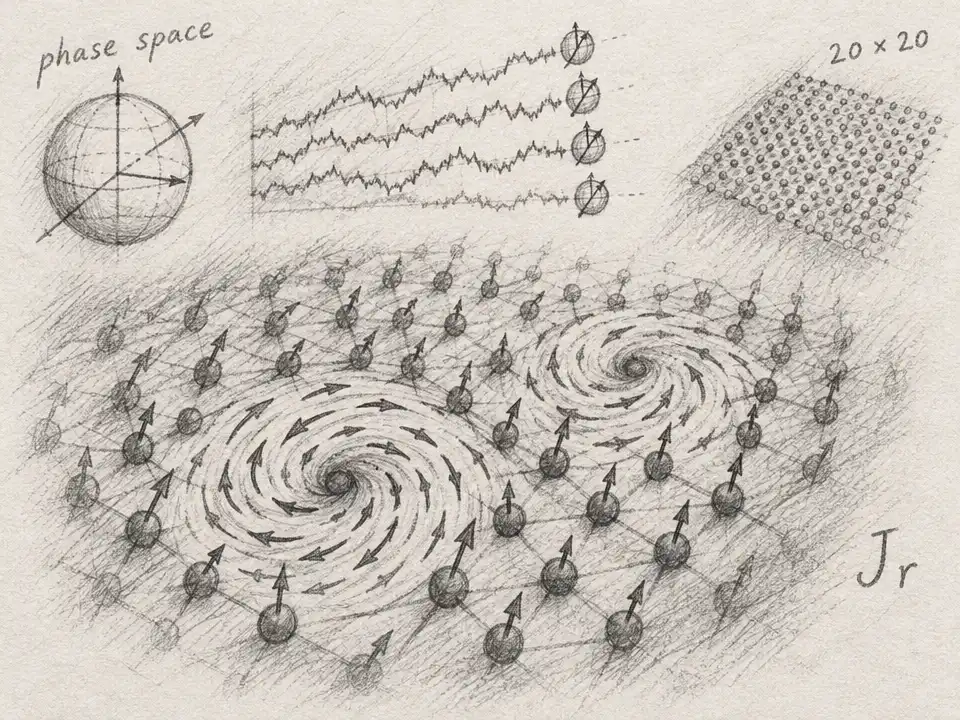
Imagine a square grid of atoms, each one able to sit quietly or jump into a highly excited state. In a computer simulation, a single excited atom begins the story. The question is what happens next: Will activity spread evenly across the grid, or will it find a way to grow that is stranger, slower, and harder to classify?
The answer, according to a recent study of dissipative Rydberg arrays, depends on an interaction that might seem like a minor detail. A weak influence from atoms two steps apart can redirect the whole pattern. The simulated result is a patchwork the researchers call a kinetic slush: some regions keep changing, while others barely move within the time observed.
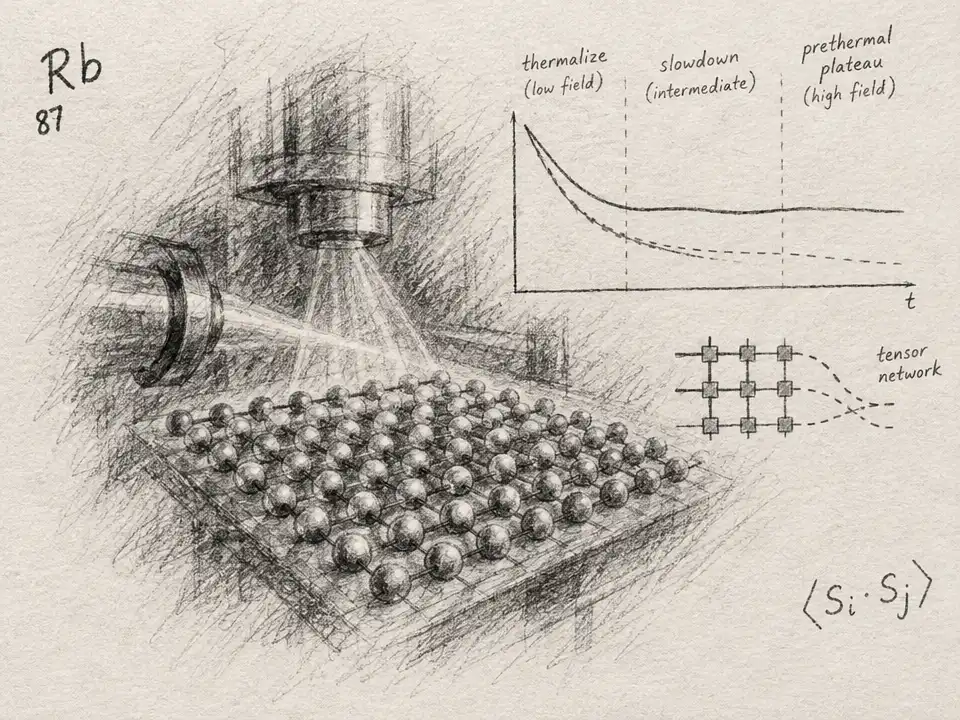
To see why, start with the atoms’ unusual rules. A laser drives them between their quiet ground state and a highly excited Rydberg state. Rydberg atoms interact strongly, so one atom’s excitation changes the energy landscape for its neighbors. The researchers tune the laser to compensate for the interaction between nearest neighbors. Under that setting, an atom is much more likely to change state when exactly one nearest neighbor is already excited. That “one neighbor unlocks the next” rule is called facilitation.
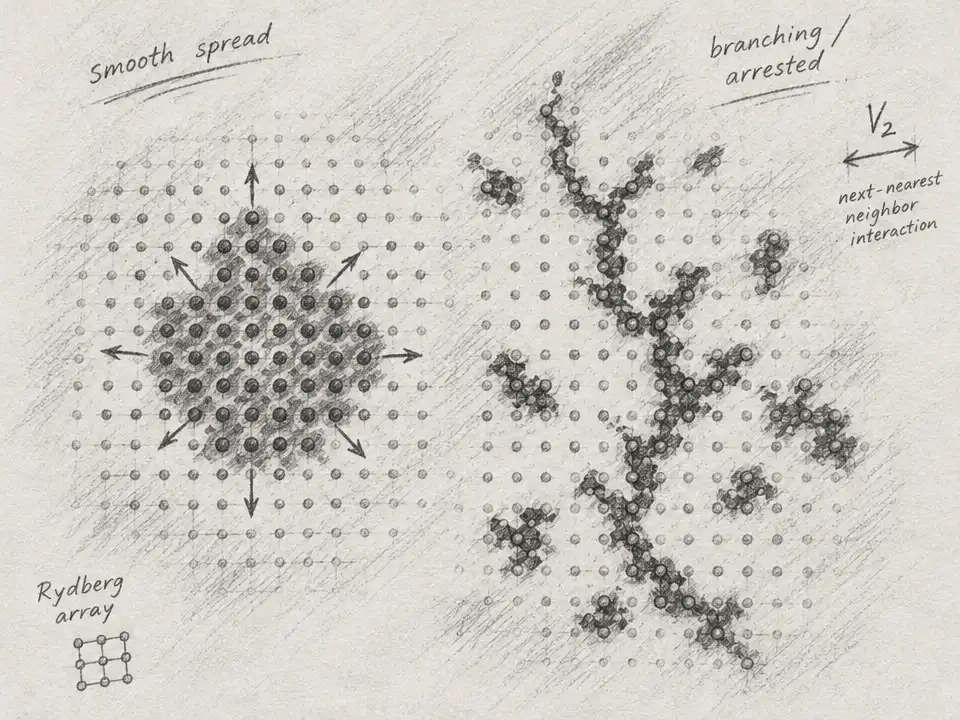
In an idealized version of the grid, facilitation could make a seed spread outward, branching as it goes. But real interactions do not stop neatly at the nearest neighbor. The study includes the weaker influence of next-nearest neighbors too. On a square grid, their interaction is one-eighth as strong as the nearest-neighbor interaction. It is weak, but it shifts the energy balance enough to slow some state changes.
That creates the puzzle. Why should a small extra interaction make growth less like a spreading wave and more like a network of stubborn branches? The team explored the question with kinetic Monte Carlo simulations, a method that models random state changes using rates calculated for each atomic arrangement. They focused on a strong-dephasing regime, where environmental noise has weakened quantum coherence. This is a study of a model’s dynamics—not a report of an experiment that has already watched the slush form.
First, consider the two extremes. With no kinetic frustration from next-nearest neighbors, the initial excitation spreads rapidly and fills the grid. At the other extreme, when that frustration becomes infinitely strong in the model, sideways branching is blocked. The growth is then effectively one-dimensional: a chain can extend and retract, but it cannot fan out into a two-dimensional network.
Between those limits lies the more surprising case. When the frustration parameter is 100, the seed first grows mainly along narrow, straight paths. In the early-time range, the simulated excitation density grows with an effective exponent of 0.48. Later, rare sideways branches begin to appear; the growth speeds up, with an effective exponent of 1.36 over the interval fitted in the study. The pattern does not simply choose between spreading freely and stopping. It gets caught between those possibilities.
Wait longer, and those occasional branches matter. They build a ramified network that eventually spans the simulated grid. In the finite-frustration case, the long-time density reaches one-half. In the strict one-dimensional limit, by contrast, the maximum number of excitations remains bounded by the chain length. For a grid length of 64, the study gives a steady-state density of 1/128 in that limit. The contrast shows how a change in a local rule can reshape the large-scale outcome.
But a snapshot alone can be misleading. A branching pattern might look frozen simply because it is changing slowly. To test that possibility, the researchers counted how often each site flipped during a chosen observation window. At a frustration strength of 100, 61.02% of sites had no recorded flips during the window; with no frustration, that share was only 3.47%. At the same time, other sites remained active, flipping repeatedly.
That combination is the defining clue: quiet, solid-like regions threaded through liquid-like active ones. “Solid-like” does not mean those atoms have become permanently locked, and “liquid-like” does not mean the array is a literal fluid. These labels describe activity over a finite window. The simulated system still relaxes, but unevenly: some locations linger while others continue to churn.
The branching geometry offers another clue. At strong but finite frustration, the simulated clusters have a measured fractal dimension of 1.808 ± 0.005. Their spatial correlations extend across the system-sized grids the researchers studied. For grid lengths of 160, 192, 224, and 256, the correlation length scales approximately with the system size over the range analyzed. That pattern supports the idea that the model is near criticality, where changes can be linked across long distances.
There is an important limit to that conclusion. The paper describes these as patterns produced by nonequilibrium dynamics; the configurations do not, by themselves, establish a distinct thermodynamic phase or prove that the model sits at a critical point. The finite-size analysis supports proximity to criticality for the system sizes studied. And because the work uses simulations, the slush remains a prediction to test in programmable arrays of atoms held in optical tweezers.
The broader puzzle is how much complexity can hide inside a simple rule. One excited neighbor encourages change; a weaker, more distant interaction makes branching harder. Together, they produce a grid that is neither freely flowing nor fully frozen. The study’s answer is not that dissipation destroys structure. In this model, even when coherence is strongly suppressed, constraints on which changes can happen—and how quickly—can still organize matter into a restless, uneven landscape.