Quantum noise sounds like a blur: a system loses energy, forgets some of its past, and gets tangled with an environment too large to track. But what if the blur has a structure? A new mathematical framework turns open quantum dynamics into a pair of graphs, where links encode interactions and the pattern of connections helps explain how a quantum system changes.
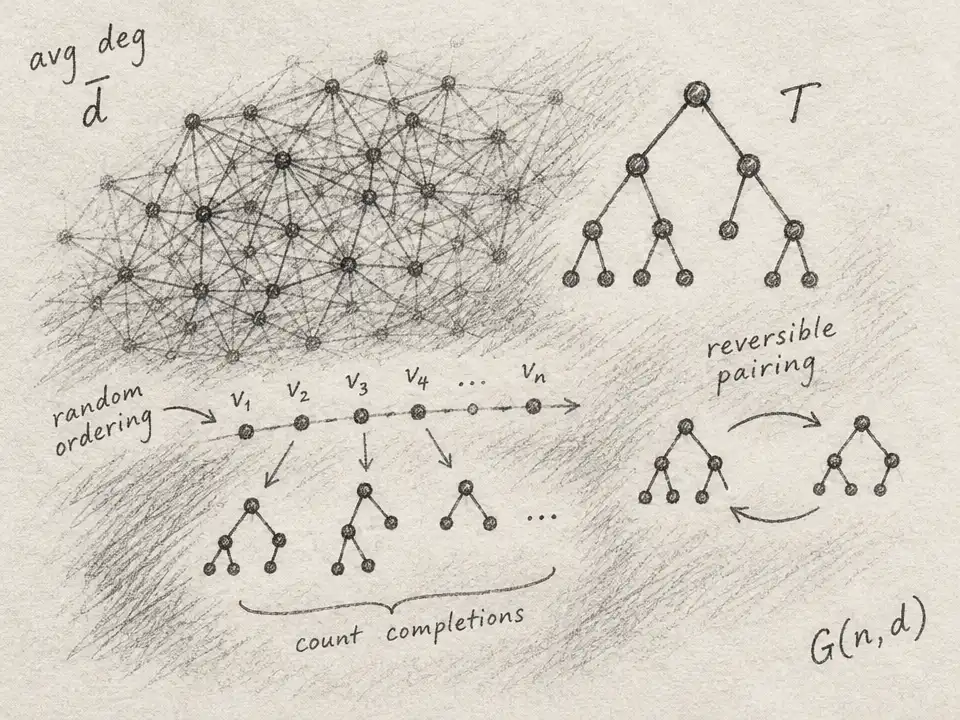
The bridge is an idea from graph theory: represent a complicated system as points and links. A graph can make a sprawling network easier to inspect by showing which connections are important, which parts cluster together, and where a few links carry much of the traffic. Kyuho Kim and colleagues apply that style of thinking to a different kind of complexity: the combined evolution of a quantum system and its surroundings.
In an isolated quantum system, a Hamiltonian describes how the system evolves. An open system also exchanges energy and information with its environment. Mathematically, that extra influence is represented by a quantum master equation. Its operator space grows rapidly with the system’s size, making the dynamics difficult to read as a whole. The researchers’ framework translates the problem into two graphs: one for the system’s coherent evolution, and another for the non-unitary effects associated with dissipation.
These are not ordinary maps of physical space. Their edges carry weighted, sometimes complex-valued connections, including phase information; each vertex also has a potential that contributes to the graph’s structure. The authors call them magnetic graphs, a mathematical term for graphs with phase factors on their edges—not a claim that a magnetic field is causing the effects. Operators associated with the quantum system are carried along the links. Averaging the relevant graph features gives a representation mathematically equivalent to the Markovian quantum dynamics.
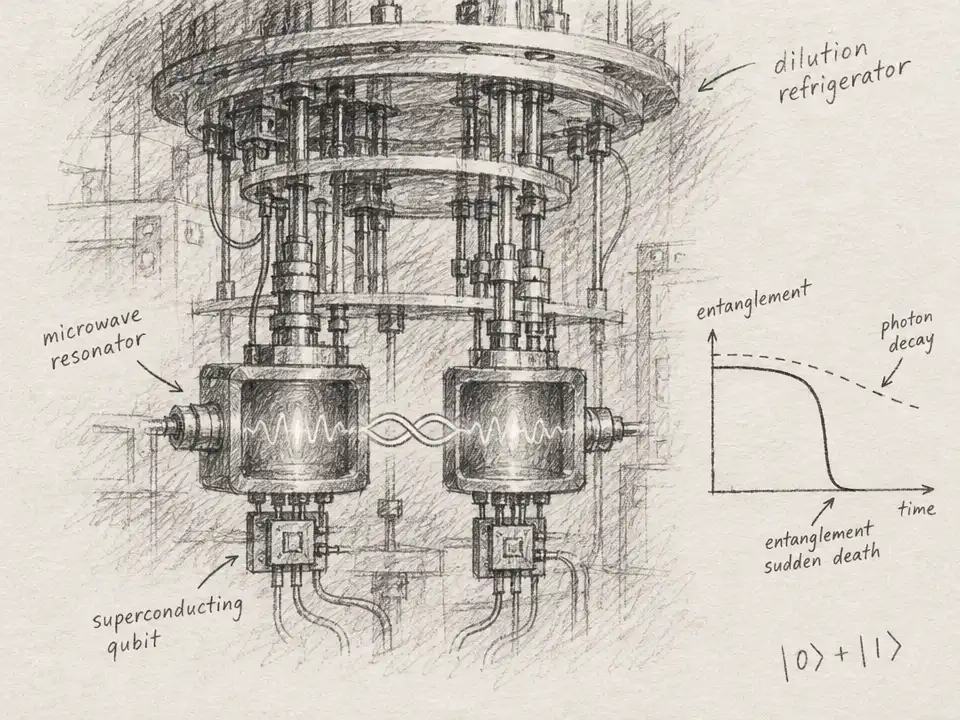
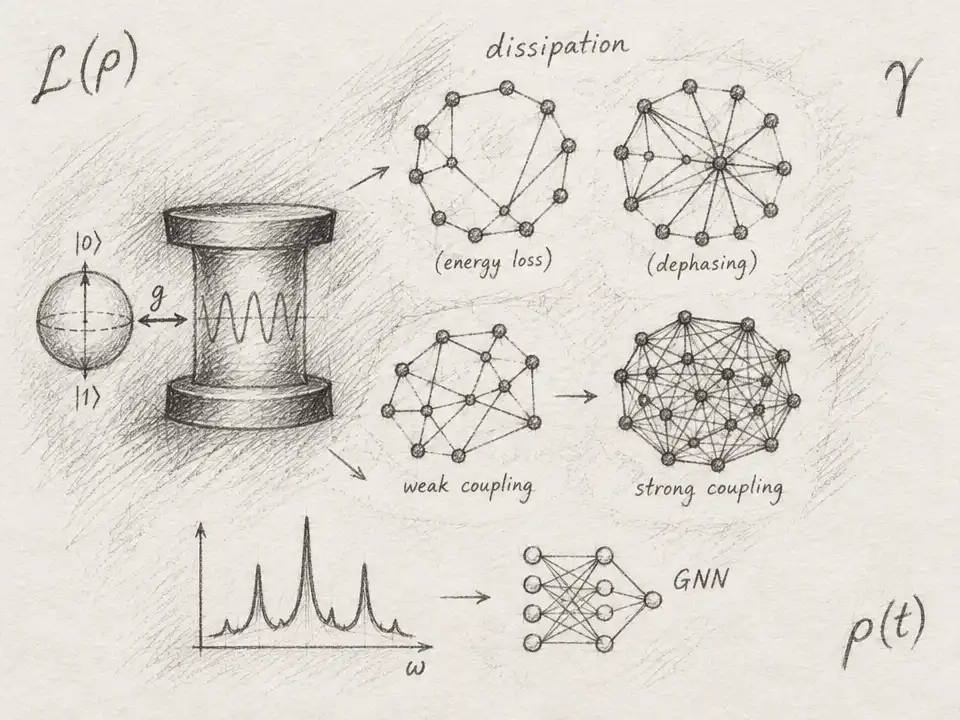
That exact connection matters. A graph picture can be an attractive illustration without preserving the behavior of the system it depicts. Here, the graph construction is designed to retain the dynamics, while making their organization available to the tools of network mathematics. The authors demonstrate it with an open quantum Rabi model: a qubit coupled to a single mode of light in a cavity, with the model subject to energy loss and dephasing.
In the weak-coupling regime, the different kinds of dissipation leave different network signatures. Cavity relaxation produces the densest of the individual dissipation graphs and is the strongest contributor to the overall spectral pattern in the example. Qubit relaxation produces a sparser graph. Dephasing is sparser still, with a hub-like pattern in which a few vertices collect many connections. That graph structure corresponds to a distinctive distribution of decay rates.
As the light–matter coupling grows toward the ultrastrong regime, the network changes. The researchers find that graph connectivity increases, hub-like vertices emerge, and the spectrum of the system’s evolution becomes more continuous. Dephasing also gains influence: stronger coupling mixes the system’s states in a way that allows dephasing to contribute to transitions between energy levels. A quantity from spectral graph theory—the Fiedler value, which measures a form of global connectivity—rises with coupling in their calculations.
The next step turns the graph from a description into a way of simplifying the calculation. The researchers remove weak edges, then adjust vertex potentials to compensate for the lost connections and preserve a physically valid graph representation. At a pruning threshold of 0.6, the spectrum retains its characteristic overall shape and much of its interior structure. The pruned graph also preserves the spectrum better than directly pruning entries in the matrix representation, according to the distance measure used in the study.
Why might removing information help? The graph was also used as input to a graph convolutional network, a machine-learning model that learns patterns by passing information between connected vertices. In tests on 1,000 randomly generated open quantum Rabi models, the researchers found that the network predicted the systems’ spectra more accurately with pruning than with the unpruned graphs. Performance was best at a pruning threshold of 0.75 in the tested settings. The authors suggest that numerous weak links can act as noise for the learner, while the strongest connections and vertex potentials preserve much of the structure it needs.
That does not mean that less information is always better. Pruning too aggressively eventually removes useful connections and degrades performance. Nor does the study show that a graph neural network can replace quantum calculations in general: the demonstration uses a particular model and numerically generated examples. The researchers describe broader applications, including learning about other open quantum systems, as directions to explore—not results already established.
The crossover is the useful surprise: a tool for understanding network structure can help organize a problem in quantum physics, where “connections” are mathematical relationships among states and operators rather than wires between computers. The graph does more than make dissipation easier to picture. It offers a way to ask which links shape the dynamics, which can be discarded without losing the main pattern, and whether those patterns can help predict a system’s behavior.