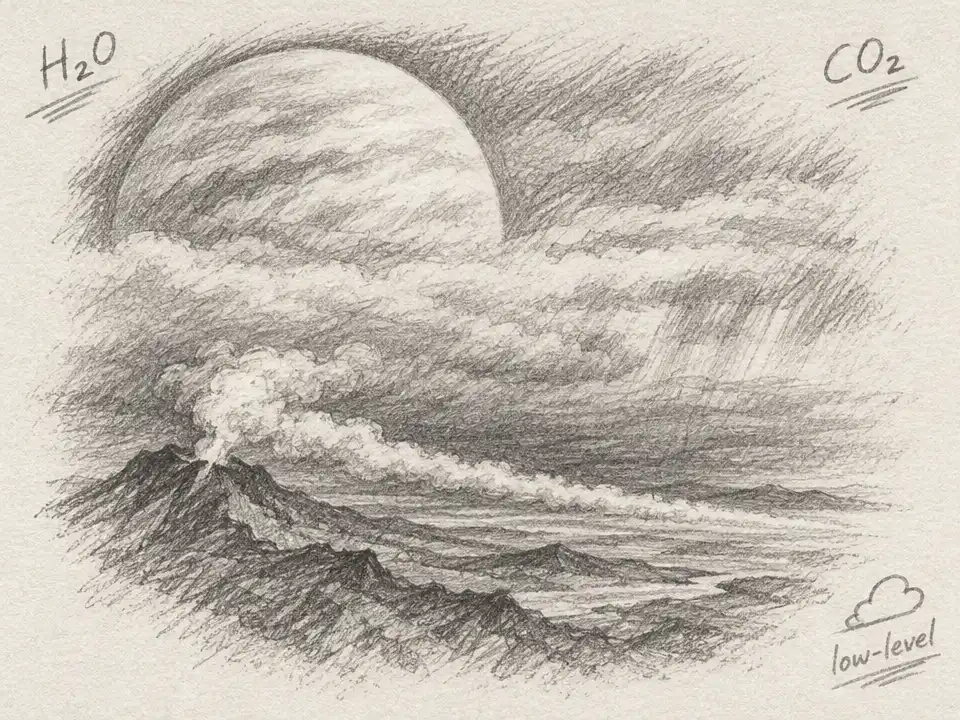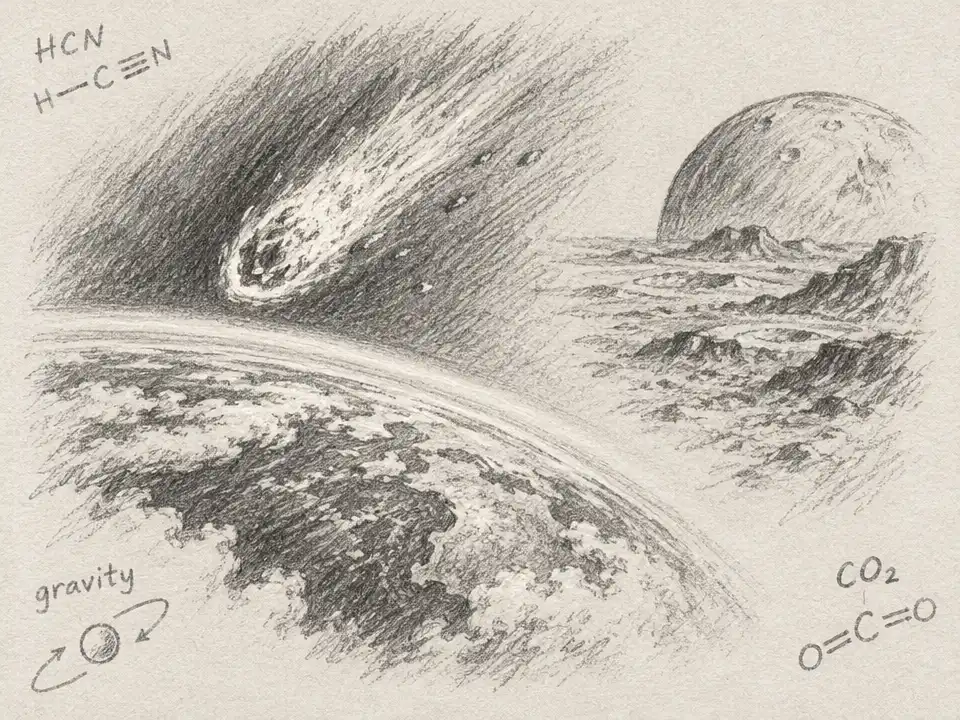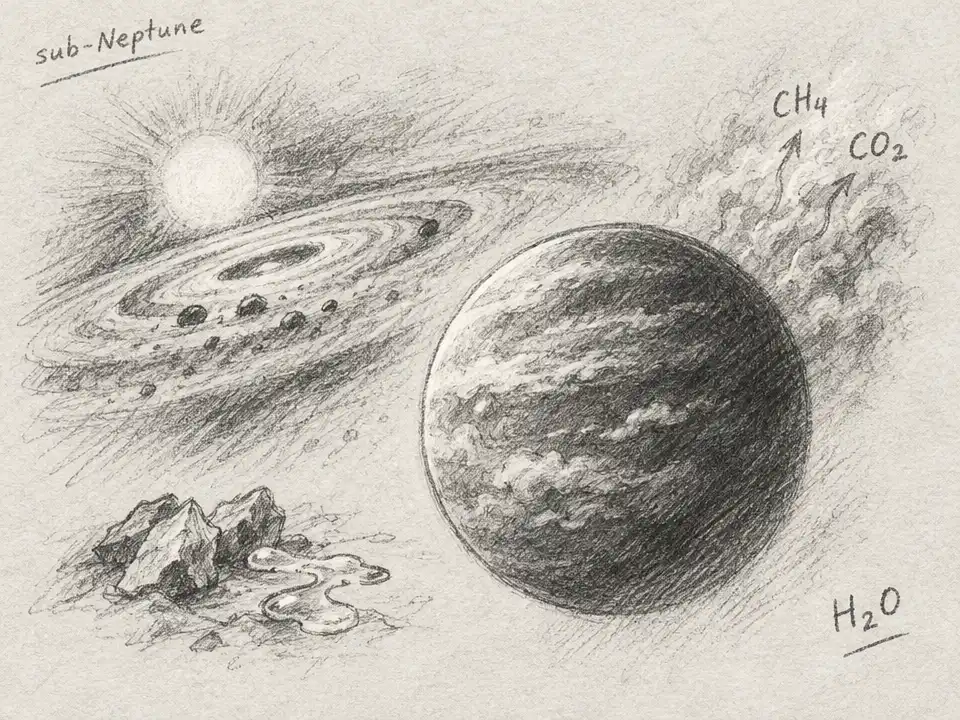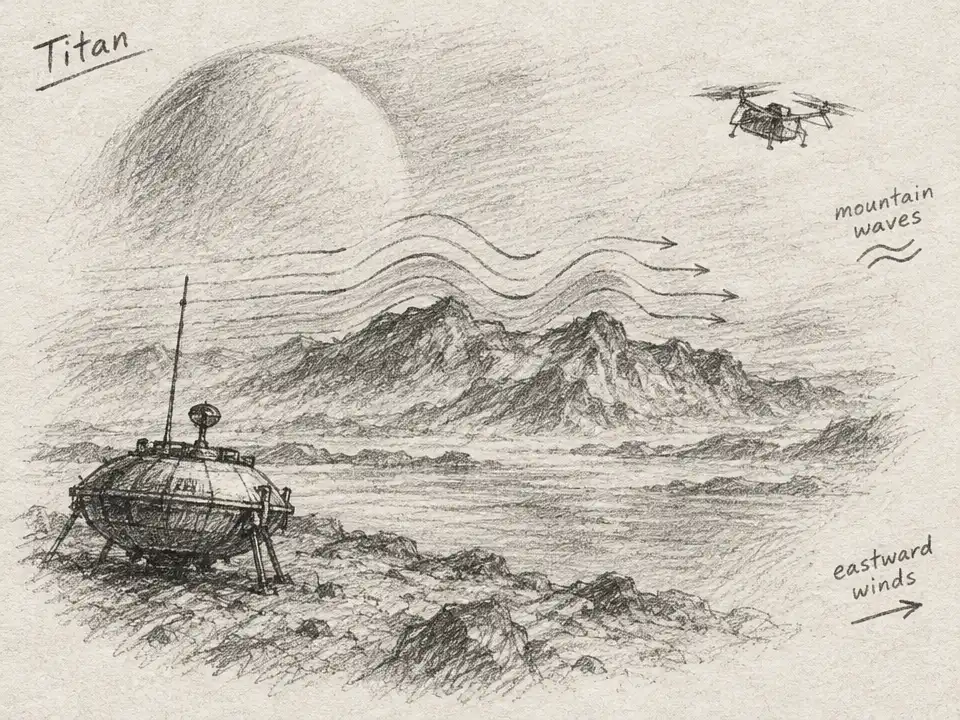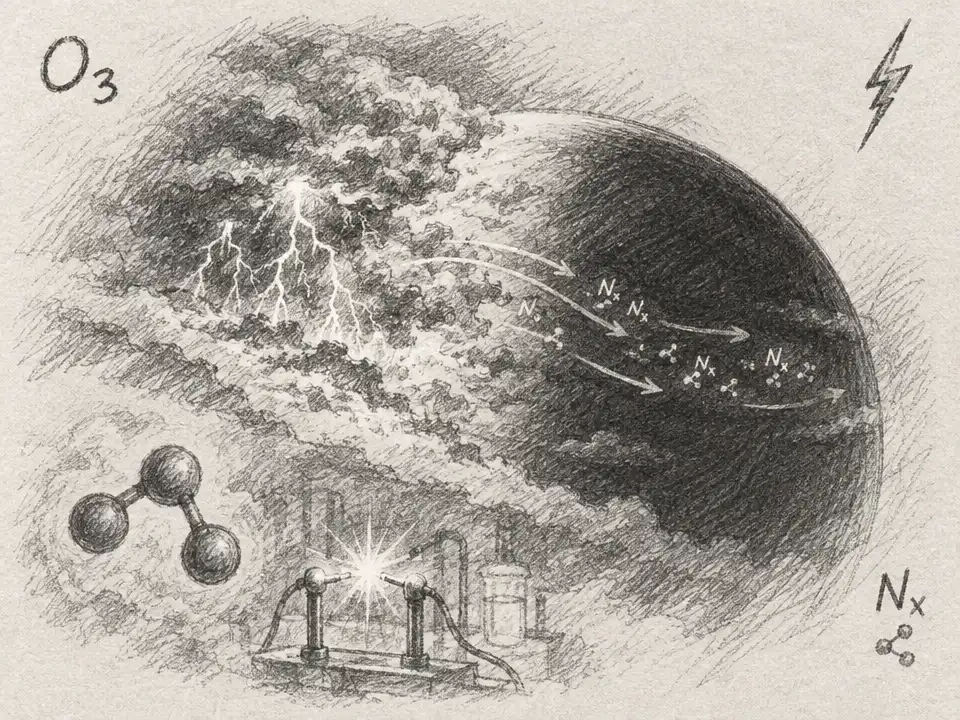
A distant planet crosses its star, dimming the starlight by a fraction. In that faint change, astronomers hope to find gases that might betray life. Ozone is one such clue: on Earth, living things replenish the oxygen that helps produce it. But a planet’s atmosphere is not a label saying “alive” or “dead.” It is a working chemical system—and lightning can alter the evidence.
The puzzle is not simply whether ozone is present. The same gas can arise through nonbiological chemistry, and its abundance can change when other molecules react with it. To explore how storms might complicate the search, Patrick Barth and colleagues paired laboratory spark experiments with computer models of planetary atmospheres. Their results offer a double twist: lightning may hide a life-related signal, or help erase one that could mislead observers.
First came the sparks. The researchers filled a 1 L glass flask with mixtures of nitrogen, carbon dioxide and hydrogen, with water at the bottom, then discharged electrical sparks through the gas. They varied the mixture and measured products in both the air and the water. The flask was a controlled stand-in for possible rocky-planet atmospheres, not a miniature planet; the point was to measure what the energetic discharge could make before asking what those chemicals might do on a world.
One result puts a limit on a familiar idea. Lightning did not readily manufacture methane or ammonia at levels that would imitate those gases as signs of life in the modeled settings. Nitrous oxide, another possible biosignature, also seemed unlikely to be produced in misleading amounts. Instead, sparks tended to make more oxidized nitrogen compounds—especially nitric oxide. In other words, a bolt is not a general-purpose life-making machine. Its chemical output depends on the atmosphere it strikes.
The team used measured production rates to feed photochemical models: simulations that track how gases form, react and break apart under starlight. They considered planets with oxygen-rich or oxygen-poor atmospheres orbiting either the Sun or the red dwarf TRAPPIST-1. They also varied the assumed rate of lightning, because no one knows how often storms flash on those distant worlds.
In one modeled case, the atmosphere contains oxygen and a biosphere. There, lightning at a rate only somewhat above modern Earth’s can add enough reactive nitrogen chemistry to weaken ozone’s detectable spectral feature. The world could still be inhabited, yet its atmosphere would show a less obvious version of a clue observers might seek. That is a potential false negative: life is present, but a process unrelated to life makes its sign harder to see.
Now reverse the problem. In an oxygen-poor, lifeless atmosphere around TRAPPIST-1, stellar radiation can help create ozone without biology. In the researchers’ simulations, lightning at roughly ten times Earth’s modern flash rate could help remove that ozone feature, reducing one possible false alarm. But the threshold depends on the planet and its star; lightning does not reliably erase every nonbiological oxygen or ozone signal. The same weather process can therefore obscure a real clue in one scenario and diminish a misleading clue in another.
A separate study by Marrick Braam and colleagues adds a crucial complication: storms do not have to blanket a planet evenly. Their three-dimensional climate-and-chemistry simulation examined an Earth-like version of Proxima Centauri b, a world modeled as tidally locked, with one side facing its star. Convection and high clouds concentrated the predicted lightning in a crescent-shaped region near the permanently lit side. The simulated peak rate—about 0.16 flashes per km2 per year—was near the lower end of rates measured over island-free parts of Earth’s oceans.
In that model, lightning-made nitrogen oxides mostly accumulated below about 20 km, while the ozone layer sat higher, between roughly 20 and 50 km. Winds then carried some nitrogen compounds toward the dark side, where the absence of starlight changed which chemical reactions could proceed. Ozone’s distribution depended mainly on the star’s ultraviolet light and reactions involving hydrogen-containing molecules, rather than on lightning alone. When the researchers simulated what a transit telescope might see, the lightning-related gases were not abundant enough to leave a detectable signal in the spectrum.
These studies do not report lightning detected on an exoplanet. They are models built from lab measurements or from assumptions about clouds, circulation, stellar radiation and atmospheric composition. Those choices matter: the studies examine different planets and use different approaches, so their results are not a single forecast for all alien skies. Their shared lesson is more useful than a universal answer: a gas cannot be interpreted in isolation from the chemistry and weather that shape it.
For future observers, that turns the hunt for life into a kind of planetary investigation. A faint ozone feature might be biological, a product of nonbiological chemistry, or a signal modified by storms. Other gases, the star’s ultraviolet output and the atmosphere’s broader composition can help distinguish those possibilities. The most telling clue may not be one molecule in a spectrum, but the pattern made by several interacting processes. On another world, even the weather can change what life looks like from light-years away.