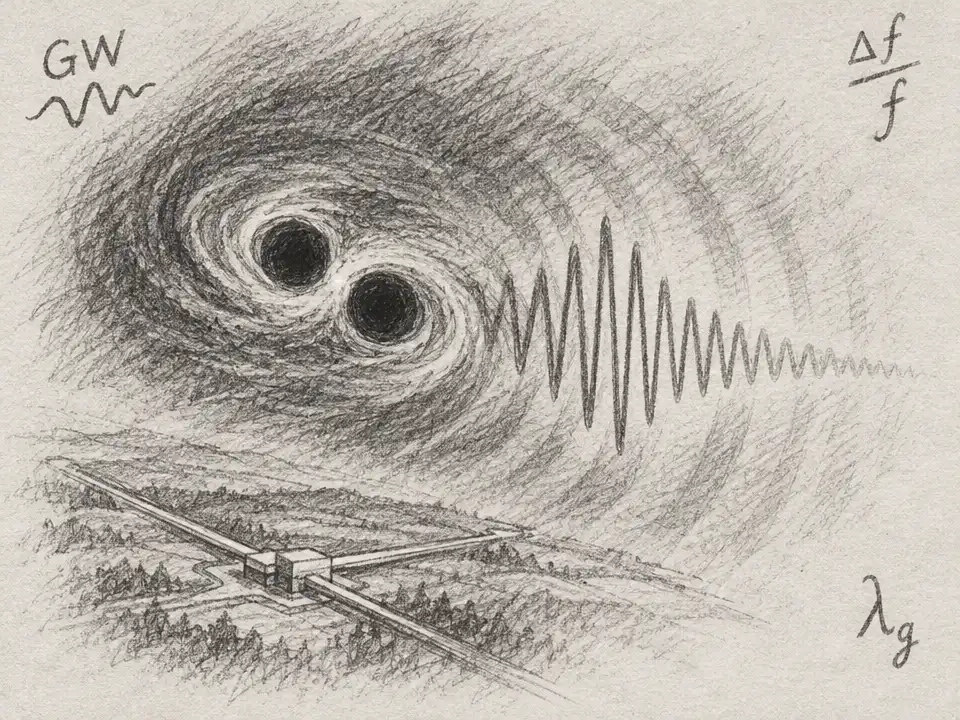
When two black holes spiral together and merge, they send ripples through spacetime. A detector records those ripples as a faint signal whose changing pitch and timing can reveal how gravity behaves under extreme conditions. But if gravity differs only slightly from Einstein’s prediction, the clue may be buried in the signal’s ordinary shape—and in the detector’s noise.
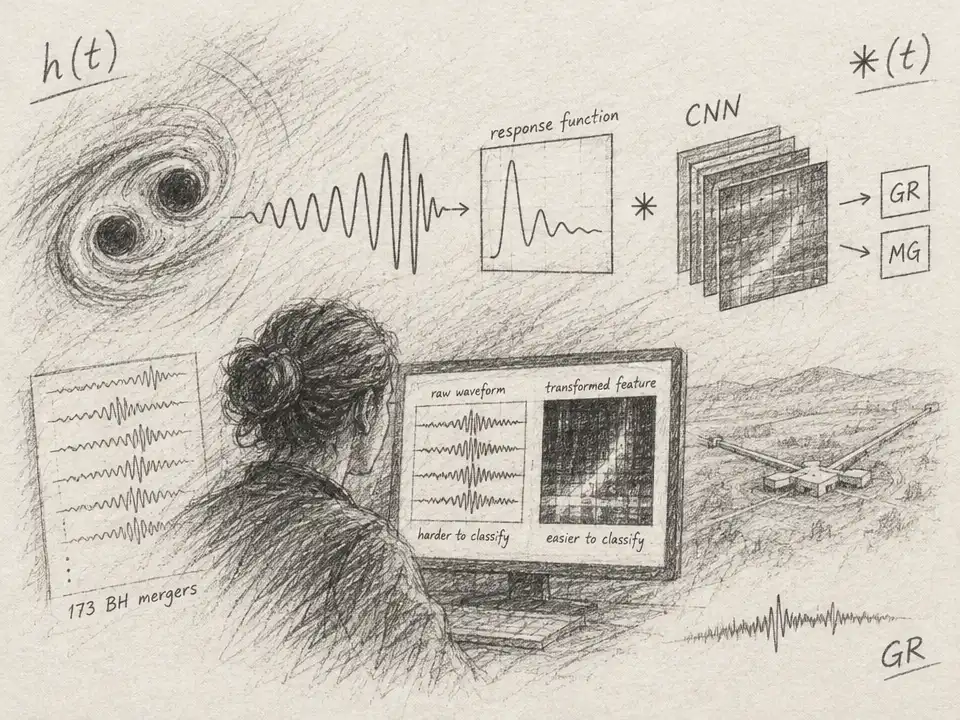
A research team has tried changing the question. Instead of asking a neural network to spot a tiny alteration in the whole gravitational-wave signal, the researchers first transform the signal into a new kind of clue: a response function, designed to highlight how a mismatch with Einstein’s theory varies across frequencies. The approach brings ideas from analyzing how systems respond to changes together with machine learning’s knack for recognizing patterns.
The motivation is straightforward. A gravitational wave predicted by general relativity has a rich, sweeping pattern of its own. A small departure from that prediction is like a faint extra note played under a full orchestra. Give a classifier the entire recording, and it must pick out that note while also learning the orchestra, accounting for noise, and handling differences between black-hole pairs.
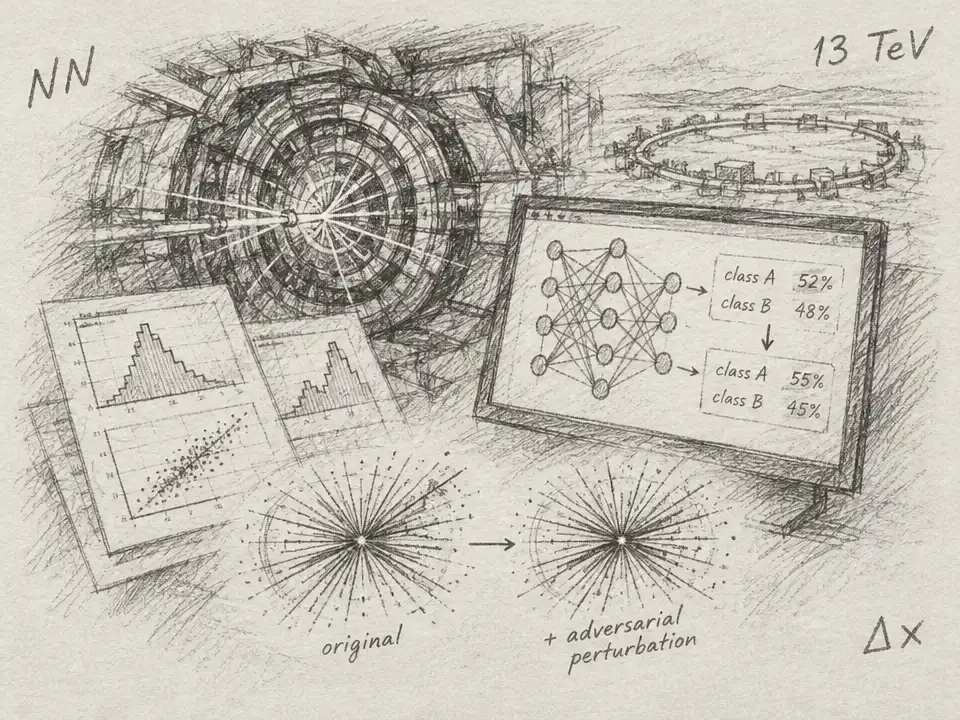
The researchers instead ask how a standard general-relativity template fails to match a signal. Their response function reorganizes information about that mismatch, reducing the dominant predicted signal and emphasizing frequencies where a possible phase change matters. In the simulations, a signal consistent with general relativity produced response patterns that looked noise-like. A modified signal carried an additional, more coherent pattern. The neural network could search for that structure rather than for a tiny change hidden in the full waveform.
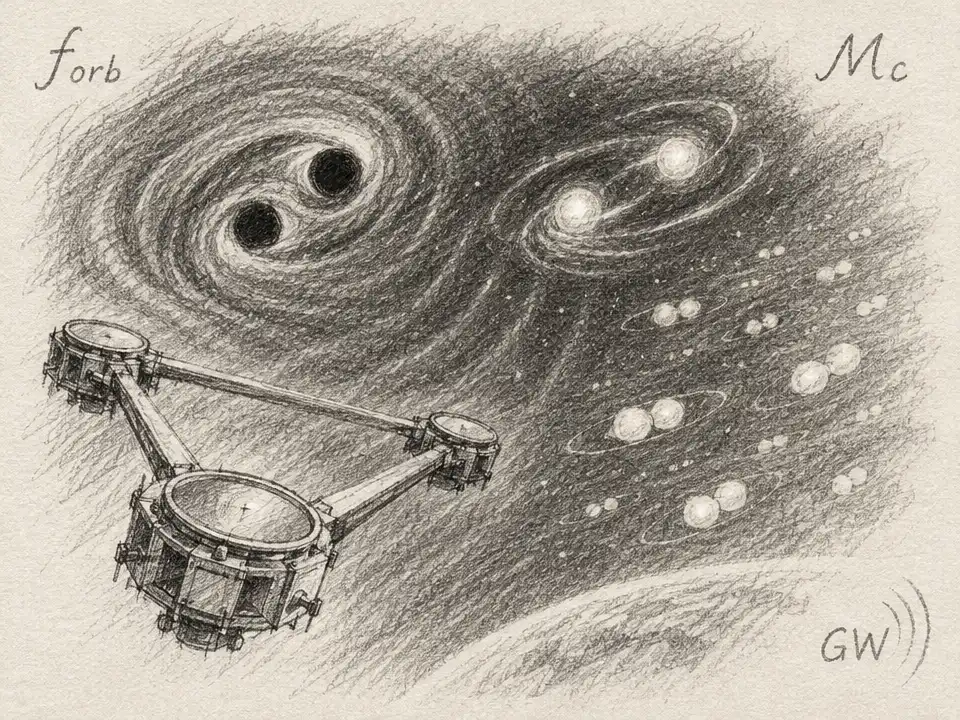
To test the idea, the team built simulated signals using the masses, spins, and distances of 173 black-hole merger events catalogued by gravitational-wave observatories. They generated both general-relativity waveforms and altered versions, then added synthetic noise based on Advanced LIGO’s design sensitivity. The altered signals included a deliberately simple test: a change in the waveform’s phase, concentrated near 50 Hz, with a width of 10 Hz. It was a benchmark, not a claim that any particular theory predicts that exact pattern.
The team also took care not to let the network recognize familiar examples instead of learning a general difference. They separated the original merger events into training, validation, and test groups, keeping every variation of an event in the same group. That way, the final test included events the network had not seen during training.
The contrast between the two ways of presenting the data was striking. With the raw, whitened waveforms, the classifier needed a strong injected alteration to reach 95% accuracy. With the response function, it reached that level when the alteration was much weaker: the paper reports a sensitivity improvement of approximately 33 times for this benchmark. At a deformation strength labeled beta equals 0.3 in the study, classification using the response function reached 85.6% accuracy; the raw-waveform classifier was near chance, at 50.1%.
Why did the change in representation matter so much? The response function does more than subtract an expected signal. Its frequency-dependent weighting gives greater emphasis to parts of the data where the signal carries useful information. In the test case, a faint deviation became a pattern spread across frequency bins, rather than a minor change sitting on top of the entire general-relativity waveform. The network could use that broader pattern to make its call.
The researchers then moved beyond the deliberately simple deformation and tested a model of massive gravity, in which gravitational waves would travel differently depending on their frequency. In their simulated analysis, using Advanced LIGO’s design sensitivity, the classifier reached 95% accuracy at a graviton mass of about 2 × 10⁻²³ eV/c2. That number describes the method’s performance on modeled signals. It is not a measurement of the graviton’s mass or evidence that gravity departs from Einstein’s theory.
That distinction is essential. The study did not analyze real detector strain data. It added stationary Gaussian noise, while actual detectors can also produce glitches and other non-Gaussian, time-varying disturbances. And a network trained to distinguish two labeled possibilities is not, by itself, a verdict about which theory nature follows. The authors present the method as a complement to established statistical tests, not a replacement.
The broader lesson reaches beyond this particular gravity test: sometimes a hard-to-find signal becomes easier to recognize when scientists change how they represent the evidence. The next challenge is to see whether this response-function lens remains useful on real observations, where detector quirks and unexpected sources complicate the picture. If it does, a tool borrowed from thinking about how systems respond to change could help physicists sift the quietest clues from black-hole collisions—and put Einstein’s predictions under a sharper test.