Imagine trying to tell which way thousands of tiny magnets point—not by looking at the magnets, but by studying a faint, blurred map of the magnetic field above them. That was the puzzle facing a team investigating artificial spin ice, a carefully patterned array of nanoscale magnets. Their solution brought together two very different toolkits: artificial intelligence and the physics of frustrated magnetism. The key was not asking AI to guess freely. It was giving the reconstruction rules drawn from how the magnets behave.
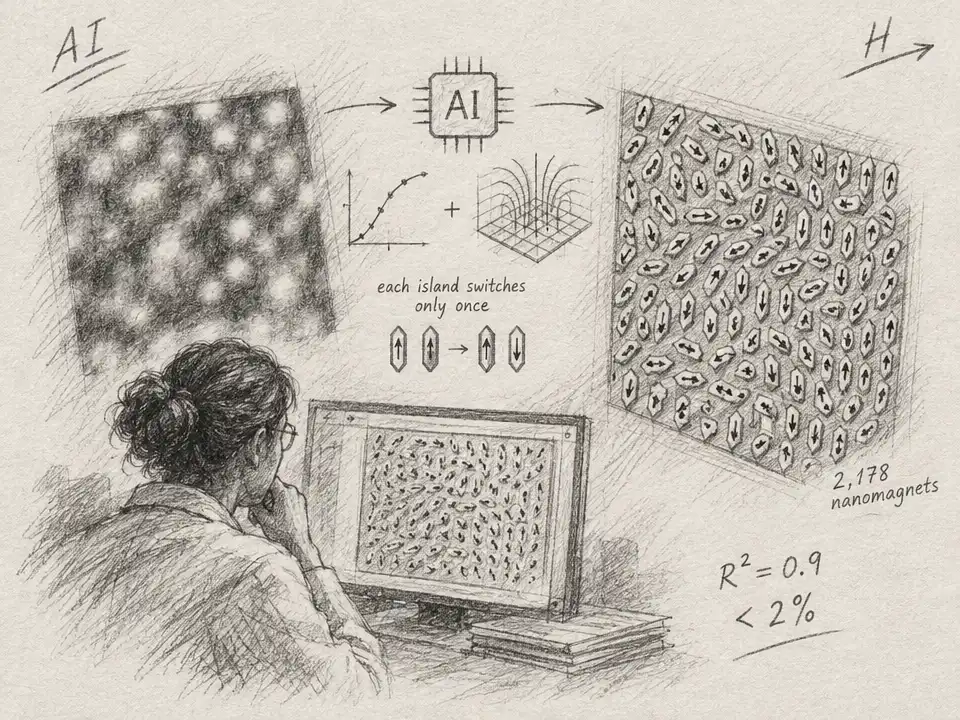
The array contained 2,178 small magnetic islands, each about 470 nm by 180 nm. Every island acts roughly like a miniature compass needle with two preferred directions, a kind of physical “spin.” The islands’ arrangement makes their magnetic interactions compete: geometric frustration prevents them all from settling into the simplest shared order. By changing an applied magnetic field, researchers can drive the array through a reversal and study how its individual magnets switch.
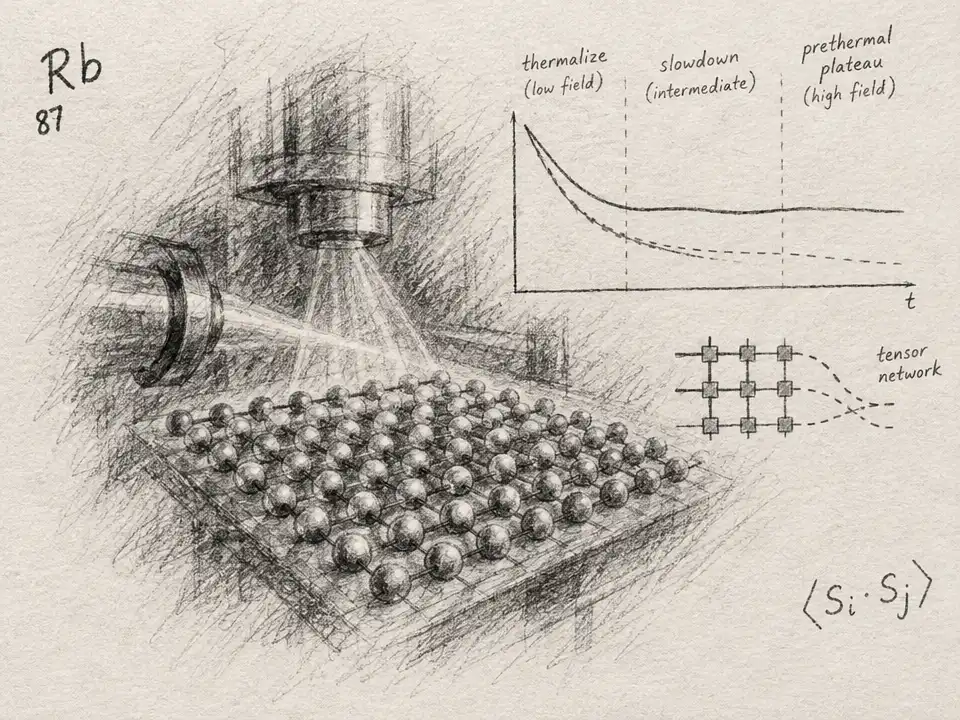
But the camera did not deliver a crisp picture of each island. The team used a microscope based on nitrogen-vacancy, or NV, centers in diamond—atomic-scale defects that can sense magnetic fields. It measured only one projection of the field, from a sensor positioned about 700 nm above the array. With a pixel pitch of 500 nm, the measurements blurred away the fine field patterns that distinguish neighboring magnets. The paper estimates those details were suppressed by a factor of about 10,000 to 100,000.
This is an inverse problem: start with an effect you can measure and infer the hidden arrangement that produced it. Many different arrangements can create similar blurred signals, so a good fit to the image alone is not proof that the answer is right. In early attempts, convolutional neural networks reconstructed synthetic data well. But their proposed maps contained roughly 100,000 unconstrained values per frame. For this ill-posed problem, the researchers could not justify those many free guesses as a trustworthy account of the actual magnets.
The better route was to build a model of how the array should produce a sensor reading, then work backward from measured readings. Researchers and AI agents developed that model over roughly a dozen separate campaigns and interactive sessions spanning two months. It accounted for details that might otherwise masquerade as magnet behavior: the distance between sensor and sample, the microscope’s point-spread function, the sensor’s orientation, slight rotation of the array between images, and field gradients from the applied magnet. It also modeled how the islands’ moments cant as the field changes, with the agents checking that part against micromagnetic simulations.
The decisive insight came from combining information across the whole reversal sequence rather than treating each image as a separate puzzle. As the applied field increased, each island could switch its direction no more than once. That physical constraint ruled out flickering, inconsistent answers that might fit a single blurry frame but made no sense across the sequence. The joint fit used the array’s known geometry and this one-way switching behavior to narrow the possibilities.
There is an important wrinkle in the story: the joint-fit idea was not invented from scratch by the AI. The research team had proposed it more than a year earlier but had not been able to implement it because of computational limits. During the later project, agents independently suggested the approach, and the humans and agents worked together to turn it into a functioning reconstruction pipeline. The achievement was therefore not a machine solving magnetism alone; it was a collaboration that connected a physical insight to a difficult computational search.
The final fit matched the measured magnetic-field data with an R-squared of 0.9 and reduced the rate of misattributed Ising states to under 2%. From the measurements, the researchers estimated a per-island switching uncertainty of 0.5 mT. In one image taken at 17.2 mT, early in the reversal, 6% of the array had switched. Instead of a blurry field map, the team could now infer which individual islands had turned.
That matters because the appeal of artificial spin ice lies in its collective behavior. Researchers use these engineered arrays to investigate frustrated magnets and phenomena that emerge from many interacting spins. If imaging reveals only the broad magnetic field, crucial local arrangements remain hidden. Recovering the state of each island offers a way to inspect how the system evolves as it is pushed from one configuration toward another.
The result also illustrates a wider lesson about AI in experimental science. A flexible pattern-finder may generate plausible answers, but when the measurements discard detail, plausibility is not enough. Here, physical laws and experimental geometry served as guardrails: they restricted the search to explanations that could make sense for this particular magnet array. Human researchers still had to decide which effects mattered, check the model, and interpret the result. The authors describe the reconstruction as the first of its kind from diffraction-limited magnetic imaging, to their knowledge, while noting that a fuller treatment was planned for a separate manuscript. The blur did not disappear. Instead, physics helped turn it into evidence.