Electrons repel. So when they gather into the paired state called superconductivity, physicists usually look for some kind of glue: an interaction that draws two electrons together despite their electric charge pushing them apart. But in a new theoretical study, the starting ingredient is repulsion—and the surprise is that, under the right conditions, the electrons’ collective behavior can make that repulsion help create its own opposite.
The puzzle is not just how a pair forms. The same model produces several competing kinds of order: chiral superconductivity, a crystal with a quantized Hall response, and fractional Chern insulators, in which electrons organize into a topological state. Why should one repulsive system allow such different outcomes? And can a single mechanism help explain the connections among them?
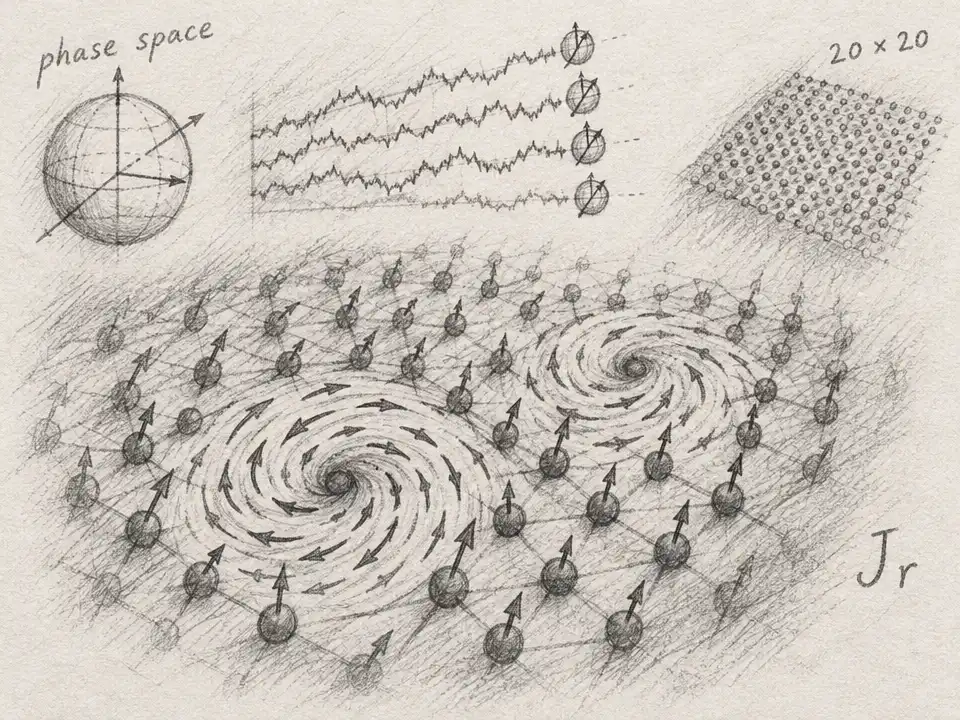
Fabian Pichler, Clemens Kuhlenkamp, Ashvin Vishwanath, and Michael Knap investigate those questions in a theoretical model inspired by topological bands studied in moiré materials. Their simulated system contains spin-polarized, effectively spinless electrons moving on a checkerboard lattice. Electrons on neighboring sites repel one another. Complex hopping gives the energy bands a property called Chern topology, while a tunable staggered potential changes the band’s dispersion and the number of available states at different energies.
That last control matters. Near a van Hove singularity, many possible electron states crowd into a narrow energy range. The authors first ask what happens in the more metallic part of the model, where electrons can still be described as moving through a band. Their first clue comes from a calculation that tracks how the other electrons respond when one electron disturbs the system.
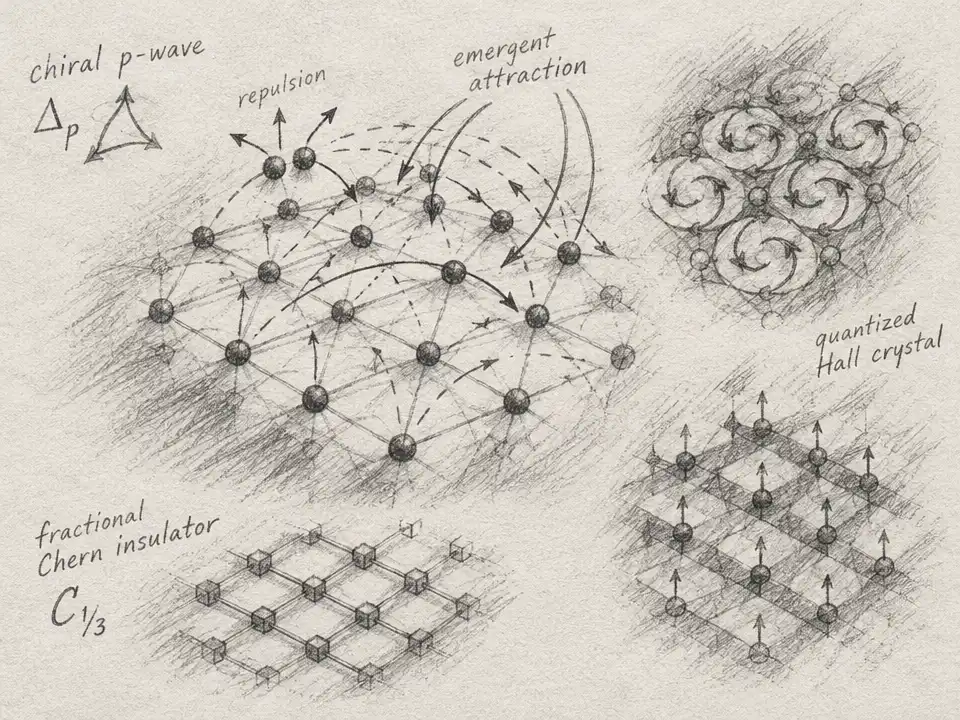
The response changes the effective interaction. In the authors’ random-phase-approximation calculation, the nearest-neighbor interaction remains repulsive, but an attractive component appears between next-nearest neighbors. In plain language, the electrons do not stop repelling at close range. Instead, their collective rearrangement changes the balance at a longer distance. The attraction is an indirect effect of the surrounding electrons, not a new force added by hand.
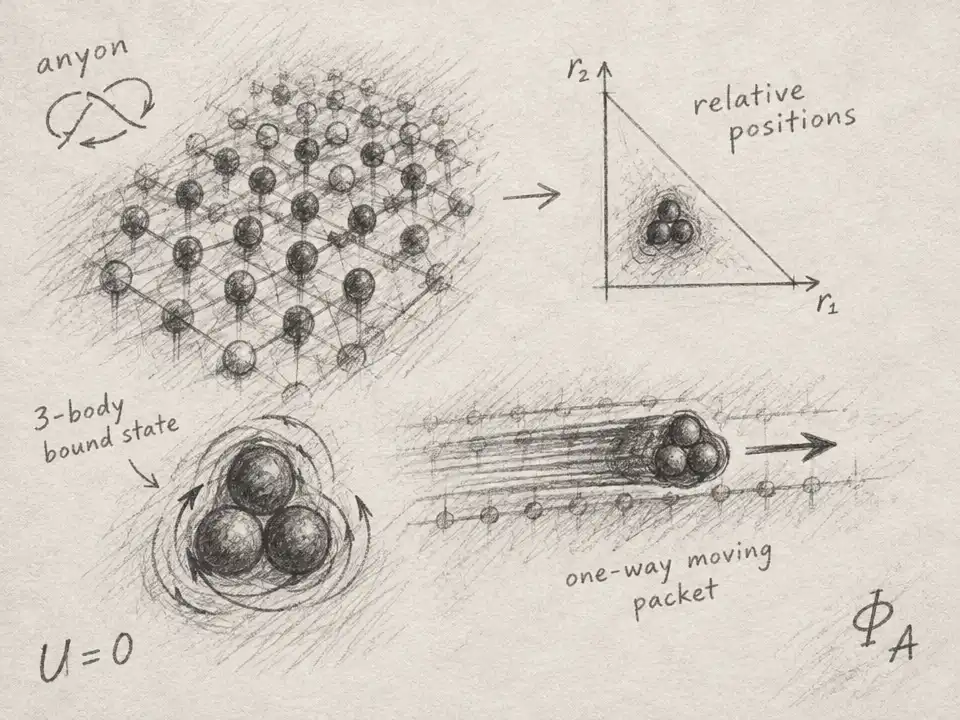
That distinction offers a route around the apparent contradiction. A pair can avoid the most strongly repulsive arrangement and benefit from the longer-range attraction generated by the medium. In the calculation, the favored pairing has chiral p-wave symmetry: the pair’s quantum phase winds as you move around it, much as a turning arrow changes direction around a circle. Because the model’s fermions are spinless, this odd-parity pairing is a natural contender.
But a neat weak-coupling explanation is not yet a solution. Such calculations work best when interactions are modest; the most robust superconducting signatures in the study appear at intermediate to strong coupling, where the weak-coupling account is no longer controlled. The authors therefore bring in a second clue: infinite density-matrix renormalization group simulations, a numerical method that approximates the ground state of a many-electron system on a cylinder.
On those cylinders, the team looks for a telltale contrast. Single-electron correlations fade quickly, while correlations between pairs persist over much longer distances. Across a broad range of fillings, the calculations show signatures consistent with chiral superconductivity. The model’s pair wave function also winds through one full turn, in agreement with the p-wave picture. These are numerical signatures, not a laboratory observation of superconductivity in a new material.
A particularly revealing test comes at one-third filling. By tuning the staggered potential, the simulated system moves between a fractional Chern insulator, a superconducting state, and a metal. The fractional Chern insulator appears when interactions dominate and the band is narrow; the metal emerges when the system approaches a limit where one sublattice is effectively removed. Between them, the calculations find the superconducting phase. The pair correlations grow longer-ranged as the cylinder circumference increases from 4 to 8 to 12 sites, a trend consistent with long-range superconducting order in two dimensions. Still, a finite-width cylinder cannot settle the two-dimensional limit by itself.
Then comes a dead end for any theory that predicts superconductivity everywhere: at half filling, the model does not superconduct. Instead, electrons form a density pattern, a crystal. Yet this is no ordinary crystal. The simulations find that inserting one magnetic flux quantum pumps one unit of charge across the system, a signature of quantized Hall conductance. The authors call the state a generalized Hall crystal.
Why should the system change its choice at precisely this filling? Here, the lattice offers a rival to pairing. At half filling, the density pattern fits the underlying checkerboard structure particularly well. The same effective longer-range attraction that favors pairs at other fillings can help select this ordered pattern instead. In the authors’ calculations, the Hall crystal even survives when the underlying single-particle bands have become topologically trivial. Its Hall response is then generated by the interacting state, rather than simply inherited from the original band.
The evidence points to a shared ingredient, but it does not prove that one simple explanation governs every regime. The authors’ weak-coupling calculation captures how longer-range attraction can emerge, while the tensor-network simulations reveal ordered phases that persist where that calculation cannot be trusted quantitatively. At half filling and small staggered potential, their numerics also cannot resolve which state wins. And at one-third filling, the data are consistent with a continuous transition from the fractional Chern insulator to superconductivity, but do not rule out a weakly first-order transition in the full two-dimensional limit.
So the answer to the opening riddle is conditional: repulsion can help create attraction when a structured band and the response of the surrounding electrons reshape the interaction. In this model, that emergent pull can favor either chiral pairing or a Hall-active crystal, depending on how the filling matches the lattice. The broader question—whether this is the mechanism behind similar neighboring phases in real moiré materials—remains open. The calculation offers a map of possible connections, not the last word on what the materials are doing.