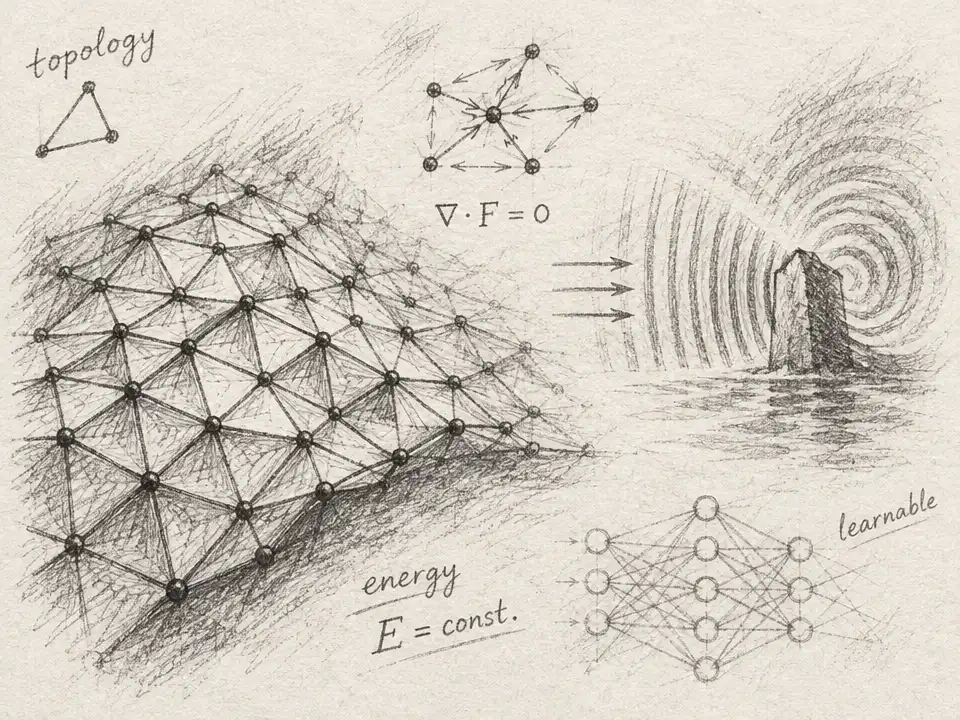
Picture a wave moving across a patchwork of triangles. A computer can represent each triangle, edge, and corner as part of a mesh, then use that mesh to calculate how the wave changes over time. But the mesh is more than a convenient grid: its connections encode rules about how quantities can move and interact. A new mathematical result asks what happens if a learning system is made to respect those rules from the start, instead of trying to discover them from examples.
The question brings together two fields that can seem far apart. Topology studies connections and boundaries: which pieces touch, and how they fit together, without asking how long an edge is. Geometry and material properties, by contrast, depend on measurements such as distances, areas, and wave speeds. In physics simulations, both matter. A wave’s route through a mesh depends on its connections, while its speed and energy depend on the medium it travels through.
That distinction is familiar in mathematical physics, but it is not always built into machine-learning models. A graph neural network, for example, can treat a mesh as a network of interacting nodes and learn how information passes between them. This flexibility is useful, but it can also leave the model to infer basic physical structure from data. A model may predict the next instant accurately yet slowly drift away from the right energy or motion when asked to run a simulation for longer.
In a paper posted in May 2026, Satoshi Noguchi and Yoshinobu Kawahara establish conditions under which the mesh’s topology constrains the form of the physical interactions. Their theorem draws on locality, consistent behavior when mesh elements are relabeled or reoriented, and a requirement that energy be conserved or dissipated rather than created without cause. Under these assumptions, the dynamics have a local port-Hamiltonian structure: the mesh fixes the wiring of conservative interactions, while geometric, material, and dissipative effects occupy other parts of the model.
The qualification local matters. The authors prove a reduction at the level of the system’s Jacobian where it exists; they do not claim that every full physical model has one global port-Hamiltonian description. Their result is also conditional on the stated principles. It is a mathematical route from assumptions about a mesh-based physical system to a restricted form for its dynamics—not a proof that all simulations, or all physical laws, fit the same template.
That route suggests a different design for a learning system. Instead of asking a neural network to learn every interaction, the authors’ MeshFT-Net hard-codes the conservative connections using the mesh’s signed incidences—the information that records how edges meet and which directions they point. The network learns quantities tied to geometry and material response, along with how energy is dissipated. In the main implementation, the conservative wiring is fixed, while the learnable parts are constrained to remain physically well behaved.
Why pay attention to the direction of an edge? Because its arrow is bookkeeping, not a physical feature. Reverse the arrow and the signs used to describe some quantities must change, but the actual wave should not. The paper treats this as a kind of sign-gauge symmetry: changing the orientation convention changes the description, not the physics. Building that invariance into the model helps prevent arbitrary choices in the mesh from becoming spurious forces or energy gains.
The researchers tested the approach on wave simulations, comparing it with several learned simulators. In one held-out regular-grid benchmark, MeshFT-Net’s normalized energy drift was 1.3 × 10⁻⁴ over the tested rollout. Two graph-network baselines recorded 5.9 and 6.0, while a Hamiltonian neural network recorded 1.0 × 10⁻². Those figures describe that particular benchmark, not a universal performance guarantee. They do, however, illustrate the difference between a model that merely predicts nearby states and one designed to respect long-run physical structure.
The paper also tested changes in frequency, wave speed, and resolution. In those out-of-distribution tests, the model generally kept energy drift lower than the alternatives, and it performed best on long-run error for frequency and resolution shifts. Several competing models diverged in some settings. That matters because a simulation is often used beyond the exact conditions represented in its training examples: researchers may want a finer mesh, a different material, or a wave pattern the model has not seen before.
To probe a less idealized case, the authors evaluated the model on acoustic-scattering data from The Well, a collection of physics simulations. The selected data involve discontinuous media and a mix of open and reflective boundaries. This is still a computational benchmark, not a new laboratory experiment. It lets the team test whether the mesh-based structure helps when the material and boundaries are more complicated than in clean, analytic wave examples.
The broader idea is modest but powerful: let mathematics decide which parts of a model should be fixed, and let data teach the parts that depend on details. Topology supplies a skeleton of permitted interactions; learning fills in properties the skeleton cannot specify on its own. That division could help make mesh-based simulations more stable and data-efficient. It does not eliminate the need for validation, and the theorem does not guarantee success for every equation or discretization. But it offers a useful crossover: a branch of mathematics about abstract connection patterns becomes a practical design rule for machine-learning models of physical worlds.