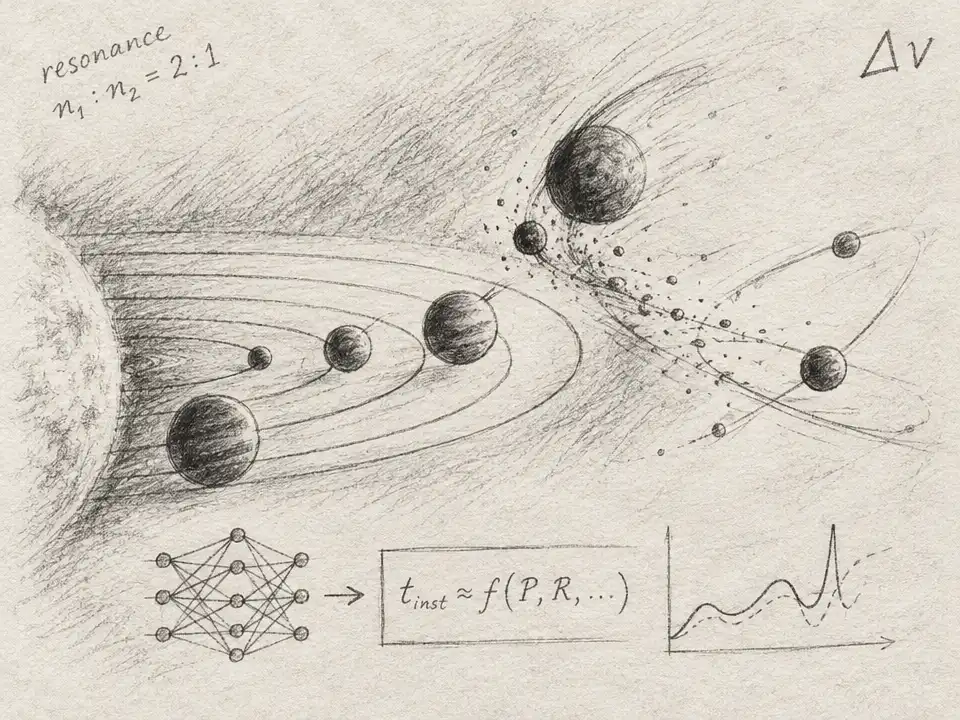
Imagine three planets circling a star, their paths repeating with the steady rhythm of a clock. For a long time, nothing dramatic happens. Then, after countless orbits, a close encounter can throw the system into chaos. The hard question is not just whether the planets will become unstable, but when. A new study brings two fields together to tackle it: celestial mechanics, which describes how planets tug on one another, and interpretable machine learning, which tries to turn a computer’s predictions into something people can inspect.
For centuries, researchers have worked to predict the behavior of systems with three or more interacting bodies. Even a small change in a planet’s orbit can matter: neighboring planets can fall near a mean-motion resonance, a repeating relationship between their orbital periods. At these resonances, gravitational nudges can build up, and the predicted time to instability can shift dramatically. The movement is governed by physics, but the long-term outcome can be so sensitive to the details that straightforward rules have been difficult to find.
Computer simulations offer one way forward, but they have a tradeoff. Run the planets forward one orbit at a time, and a simulation can reveal when two come close enough for the system to count as unstable. But repeating that calculation across many possible starting arrangements takes effort, and a result can be hard to summarize as a general rule. A neural network can learn to make quick predictions from simulations, yet its reasoning may be opaque: it can provide an answer without showing which orbital clues led to it.
The researchers’ approach was to use the network as a bridge, not a final black box. They started with 113,543 numerical simulations of compact systems containing three planets. Each simulation followed the planets’ changing orbits and recorded the time until two came within the sum of their Hill radii, a measure of the region where a planet’s gravity can dominate. The training set emphasized systems near strong resonances, where small differences in the starting arrangement can produce large differences in how long the system lasts.
First, the network learned to find patterns in the simulations. Then the team simplified that learned representation, keeping sparse combinations of orbital properties, and used symbolic regression to search for equations that could reproduce the network’s predictions. Symbolic regression is a kind of automated equation-finding: rather than only adjusting a model’s internal settings, it searches for expressions built from familiar mathematical operations. The researchers tested candidate equations that balanced two competing goals—staying simple enough to interpret while matching the network’s forecasts.
That second step matters. Simply asking equation-finding software to search the raw simulation data performed worse. The network had first learned a useful set of intermediate features; the equation search could then work with those features instead of trying to discover both the right variables and the right relationship at once. The method is a crossover in practice: machine learning helps sift a complicated orbital problem, while symbolic mathematics turns the resulting pattern into a form scientists can read and question.
The equations captured a broad, intuitive pattern: systems with planets packed closer together tended to become unstable sooner, while wider spacing generally meant longer waits. They also picked out lanes of shorter predicted lifetimes around resonances, including period relationships corresponding to 3:4 and 2:3. In the model’s interpretation, small variations in the planets’ orbital sizes during a short initial simulation could serve as clues to proximity to resonances that drive chaotic behavior.
The result was not merely a simpler version of the network. On one grid of three-planet arrangements, the distilled equations achieved a root-mean-square error of 1.52 dex, compared with 1.74 dex for the neural network. In that test, the more compact equations did better. The authors suggest that the equations’ simplicity may help regularize their predictions, smoothing away some of the network’s diffuse responses. The equations also performed better than the study’s pure symbolic-regression comparison and an existing analytic estimate on the reported tests.
Then came a test beyond the original training setup. The team trained on three-planet systems and applied the equations to five-planet simulations, with instability times reaching 1010 in the study’s dimensionless units. The equations captured variations of orders of magnitude near strong resonances. But they showed a systematic bias for closely spaced planets, a warning that carrying a pattern into a new setting does not make it exact. A useful forecast can still miss fine structure.
That limitation is part of what makes the equations valuable. The network’s predictions can be difficult to diagnose; with an explicit equation, researchers can trace a bad prediction to a feature or term. In this case, the model exaggerated the width of the unstable band around the 2:3 resonance. The researchers connected that error to one of the orbital-variation features the equations rely on. They also note that the equations do not enforce correct physical units, and that their tests cannot turn a chaotic system into a perfectly predictable one.
Nor does the study report a newly discovered planetary system or a precise countdown for a real one. Its predictions are learned from simulations, and the equations estimate the mean predicted instability time rather than carrying over the neural network’s full uncertainty model. The work is instead a demonstration of how to make a complicated predictor more inspectable—and how interpretability can expose both a model’s insight and its blind spots.
For planetary scientists, that offers a practical division of labor. A neural network can detect patterns across vast banks of simulations; equation-finding can compress some of those patterns into a handful of relationships that people can examine against established physics. The resulting rules are not a replacement for orbital mechanics or human judgment. They are a new set of clues: a way to ask which configurations deserve closer simulation, and to see more clearly why a seemingly orderly planetary clock might eventually lose its rhythm.