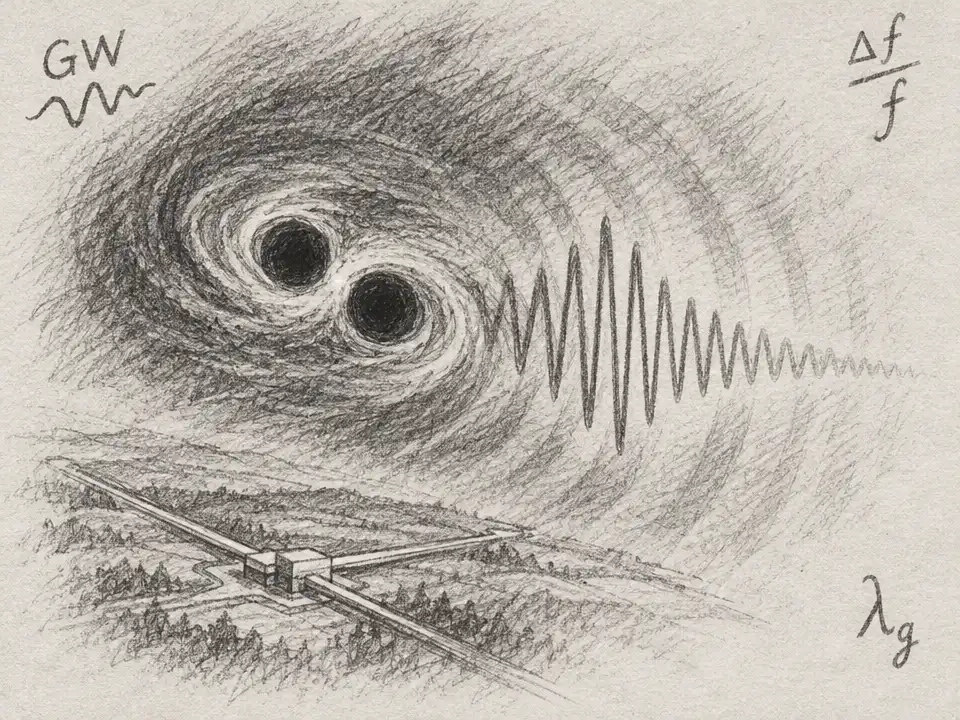
Imagine trying to pick out a handful of unfamiliar voices in a room full of people singing the same note. That is one challenge awaiting LISA, a future space-based observatory designed to detect gravitational waves: the Milky Way is expected to contain far more detectable pairs of white dwarfs than pairs involving black holes or neutron stars. The signals overlap in the data. Finding a signal, then, may not be enough. Astronomers will also need to work out what is making it.
A new study asks how to do that. Rather than analyze observations from LISA, researchers built simulated populations of compact-object binaries, placed them in a model Milky Way, and tested which features could distinguish black-hole and neutron-star systems from double white dwarfs. They varied assumptions about how stars exchange mass, survive shared stellar envelopes, and receive kicks when they explode. The result is a set of clues that could help turn a crowded gravitational-wave sky into a census of the Galaxy’s hidden stellar remnants.
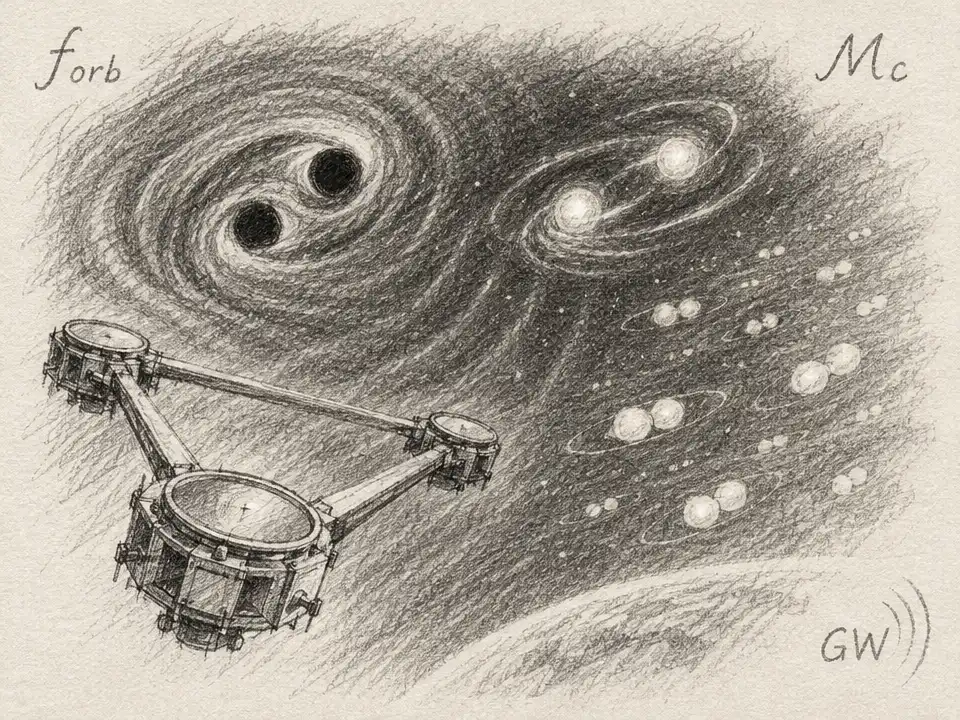
The first clue is a binary’s orbital frequency: how rapidly its two objects circle each other. At low frequencies, a double white-dwarf system is relatively hard to detect unless it is nearby. A more massive pair, such as two black holes, can remain detectable much farther away. So a source in a low-frequency band may be an impostor-proof candidate—not because white dwarfs cannot orbit that slowly, but because most would be too faint for LISA to pick up at a distance.
The scale of the contrast is striking. At the study’s reference frequency, a modeled circular pair of 0.6-solar-mass white dwarfs would be detectable only out to around 350 parsecs. A pair of black holes, each with a mass of 10 solar masses, could be detectable out to 39 kiloparsecs. The Galaxy becomes a very different-sized listening room depending on what is making the waves.
Orbital frequency is not the only clue. At the other end of the signal, researchers can look for a binary’s chirp: the gradual rise in gravitational-wave frequency as orbiting objects lose energy and spiral closer together. The rate of that rise helps reveal the system’s chirp mass, a quantity that combines the masses of both objects. White dwarfs face an upper mass limit, so a confidently measured chirp mass above what a white-dwarf pair can reach points to a heavier compact object. But this measurement works best when the frequency changes enough to be measured during the mission.
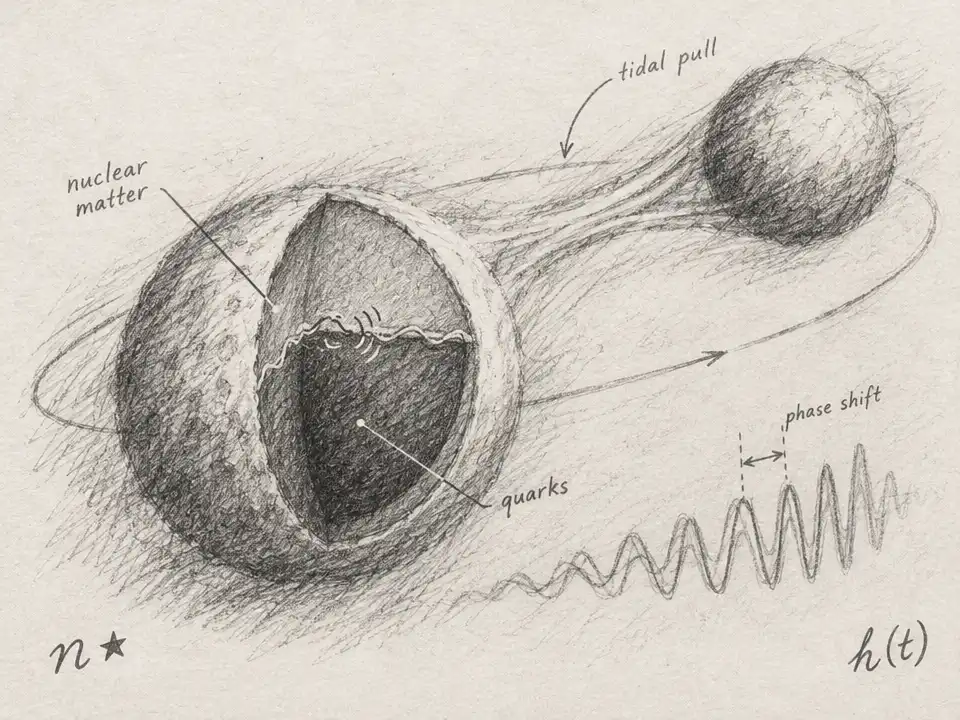
That creates a useful division of labor. The low-frequency clue can flag systems whose mass is hard to measure. The chirp-mass clue can identify heavier systems at frequencies where their signals change measurably. In the simulations, the two methods tend to catch different binaries. Combined, they distinguish an estimated 90–100% of detectable black-hole–black-hole and black-hole–neutron-star binaries from white-dwarf pairs, and around 50% of neutron-star pairs. Measurable orbital eccentricity—the departure from a perfect circle—could raise the neutron-star-pair recovery to around 60–70%.
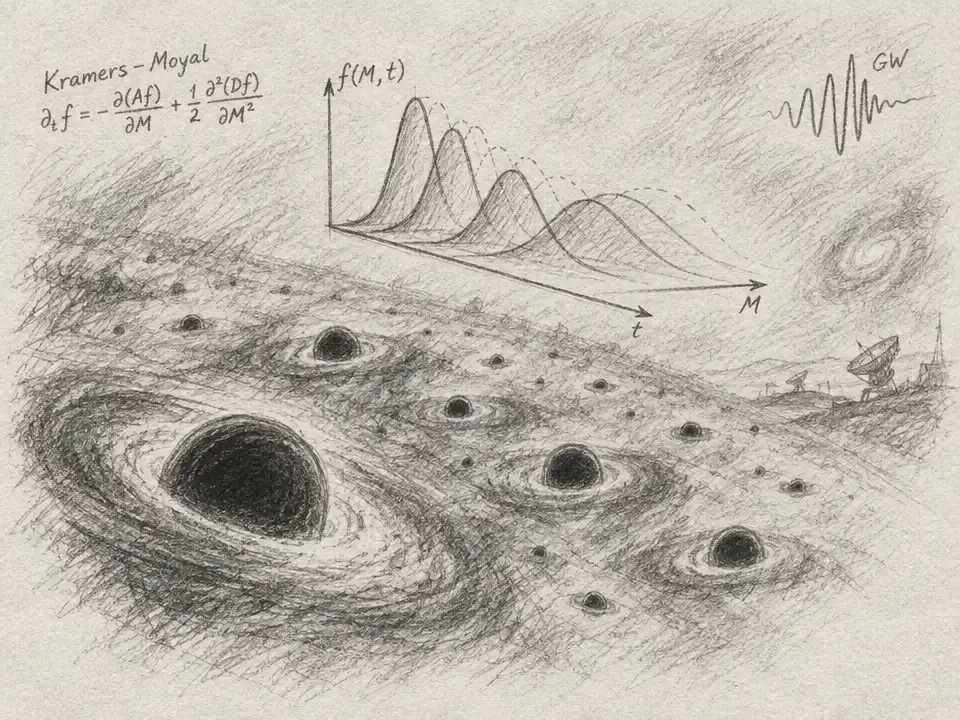
Those are promising fractions, but they are not a forecast that LISA will identify every such system. They apply to simulated sources that meet the study’s detection criteria, and the predictions depend on choices about both stellar evolution and the white-dwarf population. Across the different evolutionary models, the researchers estimate that LISA could detect around 20–240 binaries containing black holes or neutron stars over 8 years of observations, using a signal-to-noise threshold above 12. That wide range is part of the finding: how many binaries survive the complicated lives of their stars remains uncertain.
The frequency shortcut has its own price. The researchers set a dividing line at 3 × 10⁻⁴ Hz, based on models of how low-frequency white-dwarf pairs are distributed. But it is not a hard physical boundary. A white-dwarf pair close enough to Earth could still appear below it. In one test, lowering the assumed threshold to 2 × 10⁻⁴ Hz reduced the share identified by frequency alone from 69% to 37% for black-hole pairs, and from 37% to 12% for black-hole–neutron-star pairs in the fiducial model. The signature is powerful only if astronomers understand how many nearby white-dwarf systems could mimic it.
There is also a limit to what a successful identification means. A low-frequency source may be recognizable as a likely black-hole or neutron-star binary without revealing the individual masses—or even which kind of compact object it contains. The researchers argue that a population of such candidates could still test theories of binary evolution. But the distinction between “this signal is probably from a compact-object binary” and “we know exactly what is orbiting” remains important.
The study tested a more visual-sounding clue, too: a system’s distance from the Milky Way’s thin, star-forming disk. Supernova kicks can send compact binaries onto higher orbits, and the simulations found that their scale heights could grow by factors of 2–7. Yet height above the disk generally did little to separate them from white-dwarf pairs. The rarest sources are hard to identify with any population pattern; only a handful of neutron-star–white-dwarf systems might be picked out this way.
LISA’s promise, then, is not simply to hear black holes. It is to make sense of a chorus—to combine frequency, chirp, and sometimes eccentricity, while accounting for the stellar history and local white-dwarf crowd behind each signal. If those clues hold up when real data arrive, researchers could use a space-based detector to study not just dramatic mergers, but the quieter compact binaries that reveal how stars live, exchange matter, and collapse. The frontier is a new kind of stellar census. Its cost is patience, careful modeling, and a willingness to let some signals remain mysteries.