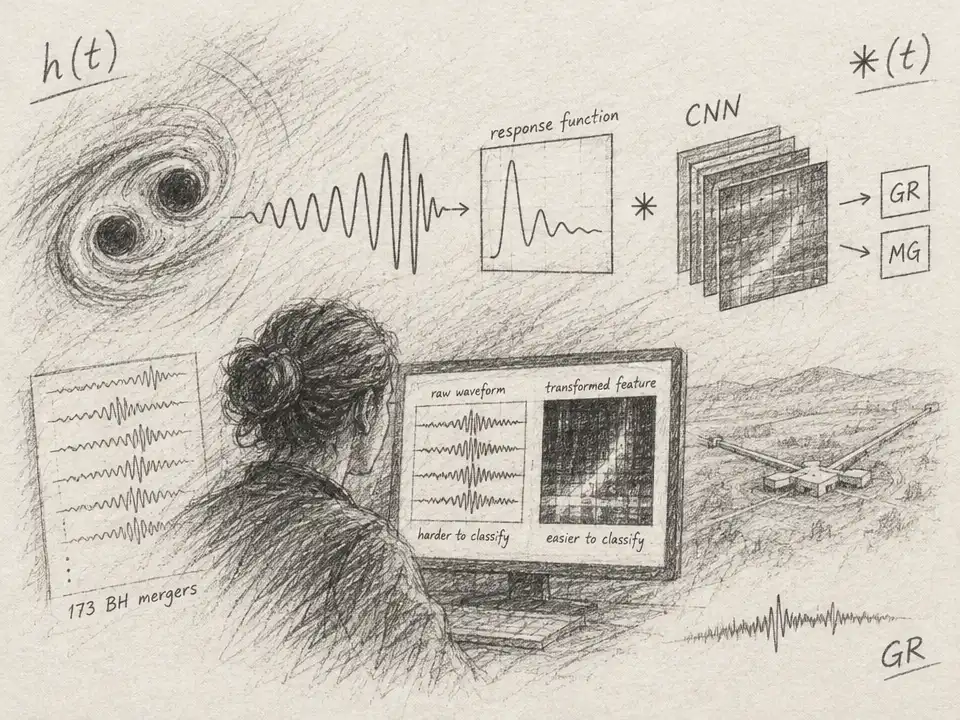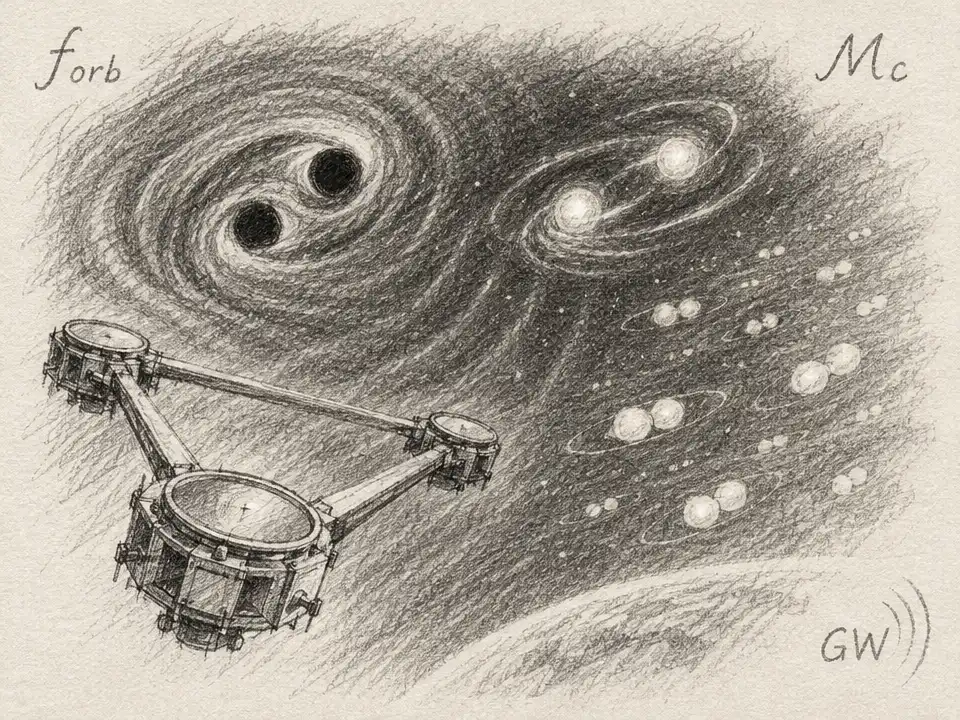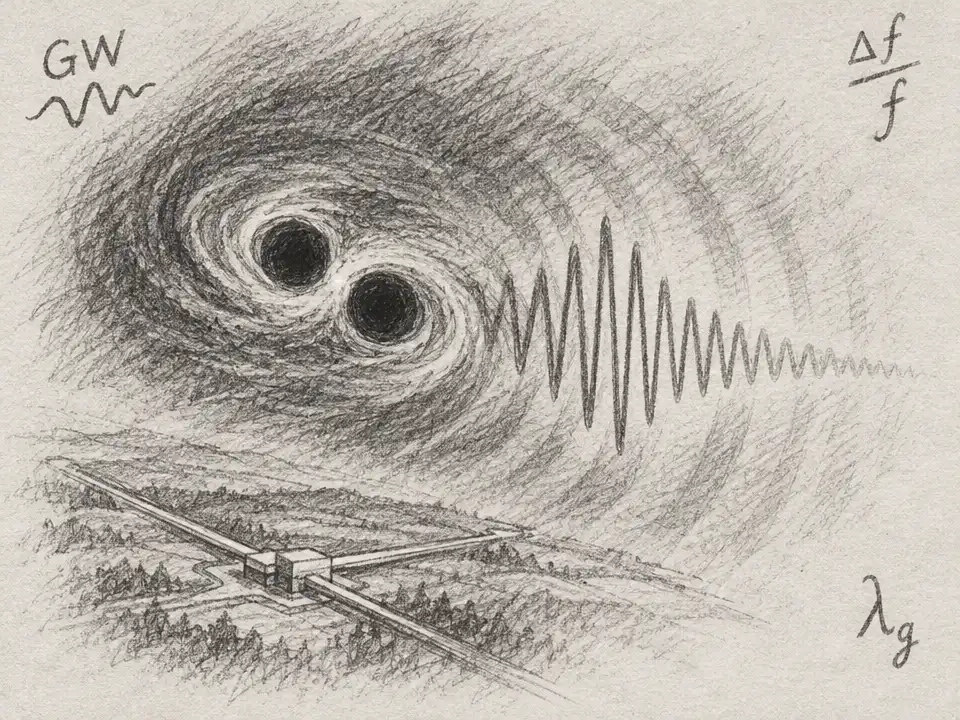
The collision is over. Two black holes have spiraled together and become one, and the newborn black hole is settling down. It does not ring like a metal bell, but its final gravitational-wave signal has a similar character: a fading pattern of oscillations whose pitch and decay carry information about the remnant.
That fading signal may contain a secret hidden in plain sight. In Einstein’s theory of gravity, two mathematically distinct families of black-hole vibrations are supposed to ring at precisely the same frequencies and fade at the same rates. If a deeper layer of physics breaks that exact match, the ringdown could split into two subtly different sets of notes.
A new study turned that possibility into a direct search. The researchers examined 13 gravitational-wave signals from black-hole mergers, looking for the spectral equivalent of a fine line splitting into two. They found no convincing evidence that the notes divide. But the search puts a new kind of boundary around what the data can still hide.
The idea begins with a striking property of black holes in general relativity, called isospectrality. A black hole can be disturbed in two different mathematical ways, known as axial and polar perturbations. They differ in how they behave under a mirror-like reversal of orientation, yet the theory predicts that corresponding vibrations share the same frequencies and damping times.
That is an unusually precise promise. The two families are not simply the two ordinary polarizations of a gravitational wave. Rather, they are distinct descriptions of the disturbance, which combine in the signal that travels outward to detectors. In general relativity, the black hole’s ringing gives those families the same fundamental tone. Some proposed extensions of gravity, however, predict that the match should break.
If the tones separate, their overlap could make the waveform subtly throb as one gets ahead of the other—a beating pattern, like two nearby musical notes played together. The effect would be woven into the brief ringdown, not visible as a second object or a glowing feature around the black hole. It would be a hidden distinction revealed through timing and pitch.
To hunt for it, the researchers built a model that lets the two vibration families share the same earlier inspiral and merger, but acquire separate frequencies and decay rates in the final ringdown. They then compared this flexible model with the standard prediction, using the full gravitational-wave signals rather than isolating the last few moments. The analysis focused on events loud enough to constrain both the approach and the aftermath of the collision.
Across the 13 selected mergers, the data did not make a persuasive case for a split. One event showed a statistical preference for the more flexible description, but it suggested a common shift in the ringing rather than the particular two-tone separation the researchers were seeking. That event is also known to be unusually sensitive to the waveform model used to interpret it. The authors therefore treat it cautiously, not as evidence of new physics.
Combining the signals, the study placed a 90% upper credible limit of 0.285 on the relative frequency splitting. In everyday terms, the data still allow some separation, but not an arbitrarily large one. A separate measure of how quickly the two branches fade showed a posterior that leaned away from the general-relativistic value; the researchers did not interpret that lean as a detection because the overall model comparison did not favor a split.
The absence of a signal can still test ideas about gravity. The researchers translated their general search into limits on five examples of modified-gravity theories. Their inferred 90% upper limits on the theories’ coupling length scales ranged from 20.3 km for axi-dilaton gravity to 27.9 km for cubic gravity. These are constraints on parameters in the theories, not measurements of a new black-hole size or a newly discovered structure.
That distinction matters. The analysis does not show that black holes possess fine structure, nor does it rule out every possible departure from Einstein’s theory. It tests a particular signature—whether the paired vibration families separate—and the answer so far is that any such separation must fit within the limits of these data. Some departures could preserve the match, while others may be too subtle for today’s observations.
The deeper shift is in what a black hole can be asked to reveal. A merger’s final shiver is not merely a last flourish after the dramatic event. It is a way to probe how gravity behaves in a region where space and time are violently distorted. By checking whether two hidden descriptions of that ringing remain perfectly synchronized, researchers can test a prediction without first choosing which alternative theory might replace it.
For now, the black hole’s two sets of notes remain indistinguishable. Future, louder ringdowns and more precise calculations could make a small separation easier to hear. If the match ever breaks, it would not announce itself as a new object in the sky. It would appear as a subtle discrepancy in the final fading tone—and as a clue that the familiar theory of gravity is missing part of the score.