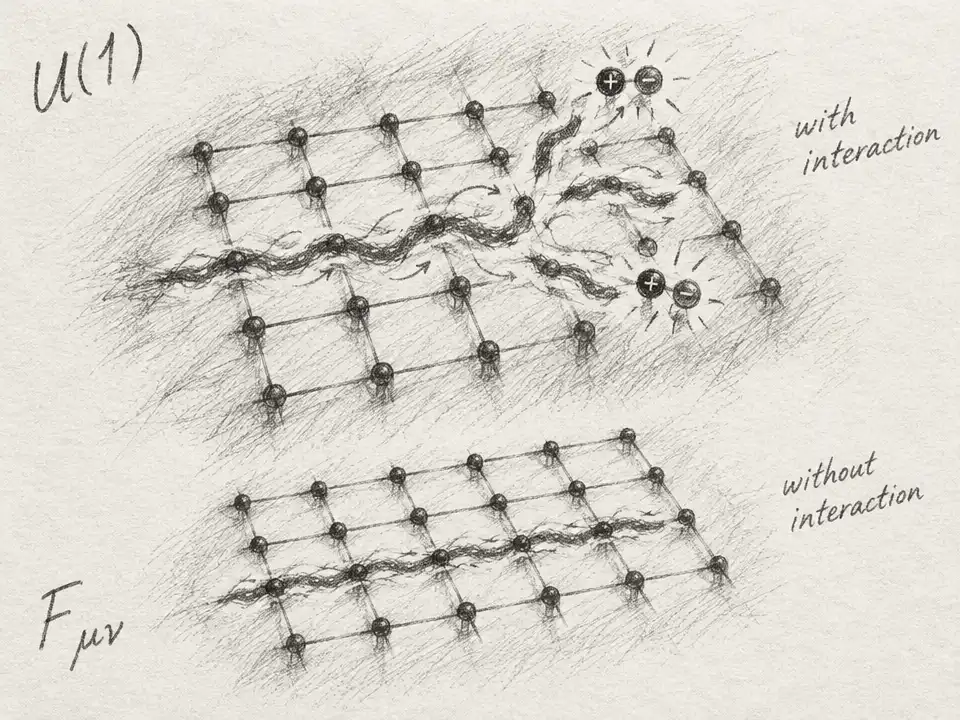
Imagine a universe with just one direction of space. Two kinds of charged particle move along a line, and electric fields stretch between them. In the usual picture, pulling an opposite-charge pair apart costs more and more energy: the field acts like an invisible tether, keeping the particles bound. But what if the tether fades almost to nothing—and the particles still never get trapped?
That question sat among three puzzles physicist Sidney Coleman posed in 1976. He was studying a stripped-down version of quantum electrodynamics, the theory of charged matter and light, with two particle species in one space and one time dimension. The model is not our universe. Its advantage is that calculations can expose mechanisms that are hard to isolate in more complicated theories.
In a paper posted in May 2026, a group of researchers returned to Coleman’s questions. They explained why the model’s lightest particles can stay nearly equal in mass even when the two species differ sharply; why the identity of a certain low-energy particle changes as the coupling is varied; and, most puzzlingly, why a special setting seemed to demand a neutral, electrically charged bound state. The last puzzle points to a twist: perhaps the supposed bound state was never there.
The special setting is the topological angle theta equal to pi. It is a parameter in the theory that changes how different electric-field configurations contribute. For the case the researchers focus on, the two particle species have equal masses. Coleman had wondered how a charged particle and its oppositely charged partner could form a neutral bound object that still carried the model’s two-valued flavor identity. As the interaction grew stronger, he considered whether the system might change into an unusual confined phase.
That sounds like a reasonable escape route. Stronger interactions often bind particles more tightly. But it is a clue that points the wrong way here. The researchers find no such change of phase along the equal-mass line: the particles remain unconfined across the range of coupling strengths they study.
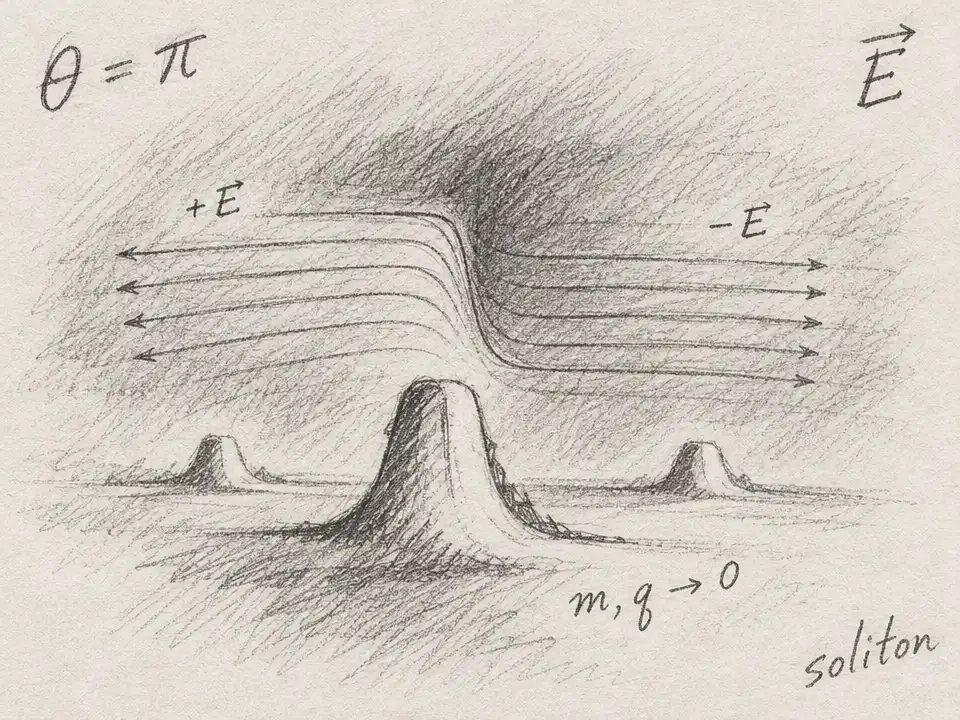
The more useful clue is the vacuum—the lowest-energy state of the theory. At theta equal to pi, the model has two equally stable vacua, each with its own electric field pointing in the opposite direction. Charge conjugation, the operation that swaps particles with antiparticles and reverses electric charge, exchanges these states. The system’s choice of one vacuum over the other is an example of spontaneous symmetry breaking: the underlying rules permit both, but a particular state picks one.
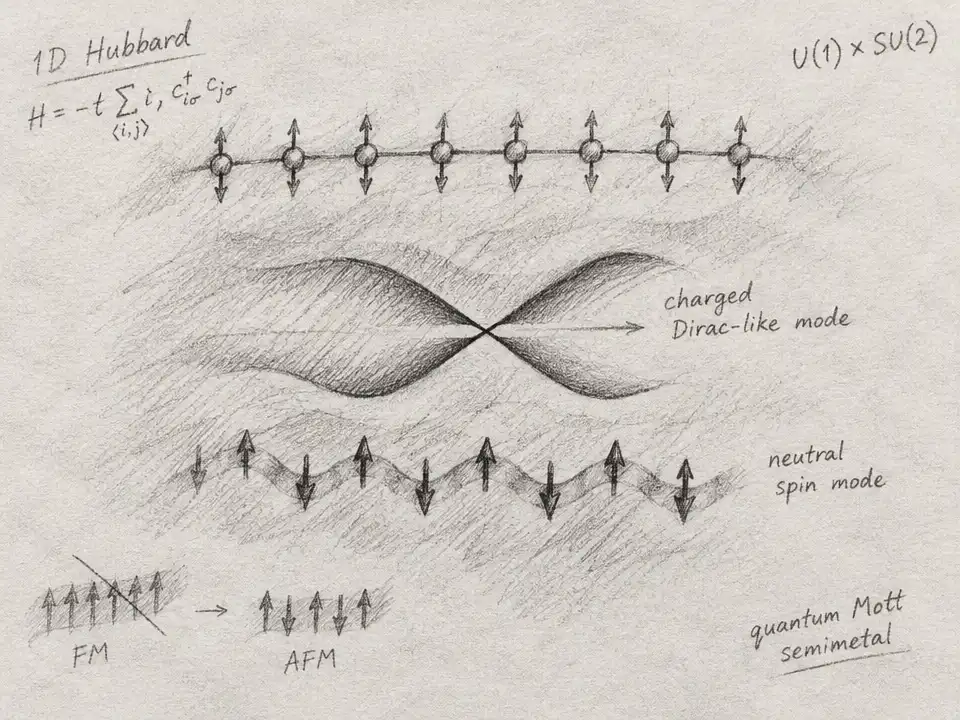
Now picture a boundary between the two choices. On one side, the electric field has one value; on the other, it has the opposite value. That boundary is a soliton, also called a domain wall or kink. Because the field changes across it, the boundary carries electric charge. In this model, such charged solitons—not neutral bound pairs—are the lightest excitations. The researchers use the historical name half-asymptotic particles for them.
This changes the question. The puzzle assumed that the lightest neutral state had to be a bound object with a surprising combination of properties. Instead, the lowest-energy neutral configurations are pairs of charged solitons. Their energies form a continuum that begins at the cost of creating two solitons, rather than revealing a hidden neutral bound particle. The charged objects are free to separate; the background of two possible vacua makes that arrangement possible.
The tricky part is that the charge does not stay conspicuous. As the gauge coupling grows, both the soliton’s mass and its electric charge fall. The researchers find that the mass becomes exponentially small in the strong-coupling regime, with 0.111 setting the coefficient in the exponent when the squared coupling-to-mass ratio is used. Their calculations also indicate that the charge fades exponentially. Yet for every finite coupling, neither quantity reaches zero. A particle can become extremely light and carry very little charge without being confined.
How did the group distinguish that answer from a phase transition that was simply hard to see? They approached the problem from several directions. Two-loop renormalization-group calculations track how the theory changes with scale, while integrability methods let the researchers calculate properties in a strongly interacting regime. They compared those results with numerical calculations of a lattice version of the model. The numerical results support a smooth passage from weak to strong coupling, rather than a sudden switch to confinement.
The other two puzzles help show why this is more than a clever reinterpretation. The near-equality of the lightest particles, even for unequal masses, comes from an approximate symmetry that emerges at low energies. And at a different setting, theta equal to zero, two particles with different symmetry labels exchange places in the energy ranking around a fermion-mass-to-coupling ratio of about 0.15. What looked like a contradiction between weak- and strong-interaction descriptions is resolved by a level crossing: the states trade places instead of somehow becoming the same state.
The answer to the charge puzzle also has an important boundary. The no-confinement result applies to equal masses at theta equal to pi. When the masses differ, even slightly, the researchers find that confinement can return beyond a critical coupling. The exceptional freedom of the solitons is not a general rule for every version of the model; it depends on the precise balance of its parameters.
In the end, the missing neutral particle was a false lead. The system’s electric charge can fade toward zero without the charged excitations becoming bound, because the two-vacuum structure supplies a different kind of low-energy object: a charged boundary between possible worlds. A simplified universe with one spatial dimension cannot settle every question about confinement in our own. But it can reveal how easily a sound theory can appear to demand an impossible particle—and how the right hidden structure can make the contradiction disappear.