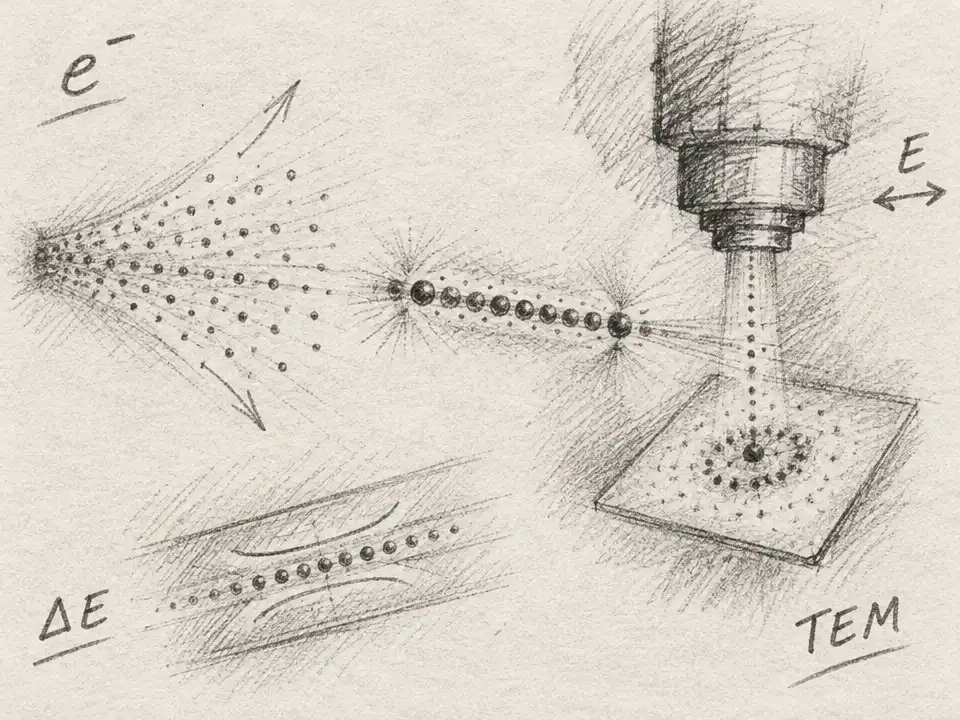
Shine light on a negatively charged object with enough energy, and an electron should be able to escape. That simple expectation has a striking exception: at just the right photon energy, the electron’s route out can nearly disappear—not because the light is too weak, but because the possible ways the electron wave can emerge cancel one another.
Physicists call the effect a Cooper minimum. It has been seen in atoms, where the shape of an electron’s wave can make the probability of emission collapse at a particular energy. But producing that near-vanishing signal in a non-atomic object is much harder. A cluster of atoms has many possible escape routes, and even a faint leftover route can keep electrons coming.
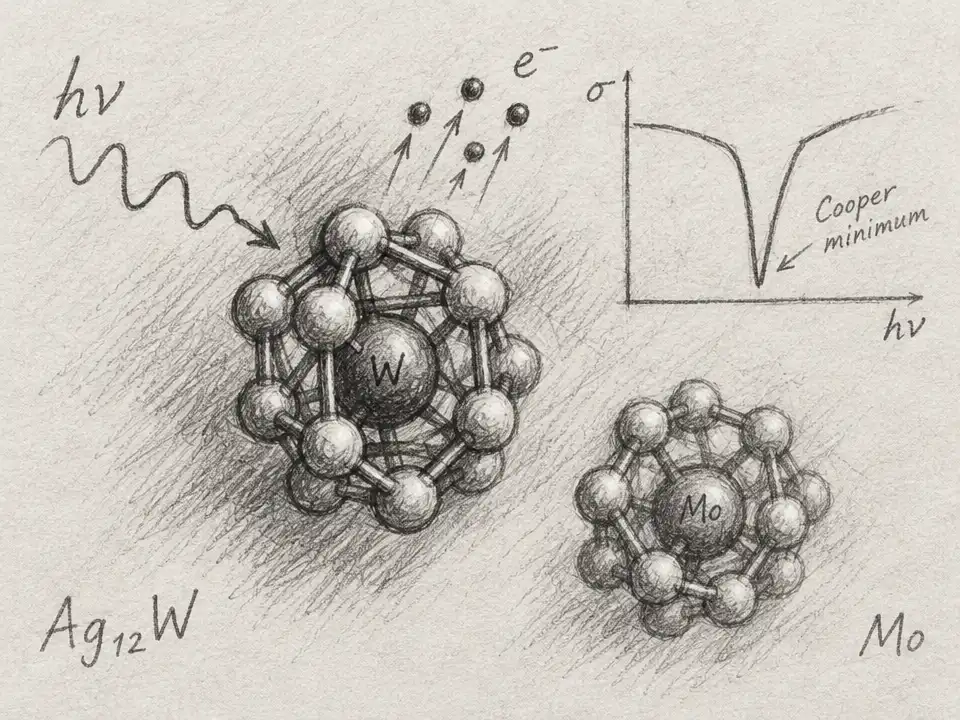
A team has now engineered a tiny object to behave enough like an atom to make the effect happen. Their target was a negatively charged cluster made from twelve silver atoms arranged around a tungsten atom at the center. The cage forms an almost spherical structure, and its outermost electron occupies an orbital that behaves much like an atom’s spherical s orbital. The researchers call such atom-like clusters superatoms.
To test it, the team produced the clusters in a gas, selected the negatively charged ones, and illuminated them with laser pulses. They varied the photon energy from 1.46 to 4.00 eV while recording images of the electrons that escaped. At first, the pattern behaved as expected: electrons appeared, and their distribution changed as the light energy increased. Then, between 2.0 and 2.5 eV, the photoelectron ring became almost invisible. Near a photon energy of 2.3 eV, the emitted electron had about 0.85 eV of kinetic energy above the detachment threshold.
This was not simply a gap in the cluster’s ability to absorb light. The measured photoemission signal itself nearly vanished, then returned as the photon energy rose. The team also checked the drop using a separate method: instead of imaging the escaping electrons, they measured how quickly light depleted a trapped population of clusters. That independent measurement showed the same deep dip.
The explanation lies in the electron’s transition amplitude—the quantum-mechanical quantity that determines how likely emission is. Picture contributions to that amplitude as signed areas: some parts of the electron’s wave add a positive contribution, others a negative one. At the special energy, the positive and negative contributions cancel. The electron is not stuck inside the cluster; rather, the usual route for the transition has become exceptionally unlikely.
For a perfectly spherical s-like orbital, the main allowed escape route in the researchers’ description is a p-wave. Their calculations show that this contribution falls to zero at the minimum. The cluster is not perfectly spherical, however. Its icosahedral arrangement permits other, higher-angular-momentum contributions. One such contribution becomes more important near the dip, but it remains weak; it does not prevent the overall signal from nearly disappearing. This distinction matters: the experiment shows a near-zero yield, not a claim that every conceivable emission channel is mathematically absent.
The calculations reproduced the main pattern, but the authors also describe an important limitation. A rigorous calculation would use a Dyson orbital to represent the change in the electron cloud when an electron leaves. That calculation was too demanding for this cluster, so the team used a Kohn–Sham orbital instead, along with a modeled Coulomb wave for the escaping electron. A simple plane-wave assumption did not reproduce the measurements. The resulting simulation is therefore a useful, phenomenological account of the observed cancellation—not a perfect, parameter-free reconstruction of every detail.
A second cluster provided a further test. The researchers replaced the central tungsten atom with molybdenum, creating a related superatom with a similar outermost orbital. Its photoemission also nearly vanished, this time at a photon energy of about 2.1 eV, corresponding to an electron kinetic energy of about 0.87 eV. That agreement supports the idea that the effect can be designed through the cluster’s structure and composition, rather than being a one-off quirk of a single sample.
The result turns a familiar rule of thumb on its head. Having enough photon energy does not guarantee that an electron will be emitted at an appreciable rate. The arrangement of the bound electron and the outgoing wave can matter just as much. Superatoms offer researchers a way to adjust that arrangement by changing the cluster’s size or the elements it contains, potentially creating carefully placed windows where photoemission is suppressed or enhanced.
For now, this is a basic-physics demonstration, not a new switch ready for a device. Its immediate value is more fundamental: a small, deliberately built cluster can reproduce a delicate atomic effect even though it is not an atom. By making the emitted electrons go quiet at a chosen energy—and then watching the signal return—the researchers have turned a vanishing signal into a remarkably precise probe of how quantum waves escape matter.