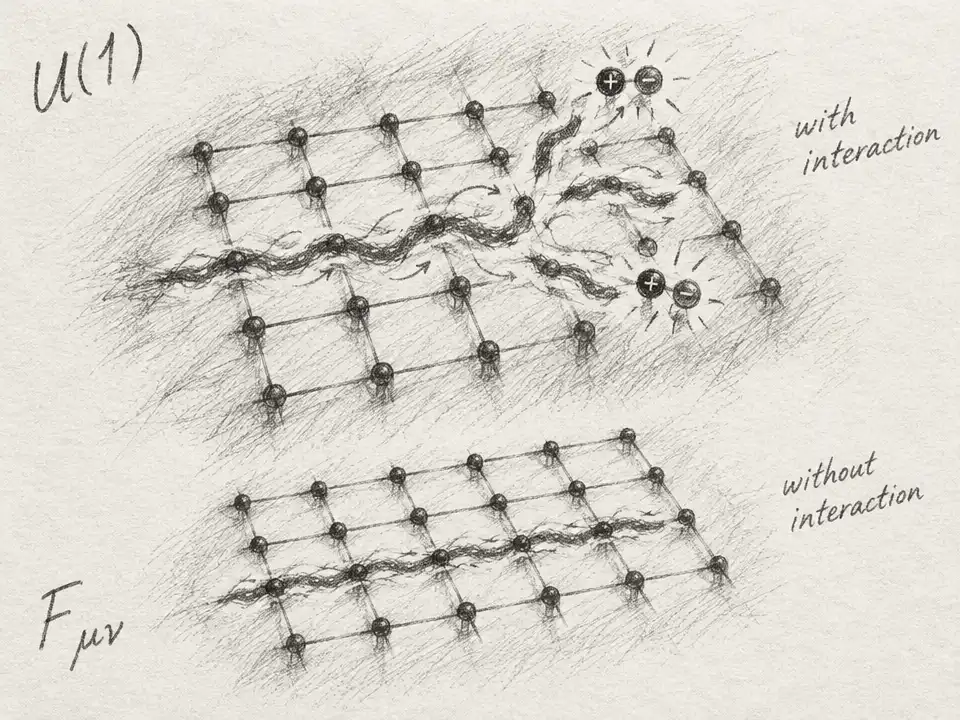
Draw a square grid. Now place a string of electric flux between two opposite charges at its corners. The grid offers paths in two directions—but does that mean the string can really move in two dimensions? In a recent quantum-computer experiment, the surprising answer was no. The lattice could be square while the simulated string remained trapped along its original route.
The missing ingredient was an interaction that lets the gauge field change around a square. Turn it on, and the string can wander sideways, rearrange itself, and break into pieces as new matter appears. Turn it off, and the motion largely collapses back to a line. The puzzle is a useful reminder: giving a model a two-dimensional map does not automatically give its physics two-dimensional freedom.
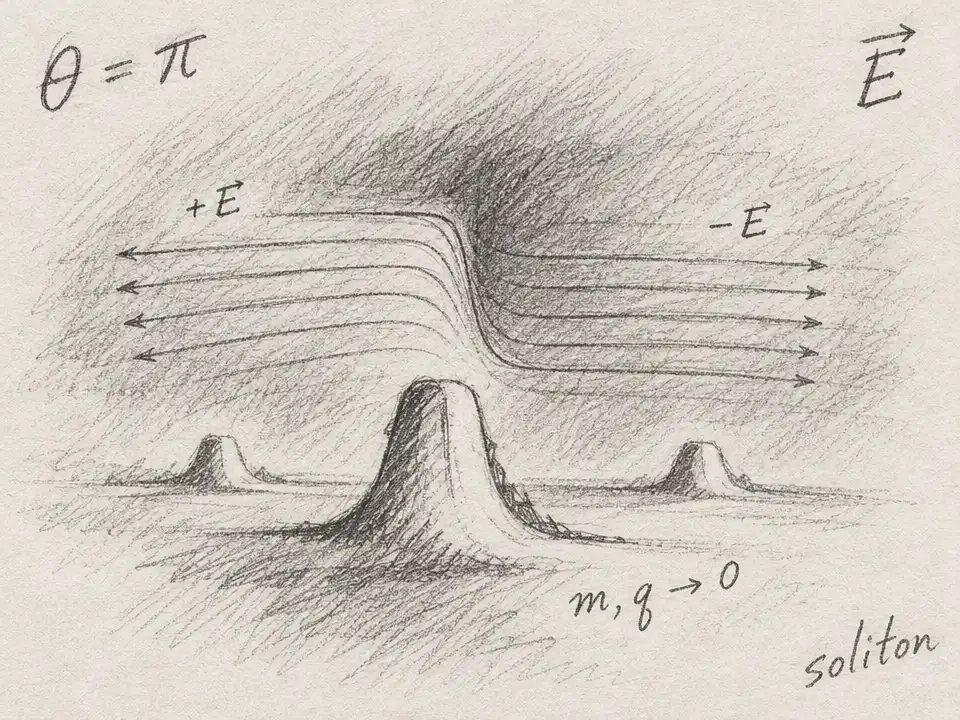
The researchers were studying a lattice version of a gauge theory—the kind of framework used to describe electromagnetism and the strong force. Here, the lattice sites represent places where matter can sit, while the links between sites carry electric flux. A chain of those links forms a flux string joining opposite charges. The string stores energy, so pulling its endpoints apart costs more and more. But if enough energy accumulates, the string can help produce a particle and its antiparticle. Their charges screen the original endpoints, and part of the string is no longer needed: it has broken.
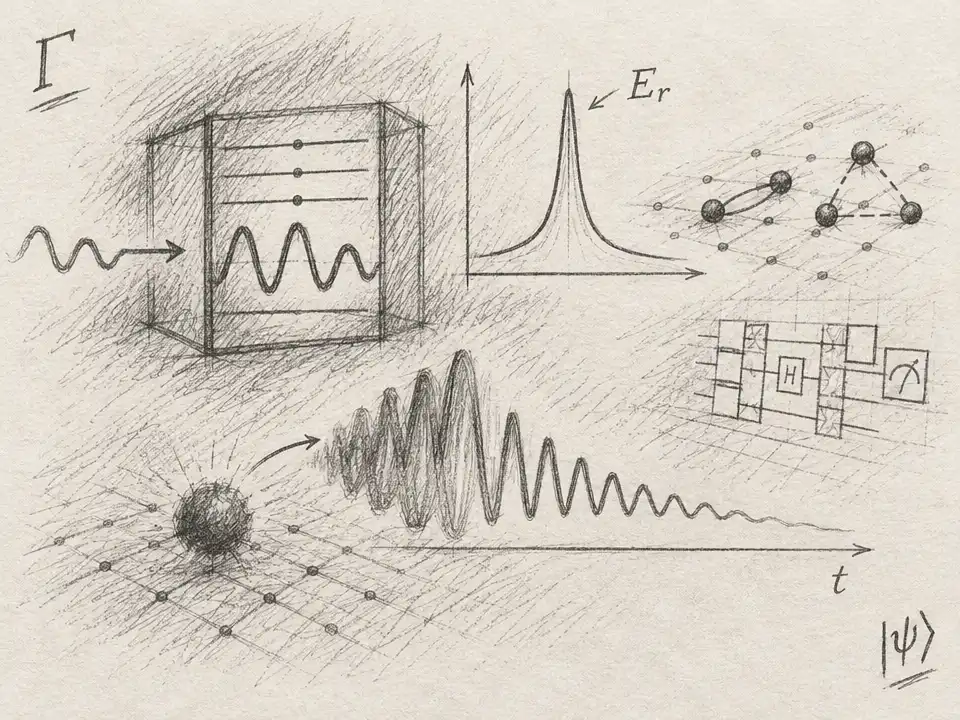
There is a catch. A string can only break efficiently when the energy released by breaking a segment matches the energy needed to make a particle–antiparticle pair. The team tuned the model to that resonance. In an accessible picture, the stored energy and the creation cost are like two notes brought into tune: the conversion between them becomes much more likely.
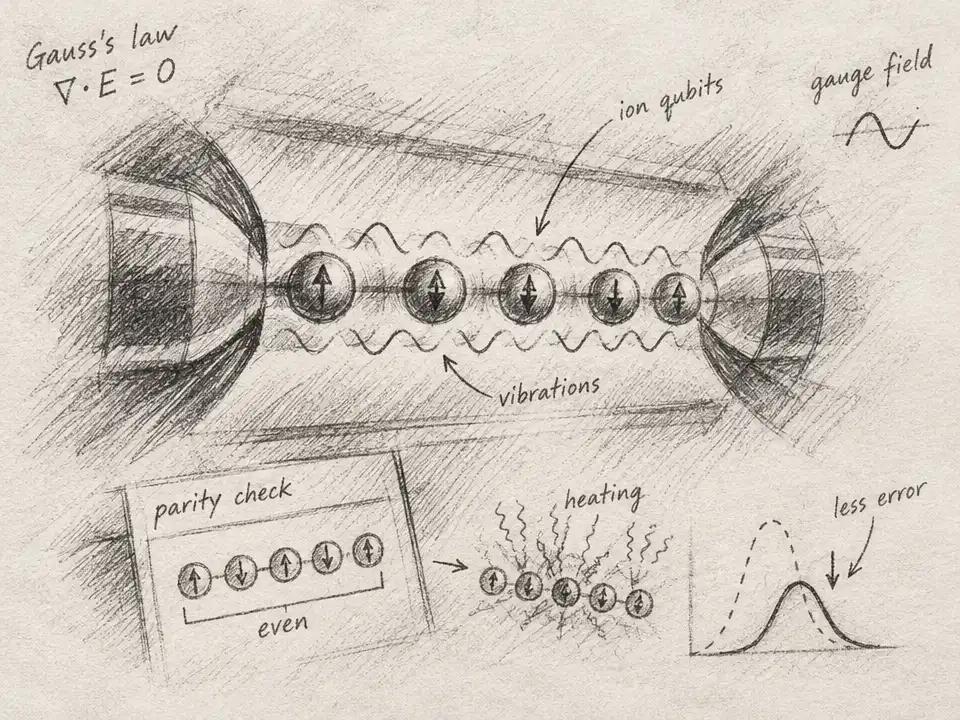
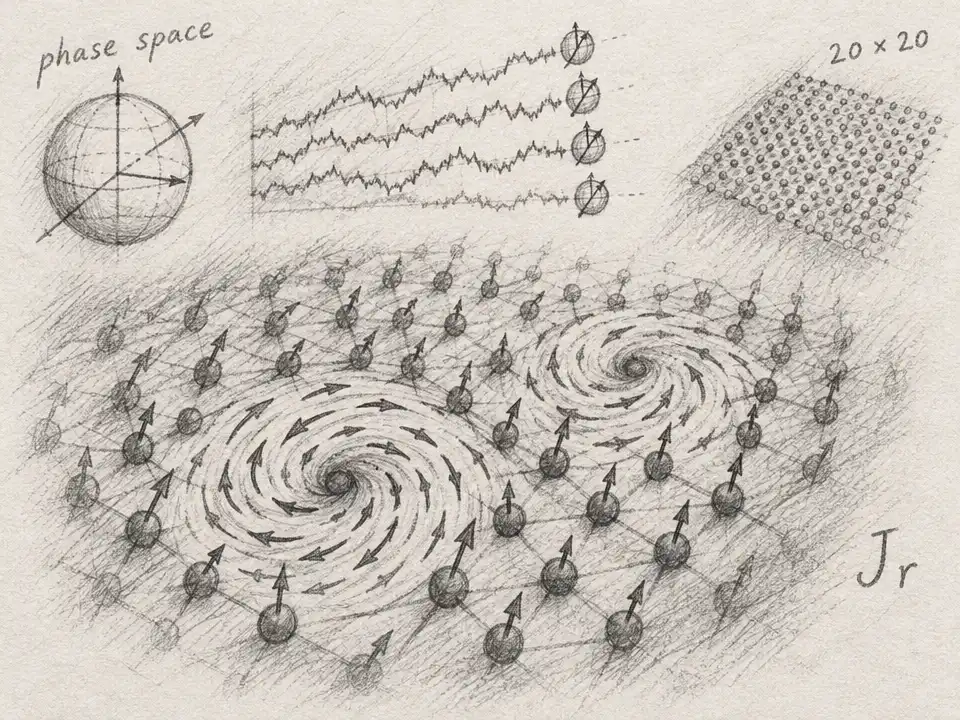
They encoded this model on a trapped-ion quantum computer, using 51 qubits to represent matter and gauge fields on a 5-by-4 square lattice. The starting state contained a diagonal flux string between fixed opposite charges. Then the researchers abruptly changed the model’s conditions—a quench—and followed the evolving pattern. This was a simulation: the ions and qubits represented the theory’s ingredients; the experiment did not create actual electrons and positrons in a laboratory vacuum.
The crucial ingredient was the plaquette interaction. A plaquette is one small square of the grid; the associated term lets the gauge field change around that loop. It supplies a route for flux to shift onto other paths, instead of remaining confined to the links in the initial string. The team could tune this interaction, making it possible to ask a direct question: is the square geometry enough, or does the loop-changing process actually unlock the extra dimension?
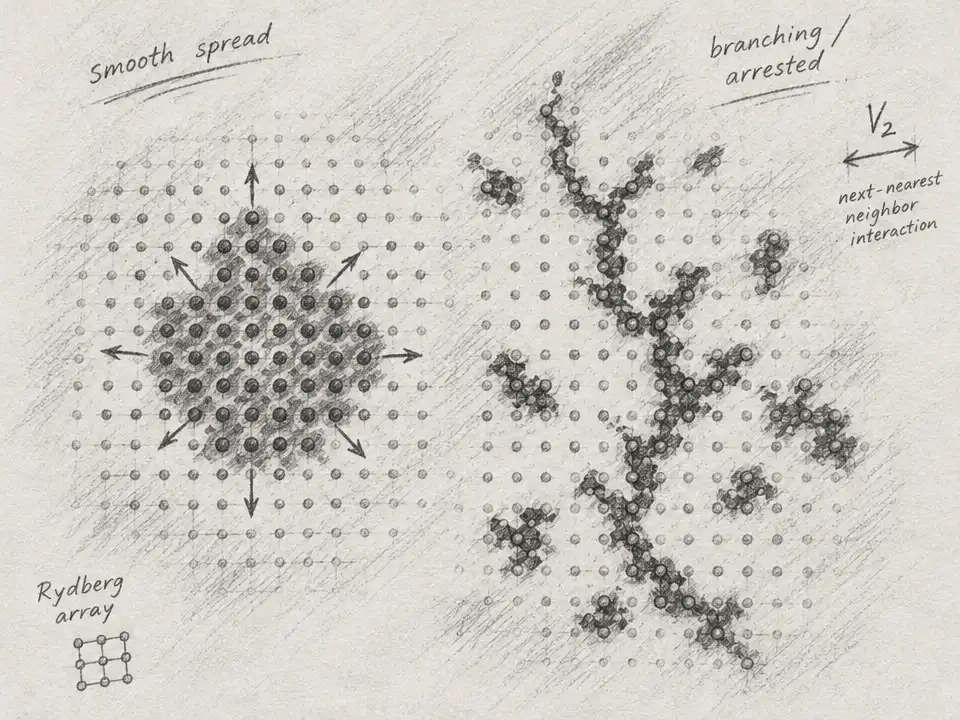
With the interaction on, the hardware data showed the initial string becoming less probable. Other string configurations appeared in sequence, while the measured matter occupation increased not only along the original string but away from it, too. Over time, the pattern spread across the lattice. In the resonant regime, the researchers saw the signatures of string breaking: matter–antimatter pairs formed in the model and screened portions of the flux string. The evolving state was no longer limited to the original line.
Then came the control case. With the plaquette interaction switched off, the string could still fluctuate and break along its original direction, but matter creation away from that path was scarce. The dynamics stayed effectively one-dimensional, and the string showed revivals—some of its original pattern returned. This comparison is the heart of the result: a two-dimensional array by itself did not produce the broader dynamics. The interaction around the squares did.
There is an important detail in that comparison. The resonant run with the plaquette interaction used a 5-by-4 lattice, while the no-plaquette control used a 4-by-3 lattice. The team compared hardware measurements with numerical simulations in both cases, but the change in system size means this was not a same-size, switch-only comparison. The authors also tested the plaquette interaction away from resonance, on the 5-by-4 lattice. The string spread among different paths, more strongly at larger interaction strength, but the energy mismatch prevented string breaking. So sideways motion and pair production were related clues, not the same effect: the plaquette term enabled the former, while resonance helped unlock the latter.
Getting this far required careful circuit design. The researchers grouped compatible operations so they could run in parallel, keeping the two-qubit gate depth to 28 per simulated time step. The circuit used up to 1,540 entangling gates. Because real devices make errors, they compared raw measurements and post-selected data with tensor-network calculations, including simulations of the same digitized circuit. That cross-check matters: an apparent spread could otherwise be a hardware artifact rather than a feature of the modeled physics.
The result does not reproduce the full complexity of nature’s strong force, nor does a 5-by-4 lattice settle how far quantum computers can push gauge-theory simulations. The model uses a simplified, truncated description of the fields, and the experiment follows dynamics only on a finite grid. But it isolates a structural question that is easy to miss: what makes higher-dimensional gauge fields genuinely dynamic? In this setup, the answer was not the extra row and column. It was the ability to circulate flux around a square—and let the string discover paths it could not reach before.