Imagine trying to count the possible ingredients in a recipe. A new set of ingredients arrives, so the number of possible dishes ought to grow. But what if the new ingredients also reveal that many recipes you counted before were really the same dish? That is the strange accounting problem facing theorists who study a family of quantum theories called ABJM—and the black holes they are used to describe.
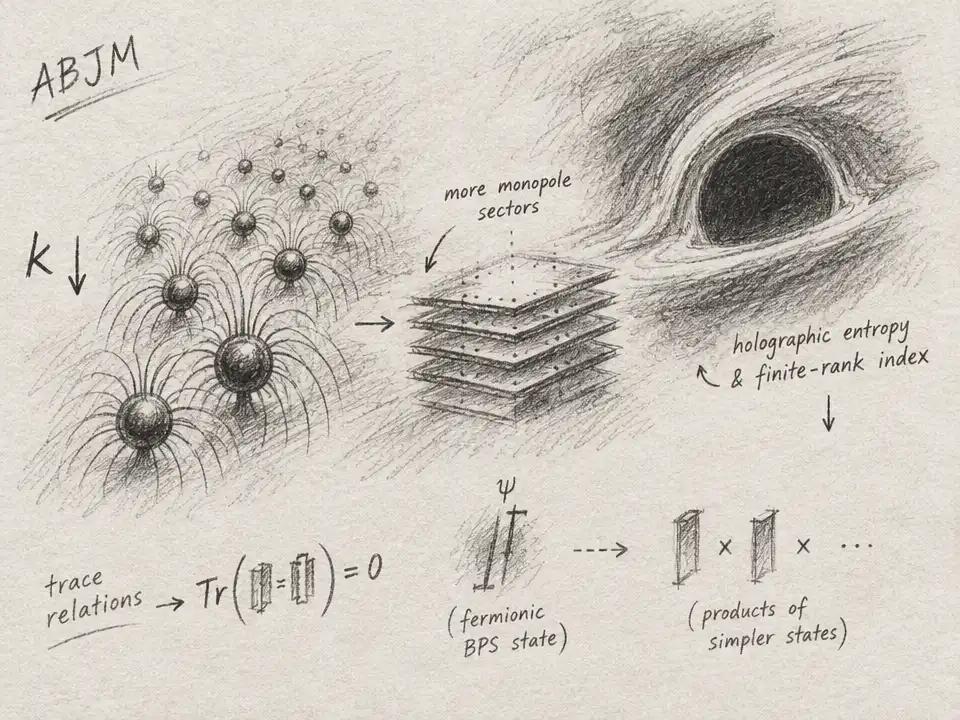
The puzzle turns on a parameter named k. In ABJM theory, lowering k opens up more ways to build certain protected quantum states. Yet the theory’s gravity description predicts that, at a fixed charge, the entropy of its supersymmetric black holes gets smaller as k falls. Entropy here is a measure of how many microscopic states can make up the same large-scale black hole. More building blocks seem to produce fewer possible black-hole states. How can both counts be right?
ABJM is a three-dimensional quantum field theory with a mathematical link to gravity in a higher-dimensional space. In the relevant limit, the theory describes M-theory in a universe containing an anti-de Sitter space and a seven-dimensional sphere identified under a discrete rotation set by k. That correspondence lets researchers compare two kinds of bookkeeping: count protected states in the field theory, or calculate the entropy of a black hole in the gravitational description.
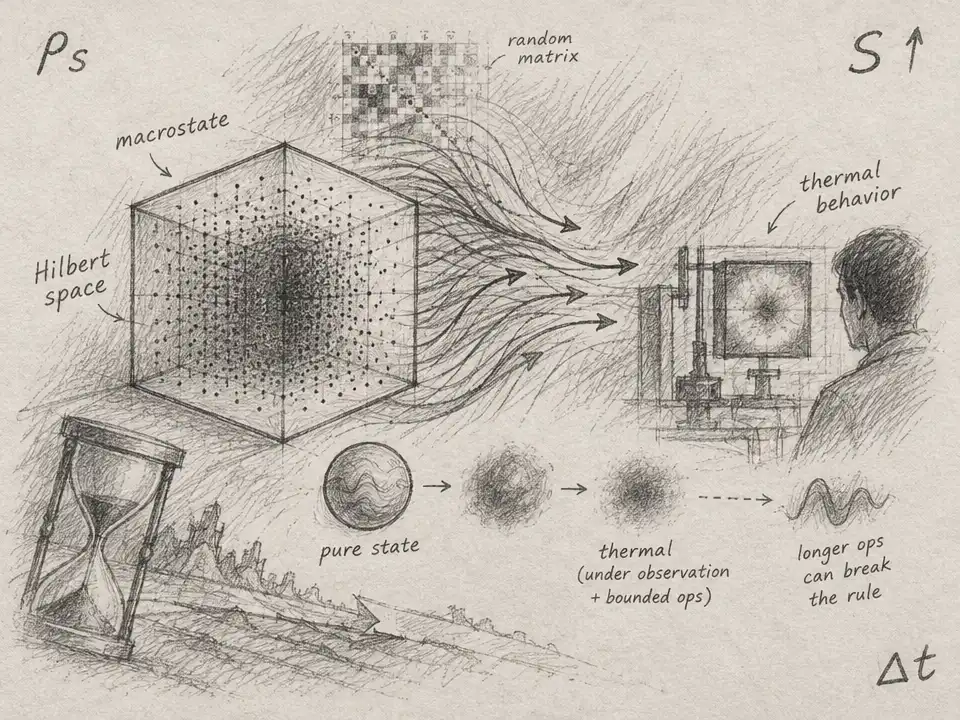
The states at the center of the puzzle are called BPS states. They satisfy a special relationship between their energy and other quantum properties, making them unusually stable under changes to the theory. The authors study them with a superconformal index, a mathematical tally that tracks protected states. It is not a simple head count: bosonic and fermionic contributions enter with opposite signs, so some can cancel. The index is a powerful clue about the state spectrum, but its coefficients must be interpreted with care.
One clue points toward abundance. ABJM includes monopole operators: local operators associated with magnetic flux through a tiny region of space. They are not little magnetic spheres hiding inside the theory. Rather, they encode a distinctive field configuration, and their gauge charges mean they often need to be combined with ordinary matter fields before the result counts as a permitted, gauge-invariant operator.
Here, k controls how much matter is needed for some of that dressing. At lower k, certain monopole-based operators can be built with fewer fields, and more monopole sectors can contribute to the protected spectrum. If each newly available construction were an independent state, the tally should rise as k decreases. That is the intuitive answer—and the first dead end.
The gravity calculation gives the opposite trend. For large gauge-group rank, the predicted black-hole entropy scales with the square root of k and with the rank to the three-halves power. So, holding the other relevant quantities fixed, a smaller k means less entropy. This tension might have been an artifact of using gravity only in its large-rank limit. The researchers therefore examined the index at finite rank and large charge, where the black-hole formula’s trend has a field-theory counterpart.
They expanded the index for ranks one and two, calculating coefficients through order 1500 in its grading variable and using extrapolation to probe their large-order growth. At rank one, the leading growth measure is independent of k. At rank two, it increases with k: the index supports the same broad direction as the gravity prediction, not the naive expectation from extra monopole sectors. A numerical analysis of a particular saddle-point branch for higher rank supports that pattern too, though identifying the dominant branch at all ranks is part of the argument, not a direct experimental observation.
The proposed resolution is a second effect hidden inside the growing list of operators: trace relations. In a gauge theory, operators are often built from traces of products of fields—roughly, compact ways of forming gauge-invariant combinations. But traces are not always independent. At finite rank, matrix identities can make a long trace equivalent to a combination of shorter traces or products of other operators. The new monopole ingredients may expand the menu while also adding rules that say some menu items are duplicates.
The authors distinguish between two broad kinds of protected states. Monotone states persist as the rank changes and are associated, in the gravity picture, with gravitons. Fortuitous states exist only over a limited range of ranks; these are candidates for the more complicated states needed to account for black-hole entropy. The authors propose that lower k can produce more monotone states while trace relations remove enough fortuitous ones to reduce the total large-charge growth. It is a plausible way for the two ledgers to agree, but the proposed link between these categories and gravity is not a literal one-to-one photograph of a black hole’s contents.
A small example makes the proposed erasure easier to see. For gauge-group rank two, the index analysis identifies four fermionic fortuitous states at a particular low order when k is large. For k above two, it finds the same four. At k equal to two, it finds a different set of ten in a larger symmetry grouping. At k equal to one, it finds no fortuitous states at that order.
Why do they vanish from that low-order tally? At k equal to one, monopoles let the basic fields form gauge-invariant combinations in new ways. The authors argue that this creates extra relations: combinations that looked like distinct operators at larger k can now be expressed as products of simpler, graviton-like operators. The states have not necessarily been destroyed; rather, they no longer count as independent entries. And the example is deliberately modest: finding none at one order does not mean there are no fortuitous states at every charge.
There is a rival possibility. Quantum corrections can lift some states out of the protected spectrum, and the authors note that such effects are known in related theories. Their preferred explanation is more concrete: the growing web of trace relations can do the accounting. They conjecture that this mechanism dominates at large quantum numbers and eventually explains the black-hole scaling, but they have not proved that general conclusion. The puzzle, then, is not fully closed. Its sharpest lesson is that adding ways to build a state does not guarantee adding a new state. In quantum gravity’s bookkeeping, the missing entry may be hiding in the fine print of what counts as distinct.