Imagine trying to hear a whisper in a stadium while a jet engine runs overhead. Now replace the whisper with a predicted interaction between photons, and the jet engine with the glare of an X-ray beam. That was the challenge facing researchers who set out to test a strange possibility: that light can scatter from light, even in what appears to be empty space.
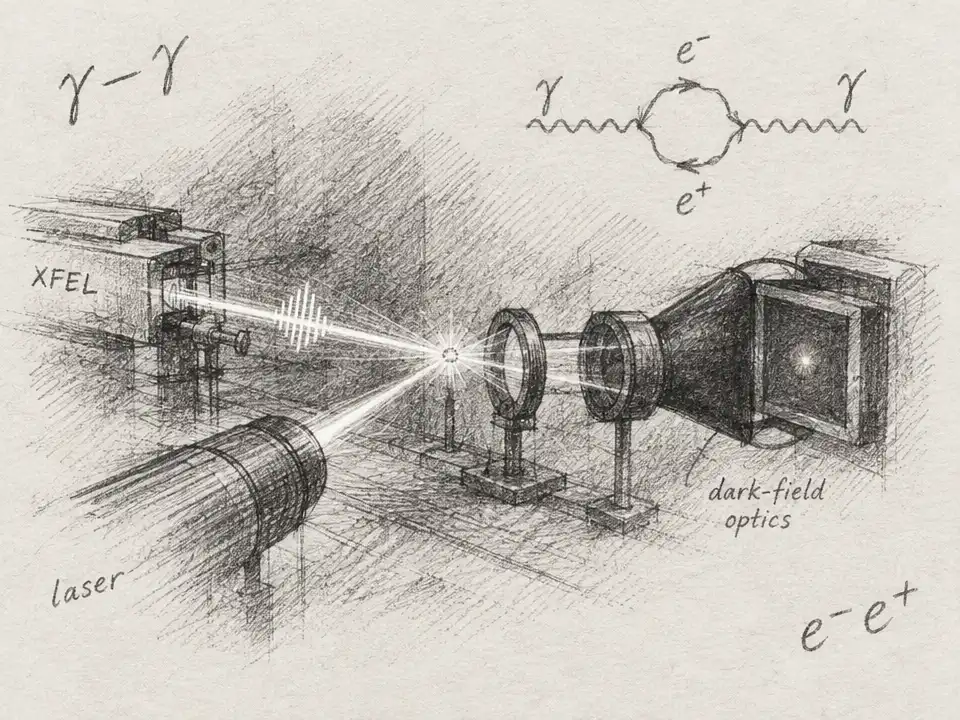
In ordinary life, two crossing beams pass through each other. Quantum electrodynamics, the theory of light and charged particles, predicts a subtler story. Photons can interact through quantum processes involving virtual electron–positron pairs. “Virtual” matters: these are not particles the experiment can scoop up or photograph. They are part of the theory’s account of how fields interact. The predicted result is that a tiny fraction of photons in one beam will emerge with their direction changed, and some will have their polarization turned by 90 degrees.
The effect has been observed in a very different setting: high-energy collisions involving heavy ions. But at the lower energies available when researchers collide beams of light, the interaction is so faint that stray photons can easily masquerade as the signal. The new experiment, conducted at the European X-ray Free-Electron Laser, was designed around that problem. Its report describes 2,751 collisions between an X-ray probe and an intense optical laser pulse, at a center-of-mass photon energy of 116 eV.
The two beams came from very different worlds. The probe was a seeded X-ray beam, with photons at 8.766 keV. The opposing pump was the ReLaX optical laser: near-infrared light with a wavelength of 800 nm and about 4 J of energy on target. The laser was powerful enough to reach the experiment’s focus as a 300-terawatt-class pulse. There, the beams met head-on. The team was looking for a change in the X-rays, not a flash from the laser.
To separate the possible signal from the flood of ordinary probe light, the researchers gave the X-ray beam a kind of artificial shadow. Before focusing it, they blocked its central portion with a thin tungsten wire. In the optical arrangement downstream, that obstacle’s shadow was imaged onto an aperture. Most X-rays that had continued along their original paths landed outside the opening and were rejected. A scattered photon, nudged into a different direction by the collision, could enter the opening instead.
That is the dark-field idea: do not try to find a dim signal against a bright beam. Arrange the optics so that the unaltered beam is mostly dark where the signal should appear. Then the team added another filter. A crystal divided the light by polarization, sending photons that kept the probe’s original orientation into one channel and photons flipped by 90 degrees into another. The angular change and polarization flip together offered two clues to the same elusive process.
Even this carefully prepared dark region was not perfectly dark. Tiny imperfections in the lenses scattered X-rays into it. The aperture itself could add stray light. At the detectors, those unwanted photons looked just like the hoped-for signal. The experiment therefore depended on measuring the background as carefully as the collision: the X-ray laser fired far more often than the optical pump, so each pump-on collision could be compared with nearby pump-off shots. The team averaged eight such neighboring shots to estimate the background at that moment, tracking local fluctuations rather than assuming the beamline stayed perfectly steady.
Timing and alignment added another layer. The two focused beams had to overlap in space and in time, at a scale of micrometers and femtoseconds. Their positions shifted slightly from shot to shot, changing how many scattered photons the setup should expect. The researchers recorded alignment indicators for individual shots and used detailed simulations of the full optical path to estimate the signal each collision could have produced. In the data analysis, well-aligned collisions counted more; poorly aligned shots, which added noise but little expected signal, counted less.
After all 2,751 pump-on collisions, the researchers found no excess of photons in the polarization channel expected to carry the clearest signal. That is not evidence that the predicted interaction does not exist. It means the experiment did not yet collect enough clean signal to distinguish it from background. The team’s main analysis set an upper limit: at this energy, the measured scattering cross section could be no more than 70,000 times the prediction from quantum electrodynamics, at 95% confidence. That remains far above the predicted value, but the limit is roughly ten orders of magnitude tighter than earlier low-energy laboratory limits.
The result is a step toward the theory’s target, not a glimpse of the signal itself. Its importance lies partly in the method: a shaped beam, a shadow, polarization sorting, shot-by-shot alignment tracking, and a locally measured background let the experiment look for a whisper without mistaking every stray photon for a discovery. The researchers also tested a more elaborate background estimate based on several beam diagnostics. It tightened the limit further, but the report uses the simpler analysis as its main result.
There is a useful lesson in this kind of search. When the thing being studied is nearly invisible, progress can come not only from making a stronger source, but from learning exactly what the apparatus is doing when nothing happens. The perpendicular-polarization channel was already close to its statistical noise floor, while the other channel showed more room for improved background prediction. Future experiments will need to keep the beams aligned, improve background control, and gather enough useful collisions for the predicted effect to stand out. For now, the vacuum has not visibly scattered the X-rays. But the experiment has made the silence much more informative.