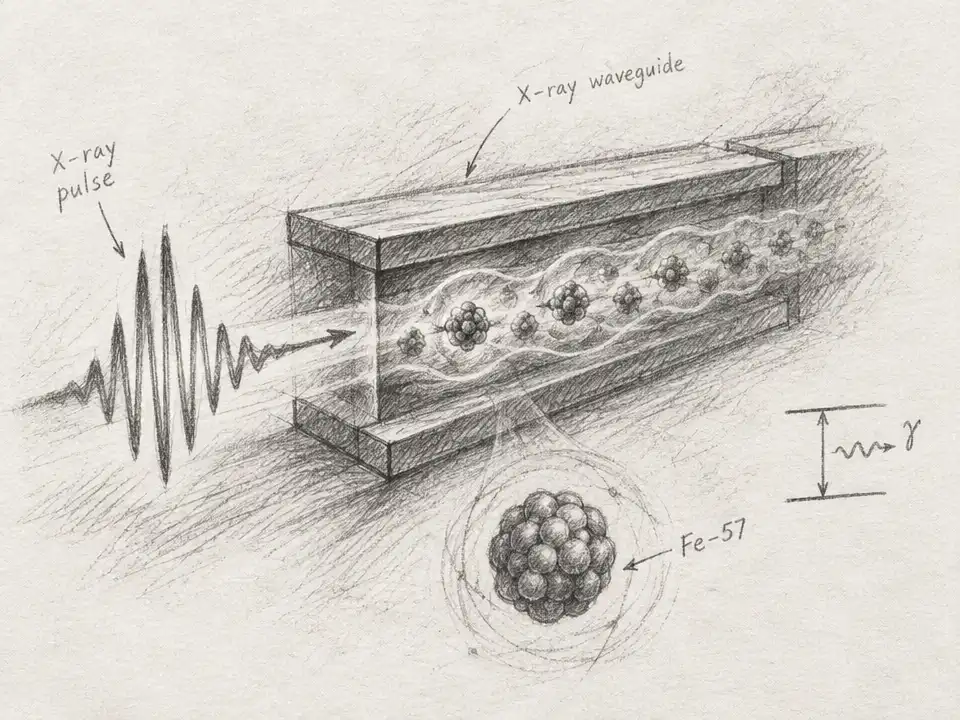
Imagine an X-ray waveguide as a narrow corridor for light, with a thin layer of iron nuclei embedded in its center. A carefully timed pulse enters. Instead of letting the nuclei’s energy leak straight back into the corridor as radiation, the pulse is shaped to counter some of that escaping light. In a theoretical design, this unusual timing could help the nuclei absorb energy together—and store more than they would independently.
That is the idea behind a proposed nuclear quantum battery. The name sounds like a miniature power pack, but the proposal is not a working battery or a new energy source. It is a way to store energy delivered by light in excited atomic nuclei, then, eventually, retrieve some of it. The challenge is to make the whole sequence work: charge, hold, and release.
In a July 2026 arXiv paper, Pravin Kumar Dahal and colleagues modeled a layer of iron-57 nuclei inside a planar waveguide. Its core is made of boron carbide, with molybdenum cladding. The nuclei respond to hard X-rays at a specific energy: 14.4 keV. That resonant response is useful, but it also makes the system difficult to drive. A nucleus can absorb the X-ray and then re-radiate energy, sending some of the incoming energy back out before the ensemble has built up a strong collective excitation.
The researchers’ proposed workaround is to shape the incoming X-ray field in time. As the nuclei respond, they generate their own radiation. The calculated pulse is tailored so that its field interferes destructively with part of this locally re-radiated field. That suppresses radiative leakage during preparation, giving the nuclei more opportunity to interact through the waveguide’s shared light mode. The pulse is not simply made stronger; its changing pattern is matched to the response it creates.
That matching matters because the nuclei are not treated as isolated absorbers. The guided field links them, allowing their responses to reinforce one another and form collective nuclear excitations. In the team’s calculations, the peak excited population rose faster than the number of nuclei as the modeled density increased. The fitted scaling followed a 1.37 power law. Against a free-space calculation using the same drive, the waveguide design produced up to 56 times more peak excitation.
Those are theoretical results, not measurements of a charged device. The researchers modeled the waveguide system and its shaped pulse; they did not demonstrate a nuclear battery in the lab. They estimate that their modeled drive excites about 30% of the nuclei. Because a 14.4 keV nuclear transition carries much more energy per excitation than a molecular one, they calculate a substantial increase in stored excitation compared with molecular quantum-battery platforms. But that comparison is about energy held in excited states—not electricity delivered to a load.
The distinction is important. A battery has to do more than accept energy. It must retain enough of it for the intended wait, release it in a controlled way, and provide useful power after accounting for the entire device. Here, the iron-57 excited state has a lifetime of roughly 102 nanoseconds. The paper describes the modeled post-pulse relaxation on a microsecond scale, but that is still brief for many storage applications. The authors suggest adapting the approach to longer-lived nuclear states; that possibility is a research direction, not a result demonstrated by this iron design.
The near-term obstacle is less about finding a record-breaking X-ray intensity than about making the right pulse. The calculated protocol needs an extended, structured temporal waveform. The authors note that hard X-ray waveguides and collective nuclear dynamics have been demonstrated separately, and that programmable pulse trains could approximate the required pattern. But combining those pieces in one setup—while delivering enough X-ray energy at the narrow iron resonance—remains a practical test.
Then comes the harder question of discharge. The iron nuclei in this proposal relax, but spontaneous relaxation is not the same as a useful, on-demand output. A practical store would need a way to retrieve the excitation when wanted, with acceptable losses and a useful output form. For a future version based on a long-lived nuclear state, engineers would have to show both how to populate that state and how to empty it controllably. Storing energy for a long time is no advantage if it cannot be recovered.
Why explore such a demanding route? Nuclear transitions offer high energy per excitation, and some nuclear states can persist far longer than the excitations used in molecular quantum-battery experiments. If collective charging, long retention, and controlled release could be combined, the result might suit specialized systems where mass, servicing, or long shelf life matters. That is a conditional possibility—not a claim that nuclear batteries are ready to replace conventional ones.
The deeper idea is that a storage material may not be the only thing engineers can design. They may also be able to shape the route energy takes into, between, and out of its microscopic parts. In this proposal, the key move is to tune the incoming light to the system’s own radiated response. The next milestone is not a more dramatic prediction. It is an experiment that charges the nuclei as calculated, measures how long the energy stays, and shows that some of it can be recovered on demand.