A wave passes. The field rises, sweeps through, and fades. Surely the world is back where it started. But classical electrodynamics leaves room for a stranger ending: a pulse of light can be gone while a charged particle still carries a change in its motion. The puzzle is not whether a wave can push a charge while passing. It can. The puzzle is whether the pushes can add up to a lasting sideways kick rather than cancel out.
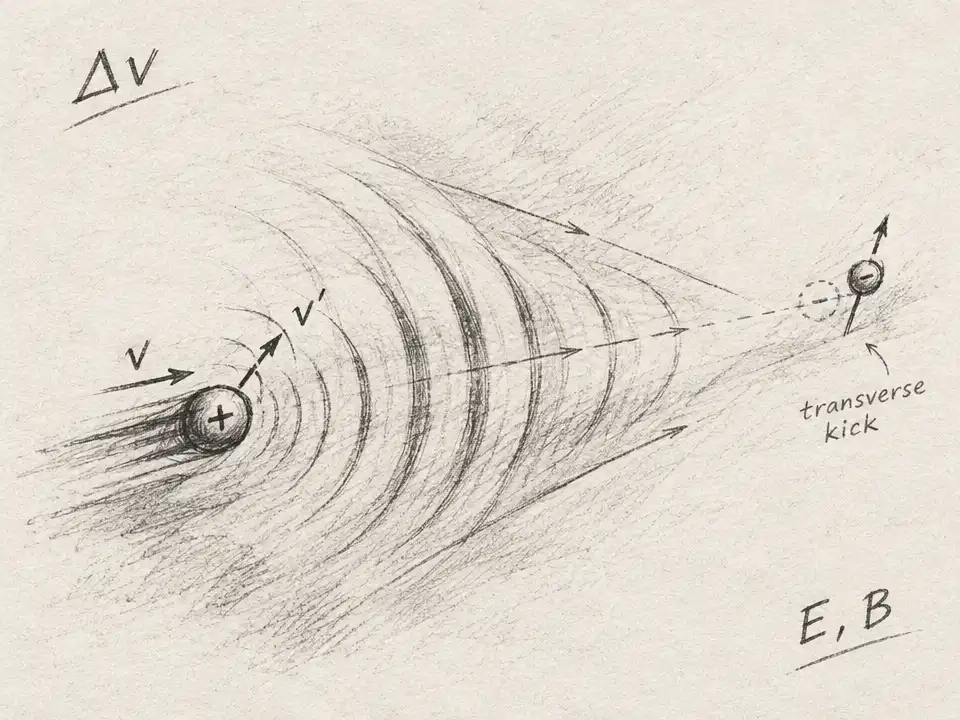
Níckolas de Aguiar Alves and Bruno Arderucio Costa revisit this possibility in a detailed study of electromagnetic memory. They start with a simple scene: a source charge moves steadily, accelerates, then continues at a different velocity. That brief acceleration sends a pulse of radiation outward. A distant test charge feels the pulse. If it moves slowly enough that the magnetic force can be neglected, its final velocity depends on the electric field accumulated over the pulse’s passage.
This is already unlike the familiar picture of radiation pressure. Radiation pressure comes from the wave’s energy and momentum, and its effect is quadratic in the field. Memory is tied to the field added up over time, so it is linear. The predicted kick is also transverse: it points across the direction the wave travels, rather than along it. These differences are clues that the effect is not just ordinary light pressure in disguise.
The first obstacle is an apparent contradiction. Radiation is temporary, so how can it leave anything permanent? The answer emerges from separating the field of a moving charge into two parts. One resembles the familiar electric field around a charge and fades with the square of distance. The other depends on acceleration: radiation. It fades more slowly, in proportion to inverse distance, and dominates far from the source.
Before the acceleration, the source has one steady velocity and its electric field has one pattern. Afterward, it has a new velocity and a different pattern. The radiation pulse is the transition between those two quiet arrangements. In the paper’s field-line illustration, a charge initially moving at 0.25 times the speed of light accelerates and ends up moving at 0.75 times the speed of light, at an angle of 30 degrees to its original direction. A shell of radiation marks the change. Outside that shell, the field still reflects the earlier motion; inside it, the field reflects the later one.
That difference between the early and late fields is more than a visual afterimage. It signals that the electric field’s time-integrated effect does not vanish. A test charge crossing the pulse can keep a net change in velocity: the electromagnetic memory effect. The wave does not need to remain present. Its passage has changed the field configuration and, under the right conditions, the motion of the charge that encountered it.
There is a catch in the word “lasting.” The cleanest calculations consider a source that moves at a steady speed indefinitely before and after its acceleration. No laboratory source can do that forever. At some point, a charge hits a boundary, bends, or slows down. That later motion can alter or erase the memory signal. The idealized story, then, risks asking experimenters to measure an effect that exists only at infinite distance or over infinite time.
Alves and Costa examine that dead end rather than treating it as a reason to give up. Their calculations show that the early and late measurements need not actually happen infinitely far apart in time. A real detector can, in principle, measure the field around the pulse before the source’s later motion interferes. The window is finite, but timing matters: wait too long and the source’s return or deceleration can undo the change. Measure soon enough, and the temporary pulse may leave a detectable step.
The authors illustrate the point with a model source whose velocity changes from rest to half the speed of light over 1 nanosecond. They calculate the vector potential at distances of 10 meters and 100 meters. In the model, the potential shifts after the pulse. At the nearer location, the apparent step slowly slopes away because the source is at a finite distance; at 100 meters, that slope is much less noticeable. These are theoretical illustrations, not measurements. They show why a detector would need to distinguish the memory signal from ordinary finite-distance changes.
A second puzzle lurks in the mathematics. The lasting shift in the vector potential resembles a gauge transformation, a change in the mathematical description that usually leaves observable physics untouched. Does that make memory a bookkeeping artifact? The authors’ answer is no. The relevant shift is connected to the pulse’s electric field and the predicted kick; it cannot simply be dismissed as a change of notation. In the language of the theory, it is a “large” gauge transformation, one that does not fade away at infinity. The odd name points to a real distinction: the transformation links two different field configurations after the radiation has passed.
So why has no one seen electromagnetic memory? The paper notes two practical barriers. Charges in ordinary wires are confined and cannot maintain the idealized free motion for long. Particle-beam scattering can produce the needed changes in motion, but the currents have been too small to make a visible signal. Earlier work has proposed a laboratory test using a radiating antenna, and the analysis here emphasizes that a finite, sufficiently fast measurement should be possible in principle. But the effect remains unobserved.
That leaves the central question open in the most useful way. The equations make a prediction, and the authors trace how it follows from well-established electrodynamics. Yet theory is not a detector readout. A successful experiment must catch the pulse’s imprint before ordinary motion washes it out, while separating that imprint from the background field. If it works, a passing wave will have left behind a record not in a photograph or a damaged object, but in the changed velocity of a charge—and in the shape of the field that remains.