More than a mile underground, inside a tank of chilled liquid xenon, a detector built to catch dark matter began registering something else: tiny deposits of energy that might have come from neutrinos streaming out of the Sun. The difficulty was that the detector could not label any one flicker “solar.” Radioactive atoms inside the xenon could make much the same trace. The puzzle was whether a signal could be separated from its lookalikes well enough to show that the Sun was there.
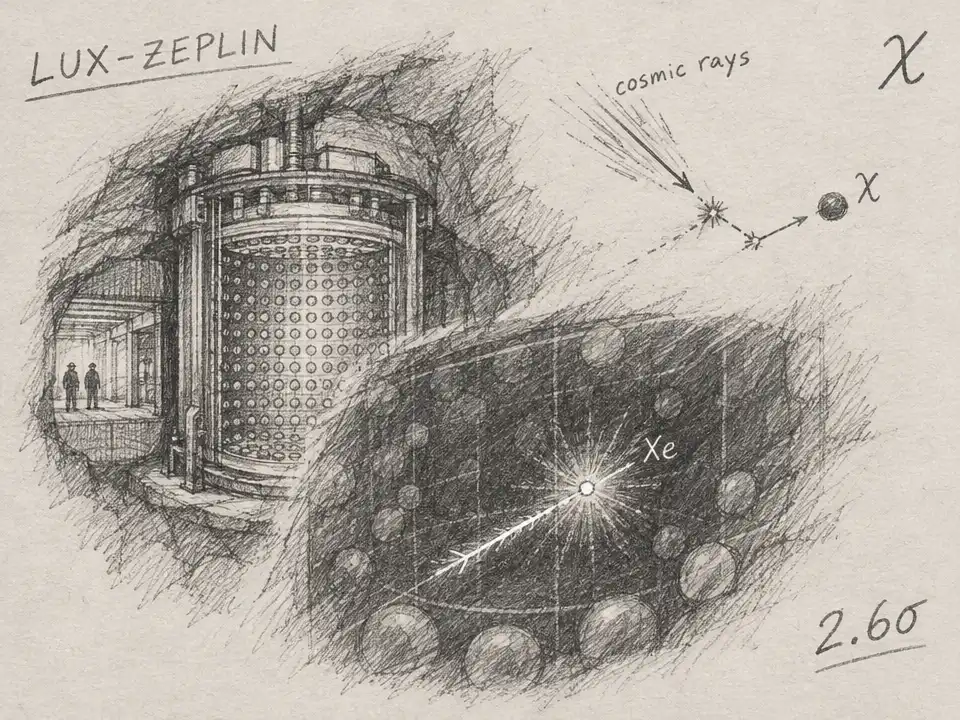
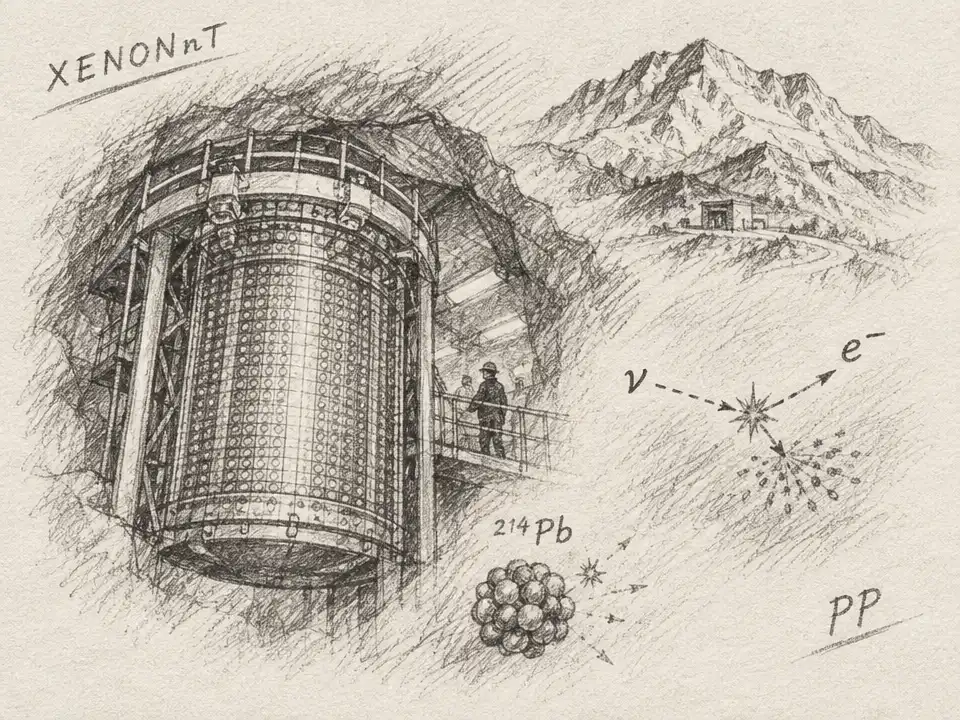
XENONnT sits beneath about 1,400 meters of rock at Italy’s Gran Sasso laboratory. The rock screens out most cosmic-ray muons; the detector’s active target holds 5.9 tonnes of liquid xenon. When a particle interacts in the liquid, it can produce a brief flash of light and free electrons. The light is recorded promptly. An electric field pulls the electrons upward, where they create a second flash. Together, the two signals help researchers reconstruct where an event happened and how much energy it left behind.
That apparatus was designed chiefly to look for dark matter, but it has another useful talent: it can register very small energy deposits. In this analysis, the threshold for electron recoils was about 1 kiloelectronvolt. That brought the detector within reach of solar neutrinos with energies as low as about 17 kiloelectronvolts, a far lower-energy population than the higher-energy solar neutrinos previously seen in liquid-xenon detectors.
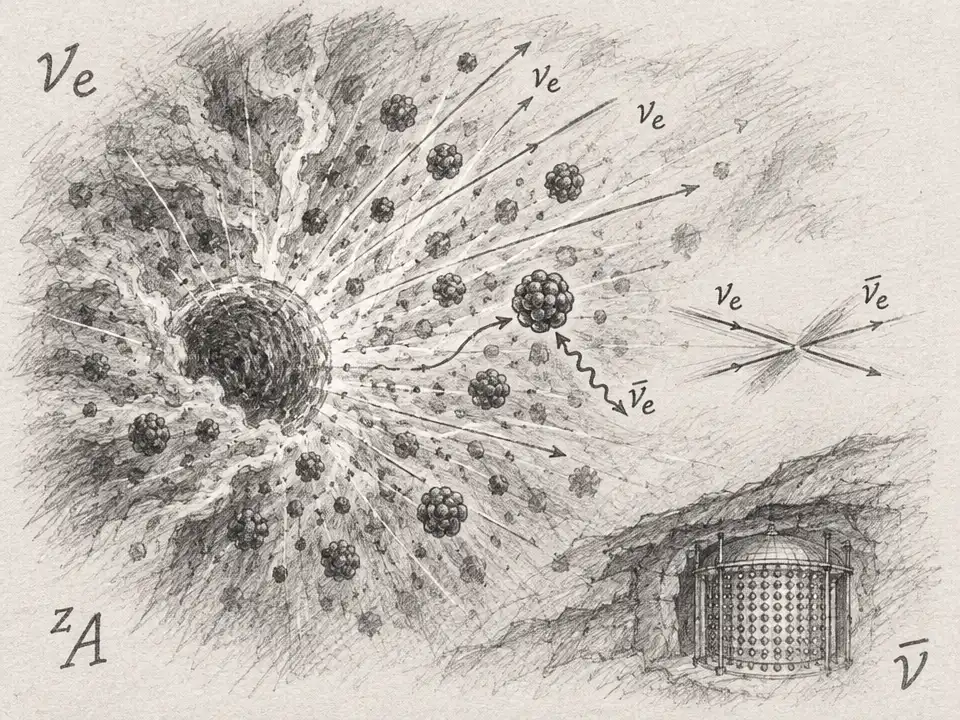
The Sun makes these low-energy neutrinos in its proton-proton, or pp, fusion chain. They are abundant, but almost all pass through matter without interacting. On the rare occasion one scatters from an electron in the xenon, it leaves a faint recoil. Unfortunately, many ordinary radioactive decays also release electrons. For this search, the usual distinction between nuclear recoils and electron recoils that helps a dark-matter hunt offered little protection: the sought neutrinos themselves mostly produced electron recoils, the same broad category as the main background.
The first suspect was lead-214, a decay product of radon that enters the detector from trace impurities in its materials. Its beta decays produce a low-energy spectrum that can resemble the neutrino signal. Because radon and its descendants are mixed through the xenon, simply selecting a cleaner central region cannot remove this background. The team needed a way to estimate how many lead-214 events were hiding among the candidate signals.
They turned to another clue in the decay chain. Radon also produces alpha decays, which leave distinctive, energetic events. During a calibration, the researchers introduced a known radon source and tracked those alpha events alongside the low-energy electron recoils. The two rates rose and fell together, letting the team estimate the relationship between radon’s alpha decays and lead-214’s beta decays. In the calibration, the inferred activity ratio was 0.66 ± 0.03. It was not a way to tag each individual beta event; it was a way to put a tighter bound on how many such events the background model should contain.
Other clues complicated the investigation. Krypton-85, another radioactive contaminant, produces a broad low-energy spectrum. One period of data-taking had an unexpectedly high krypton concentration and was left out of the analysis; the team used data from two cleaner periods instead. They also accounted for decays of xenon-136, material-related gamma rays and additional radioactive sources. Each background had its own estimated rate and energy pattern. The challenge was to see whether the combined data fit those known sources alone, or needed a solar-neutrino contribution as well.
The team compared the observed energies with models of the signal and backgrounds in a joint statistical fit. Across the two data periods, the fit attributed about 500 ± 70 and 660 ± 90 events, respectively, to solar neutrinos. The solar component was dominated by pp neutrinos, which made up 89.0 percent of the modeled solar signal in the selected energy range. The fit rejected the possibility of no solar-neutrino interactions at 5.0 sigma, the conventional threshold for calling a result a discovery.
The inferred pp-neutrino flux was (10.2 ± 2.0) × 1010 cm−2 s−1. It was higher than Borexino’s earlier measurement, but statistically consistent with it within 1.9 sigma. The result does not mean that the detector watched individual neutrinos arrive with certainty. It means the pattern of energies across many events was much more consistent with a solar-neutrino contribution than with the modeled backgrounds alone.
The researchers checked whether that conclusion depended on a particular slice of the data. They repeated the fit across different energy intervals, used a smaller central volume, and tested time-separated samples. These checks supported the signal; most of the discovery power came from recoils between 1 and 60 kiloelectronvolts. But the fit still rests on how well the background possibilities are understood, and one especially troublesome possibility resembles the signal closely.
That possibility is carbon-14. The isotope was not expected in the detector, but its beta spectrum could imitate solar neutrinos. In a deliberately conservative test, the team allowed for the largest plausible carbon-14 contribution. The significance fell from 5.0 to 4.3 sigma, while the inferred flux shifted downward, but the neutrino interpretation remained. That test does not establish carbon-14 as a real contaminant; it shows how much the conclusion could move if an unanticipated background were present.
The answer to the puzzle is therefore both a detection and a careful accounting exercise. A dark-matter instrument can also act as a low-energy solar-neutrino detector, provided its faint signal can be disentangled from decays occurring inside its own target. XENONnT has opened that window, while the remaining uncertainty points to the next task: better control of radioactive backgrounds and detector response. The same quiet chamber built to wait for dark matter has become a new place to study the Sun’s most common neutrinos.