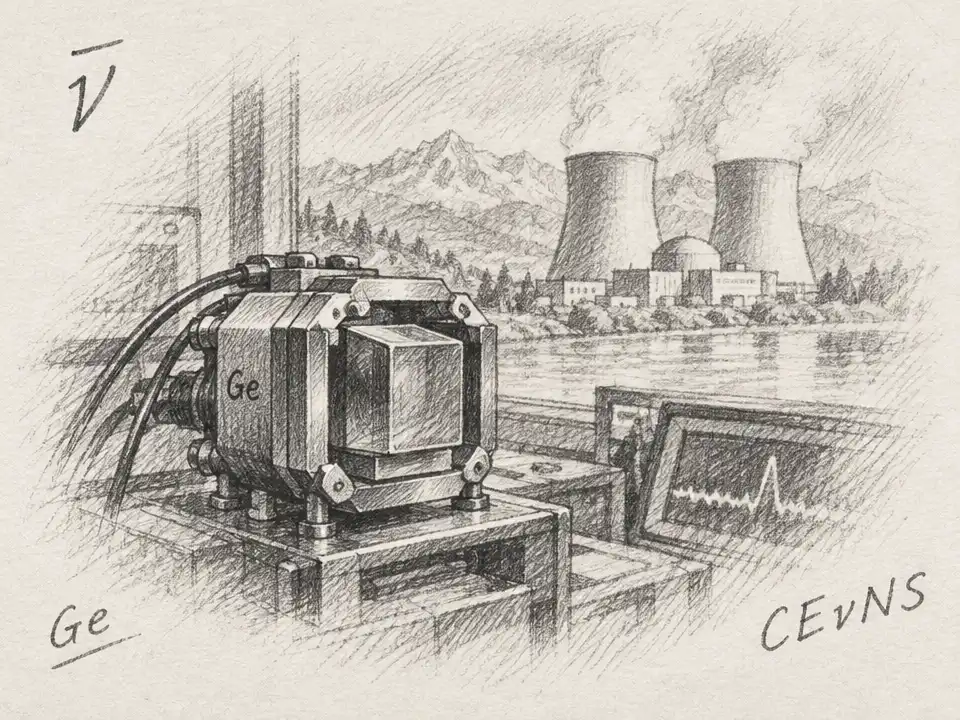
Inside a nuclear power plant in Leibstadt, Switzerland, a detector waits for a signal so small it nearly disappears into the everyday noise of the world. The signal is not a flash from a neutrino being absorbed. It is a faint electrical trace left when an antineutrino gives a tiny shove to a germanium nucleus.
That subtle recoil reveals a hidden trick of nature: under the right conditions, a neutrino can scatter from a nucleus as a whole. The CONUS team’s latest analysis reports evidence for this collective interaction at a reactor, then uses the data to test familiar physics and search for hints of something beyond it.
Neutrinos pass through matter so readily that detecting them usually calls for enormous targets. But at low momentum transfer, the wave associated with a neutrino can interact with a nucleus without resolving its individual protons and neutrons. Their contributions add together, making the interaction more likely than a hit on just one constituent. The result is called coherent elastic neutrino-nucleus scattering.
There is a catch. A heavy nucleus recoils only slightly, and the detector does not read out that recoil energy directly. It registers the charge produced as the recoil moves through germanium. Only a fraction of the recoil’s energy becomes measurable ionization, so the signal is tiny: the CONUS+ detectors were operated with thresholds between 160 and 180 electron volts. That is the scale at which a nuclear nudge can start to stand out from electronic noise and background radiation.
The experiment places a few kilograms of high-purity germanium about 20.7 meters from the core of a 3.6-gigawatt reactor. The team surrounds its detectors with shielding designed to reduce interference from radiation and neutrons, and uses periods when the reactor is running and shut down to help distinguish reactor-linked events from backgrounds. The comparison is demanding: cosmic rays and environmental radioactivity can also leave signals in the detector.
In data collected between November 2023 and July 2024, the analysis reports an estimated 395 ± 106 coherent-scattering events. The Standard Model prediction was 347 ± 59 events. The measured excess corresponds to a significance of 3.7σ and agrees with the predicted rate. That is evidence for the interaction, not a picture of individual neutrinos arriving one by one: the researchers infer the signal from patterns across the detector data, with systematic uncertainties included in their analysis.
The result depends on more than making the detector quiet. The team also had to understand how germanium converts a nuclear recoil into ionization, calibrate the energy scale near the threshold, and model backgrounds. A detector can register a small pulse; deciding what caused it requires checking that the pulse appears where the neutrino signal should, behaves differently from the backgrounds, and fits the expected recoil spectrum.
Once the team has a signal consistent with the Standard Model, it can ask a more ambitious question: does the data leave room for new interactions? A neutrino might have properties beyond the familiar picture, or interact through an as-yet-undiscovered mediator. Those possibilities could change the number or distribution of recoils. The researchers use their datasets to place limits on such scenarios, including limits on the neutrino’s possible magnetic moment and electric charge, and on interactions involving new particles.
These are constraints, not discoveries of new particles. For example, the analysis reports a limit on the electron-neutrino magnetic moment of less than 5.18 × 10⁻¹¹ Bohr magnetons at 90% confidence. It also estimates the weak mixing angle, a measure of how the electroweak force is divided between two kinds of interaction, as 0.28+0.03−0.04. The estimate is about one standard deviation from the Standard Model prediction, so it remains compatible with it.
Here the shift in scale is the story. A power plant produces an immense flood of antineutrinos, yet the detector’s clue is a minuscule recoil in a solid crystal. Because the nucleus responds collectively, that whisper can be easier to hear than a neutrino’s interaction with a single electron. And because the recoil is so small, the experiment’s progress hinges on lowering thresholds while keeping a careful account of every competing source of noise.
The broader payoff is a new way to use nearby reactors as laboratories for weak interactions. Each improvement in low-energy detection can sharpen tests of the Standard Model and make subtle deviations easier to spot. For now, the reported signal fits the known picture. But the same delicate measurement that registers a neutrino’s quiet push also gives physicists a more sensitive place to look for a surprise.