Imagine searching for dark matter not by waiting for a particle to strike a detector, but by watching a laser’s light for a faint flicker. A paper posted to arXiv proposes a way to do just that: use a tiny cell of cesium vapor to listen for an almost imperceptible electric field that a hypothetical form of dark matter might produce.
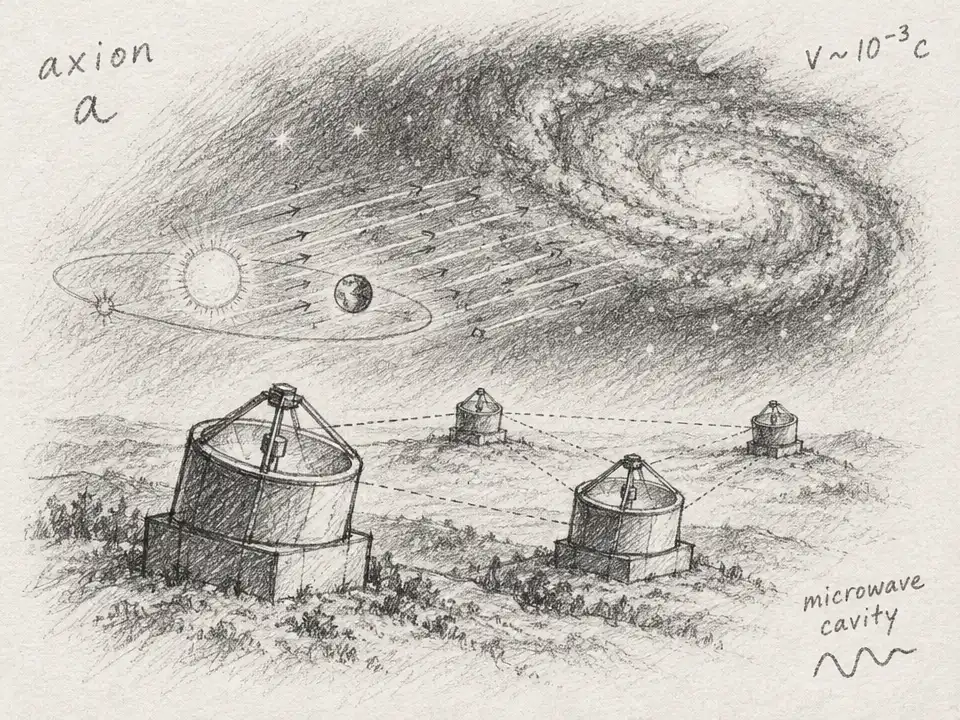
The target is a hidden photon, a proposed cousin of the ordinary photon. If it exists, it could make up dark matter and interact ever so slightly with familiar electromagnetism. That interaction would create a weak, regularly oscillating electric field. The challenge is that the field would be far too faint to notice directly. The researchers’ solution is to change the scale of the search: instead of trying to collect a lot of signal in a large detector, they propose amplifying the field in a compact resonator and reading it through the behavior of individual atoms.
This is a proposed detection scheme, not a report of finding dark matter. The authors combine components that have been demonstrated or studied separately—a chip-scale atomic vapor cell, sensitive optical readout, and a microwave cavity—to estimate what a search could achieve. Their idea turns a cosmic mystery into a carefully tuned laboratory measurement, with a small chamber at its center.
The chamber is a cavity only a few millimeters across. Like a musical instrument that resonates strongly at particular notes, it responds especially well to selected electromagnetic frequencies. The paper considers a cavity with a radius of about 2.5 millimeters and a length of about 3 millimeters. Its basic resonant mode is at 45.9 gigahertz; a higher mode could reach 165.2 gigahertz. Hidden photons in the right mass range would drive electric fields at frequencies the cavity can enhance.
Small cavities present a familiar problem for dark-matter searches: as the frequency rises, the resonator shrinks, leaving less volume in which to collect a signal. This proposal shifts attention from the total signal power to the local electric field itself. The atoms sit in a sensing region about 100 micrometers across, where the researchers expect the cavity’s field to be strong. In this arrangement, a tiny detector is not merely a shrunken version of a large one; its small sensing region is matched to the field the experiment wants to read.
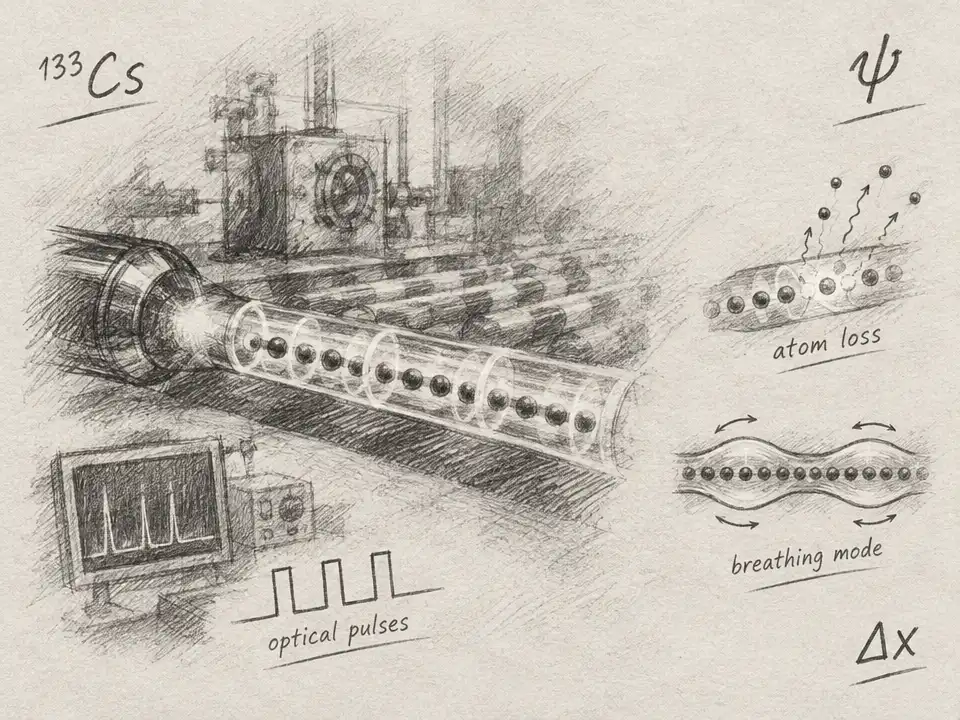
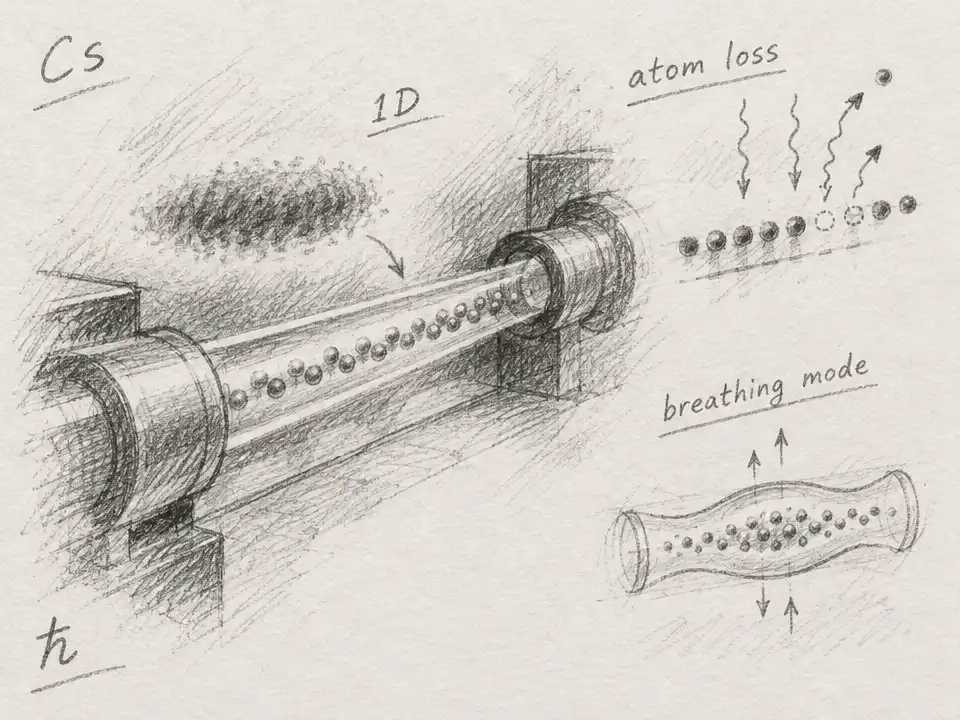
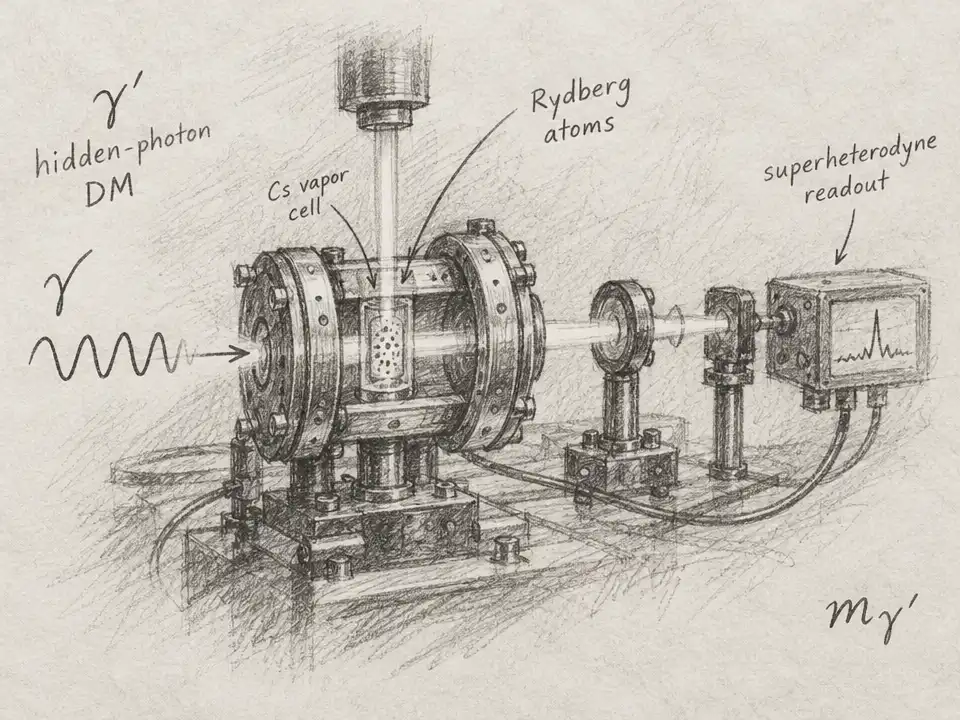
Cesium atoms make the readout possible. The scheme uses atoms excited into Rydberg states, where an electron occupies a large, fragile orbit and responds strongly to electric fields. A microwave signal at the right frequency can nudge the atom between two such states. The larger the atom’s response, the more useful it can be as a probe of a weak field—but the dark-matter signal is still predicted to be too faint to register on its own.
To make that tiny nudge visible, the proposal uses light as a kind of indicator. A probe laser at 852 nanometers and a coupling laser at 510 nanometers prepare the atoms in a condition that lets the probe pass through within a narrow transparency window. A strong microwave field, called a local oscillator, modifies the atomic response and splits that window into two features. The experiment would position its optical readout on a steep edge of the split feature, where even a small change can produce a measurable shift in transmitted laser light.
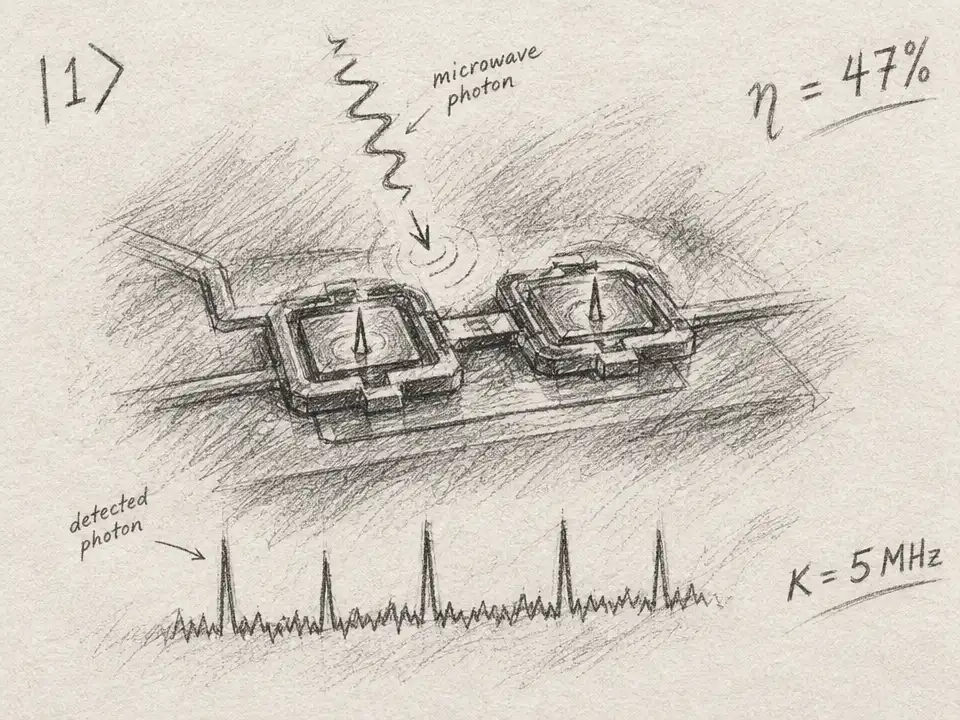
Then comes the crucial translation. If the hidden-photon field is close in frequency to the local oscillator, the two fields combine to produce a slower beat. Instead of asking the instruments to resolve the original, high-frequency whisper, the sensor looks for a low-frequency modulation in the transmitted probe light. The paper says this beat could fall below 1 megahertz. In effect, an invisible microwave oscillation is mapped onto a detectable change in brightness.
The researchers estimate that their setup could search for hidden-photon masses from 5.3 × 10⁻⁵ to 6.8 × 10⁻⁴ electronvolts. Their projections assume two hours of measurement at each tuning point and consider cavity amplification factors of 10³ and 10⁴. Under those assumptions, they estimate sensitivity several orders of magnitude beyond existing limits in part of this range. Those numbers describe a projected reach, not an experimental result: they depend on the proposed setup achieving the assumed amplification and readout performance.
The search would also be selective. A resonant measurement listens closely to a narrow band of frequencies, so the detector would need to be tuned to different atomic transitions and cavity resonances to cover more ground. The analysis assumes the dark-matter field is aligned with the cavity field, and the authors note that measurements at each setting cover only a narrow range. A real search would have to contend with these constraints as well as ordinary sources of noise.
Still, the proposal offers a striking change of perspective. Dark matter, if it is made of hidden photons, might not announce itself with a dramatic burst. It could instead leave a nearly imperceptible rhythm in an electric field, detected by a few atoms and translated into a shimmer of laser light. The result would not be a picture of the invisible. It would be a tiny, reproducible flicker—and a reason to tune the apparatus and listen again.