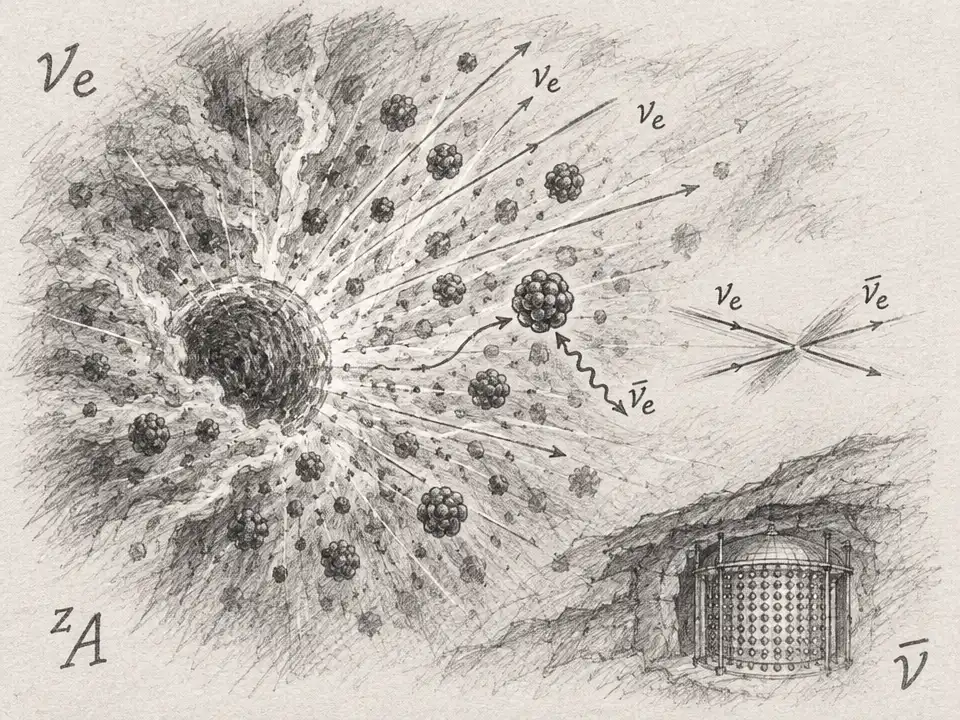
Imagine a star collapsing far away, releasing an immense burst of neutrinos. The particles pass through planets, stars, and whole oceans with little notice. A few may interact in the deep sea, where a detector’s glass eyes wait for the faintest flash. But in a telescope built to catch high-energy cosmic particles, spotting one low-energy neutrino at a time is difficult. The ocean may have a helpful ingredient already mixed in: salt.
A new study explores how chlorine naturally dissolved in seawater could make a deep-sea neutrino telescope better at recognizing electron antineutrinos, including those from a supernova. The idea links ocean chemistry to particle physics: chlorine nuclei can capture neutrons produced in antineutrino interactions, giving detectors a brighter, more distinctive signal to look for.
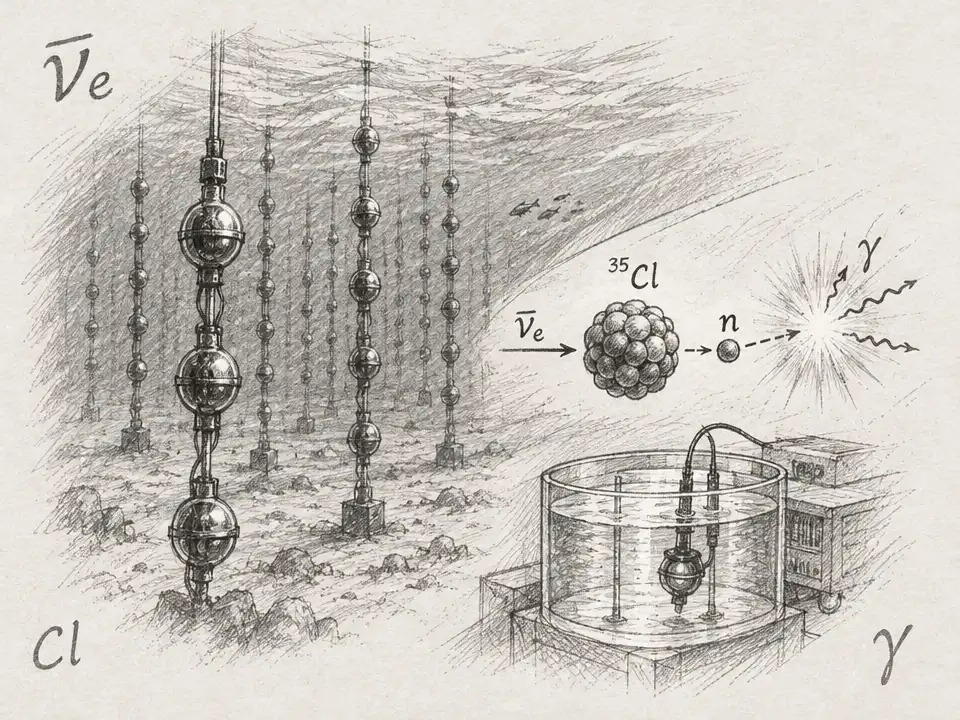
The target is a particular interaction in which an electron antineutrino meets a proton. The encounter produces a positron and a neutron. The positron makes an immediate flash of light; the neutron slows down and is captured a short time later, producing another flash. In a densely instrumented detector, that prompt-and-delayed pair can identify an antineutrino interaction. In a huge, sparsely instrumented ocean detector, the delayed flash has usually been too faint to pick out reliably.
In pure water, the neutron is most likely to be captured by hydrogen. That capture releases a gamma ray with an energy of 2.2 MeV, after a typical wait of about 200 microseconds. The trouble is not that this signal is absent, but that it is hard to distinguish from the detector’s background noise when sensors are spaced far apart.
Seawater changes the chemistry of the wait. Although 35Cl makes up only 0.25% of the nuclei in seawater, compared with 66.1% for hydrogen, its neutron-capture cross section is 43.6 barns—about 130 times hydrogen’s 0.333 barns. Capture on chlorine releases a cascade of gamma rays with a total energy of approximately 8.6 MeV. The capture also happens sooner: the effective neutron-capture time is about 130 microseconds in seawater.
That brighter, quicker afterglow could help a detector distinguish a real event from accidental flashes. A high-energy positron produces a burst of light in one module; the captured neutron then makes a second, brighter-than-hydrogen signal nearby, soon after. Looking for the right timing and pattern is like matching two brief flashes that belong together, rather than trying to interpret either one alone.
The researchers tested the idea using TRIDENT, a planned neutrino telescope in the South China Sea. The design calls for a detector volume of approximately 10 km3, with about 1,000 detection strings. Each hybrid digital optical module, or hDOM, contains 31 three-inch photomultiplier tubes. Those multiple light sensors let the team compare which parts of a module saw light, when they saw it, and whether another module recorded a nearby signal that might indicate a background muon passing through.
The team used detector simulations that included measured seawater properties at the planned site and considered backgrounds such as radioactive decays, sensor dark noise, and atmospheric muons. For a modeled core-collapse supernova with a 27 M⊙ progenitor, the simulation estimated that prompt signals alone could give TRIDENT a five-sigma discovery reach of approximately 50 kpc. Adding the delayed neutron signal associated with chlorine extended the modeled reach to over 100 kpc. For another supernova model, the estimated reach increased from approximately 60 to 125 kpc.
Those distances are predictions, not a supernova detection. To check the underlying capture signal in the lab, the team placed an hDOM beside a radioactive americium-beryllium neutron source in a water tank at the China Jinping Underground Laboratory. They compared pure water with a sodium chloride solution at seawater concentration, and with a salt solution that also included potassium chloride to add a radioactive background similar to one found in seawater. The source produced a prompt gamma ray along with neutrons, creating a controlled test of the prompt-and-delayed pattern—not actual antineutrinos.
In the sodium chloride run, the researchers found a delayed excess consistent with neutron capture, with a fitted capture time of 0.14 ± 0.04 ms and a significance exceeding 3.4 sigma. With potassium chloride added, the excess was about 2 sigma, as the higher radioactive background made the measurement less certain. The experiment therefore supports the capture-tagging principle; it does not yet establish that a deep-sea telescope can identify individual supernova antineutrinos in the ocean.
That distinction matters, but so does the leap the study makes possible. Chlorine does not need to be added to the detector or engineered into a special target. It is already in the seawater surrounding the sensors. If the proposed method works in a full detector, the sea’s dissolved salt could help turn a telescope designed for high-energy cosmic particles into a more capable listener for the lower-energy neutrinos from a stellar collapse. The same approach could also be explored for reactor and geophysical antineutrinos. In this case, the ocean is not just the place where the instrument sits. Its chemistry may help the instrument hear.