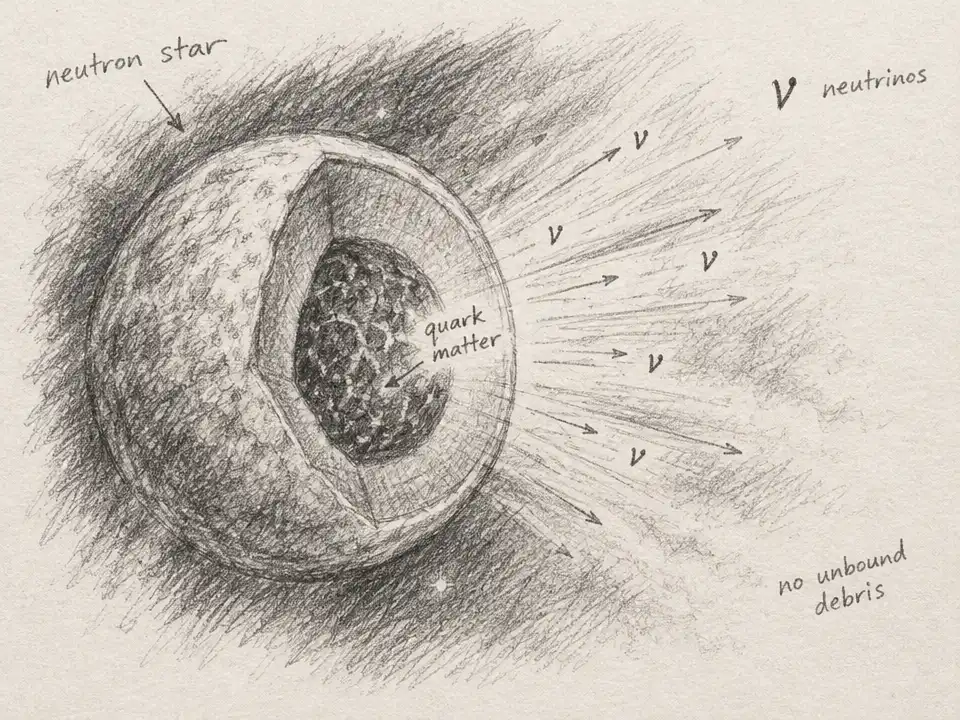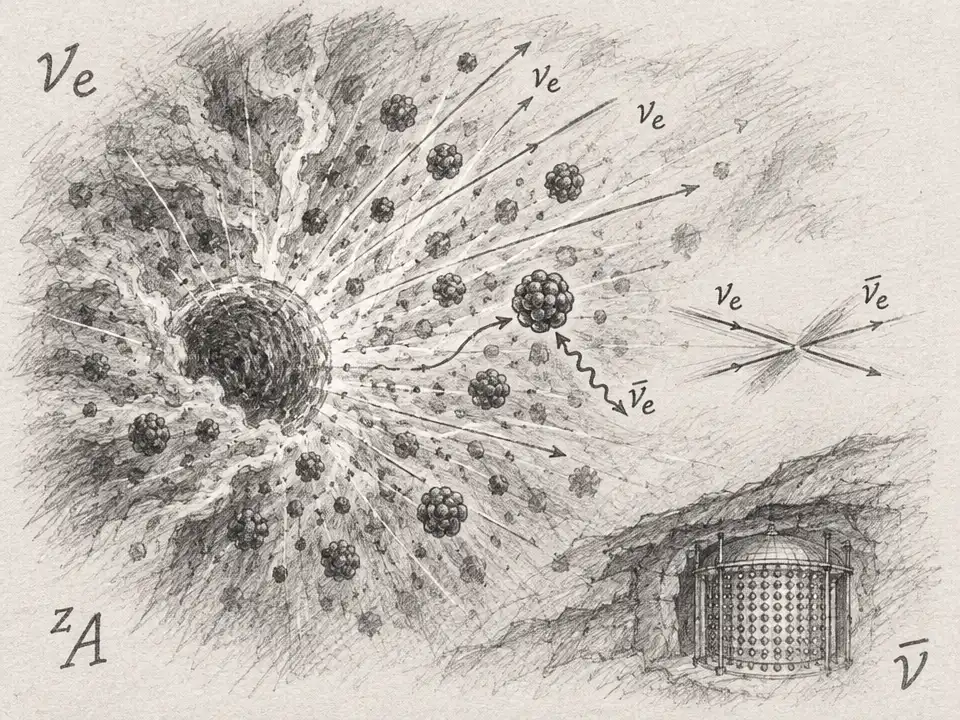
When a massive star’s core collapses, it releases a flood of neutrinos. Most stream outward through the star, carrying clues about the collapse and the shock wave trying to escape it. But some neutrinos take a less obvious route: they scatter off nuclei and turn back inward. A small research team found that this faint return flow could change how neutrinos behave across the whole star.
The puzzle starts with neutrinos’ flavors. Electron neutrinos and their antimatter partners, electron antineutrinos, interact differently with matter. Scientists track how many of each travel in different directions. If electron neutrinos dominate in one direction but antineutrinos dominate in another, the balance crosses zero as you scan across angles. That crossing can open the door to fast, collective flavor conversion, in which neutrinos change flavor through their interactions with one another.
For a long time, the obvious place to look was the powerful outward stream. Yet in some models, that stream showed no crossing. The overlooked clue was behind the main beam, in the much thinner population traveling inward. Before the shock has passed, heavy nuclei remain in the star’s outer layers. A neutrino can scatter coherently from one of these nuclei, changing direction while giving up little energy. The inward trickle can then have a different balance of neutrinos and antineutrinos from the outward flow. Put the two together, and their angular distributions cross.
A 2019 study found this pattern in supernova simulations. In one representative model of an 11.2-solar-mass star, the researchers examined the region just ahead of the shock. There, scattering from heavy nuclei created a small inward-going population in which antineutrinos could outnumber electron neutrinos, even as electron neutrinos dominated the outward stream. In the paper’s plot, the inward contribution had to be multiplied by 100,000 to make it visible alongside the main flow. Small did not mean irrelevant: the researchers’ calculations found unstable modes that could grow rapidly and travel outward.
That result is a clue, not a movie of neutrinos completing the flavor change. The study used a linear stability analysis to identify where a disturbance could grow; that does not, by itself, show how far conversion proceeds once the process becomes nonlinear. The authors argued that the mechanism could be common, but the result still depends on models of the collapsing star and its neutrino transport. No supernova has yet been observed to confirm this particular effect.
A later study tackled a wider question: if flavor conversion takes place, how might it reshape the neutrino field? The researchers ran multi-angle, three-flavor quantum kinetic simulations using spherical snapshots from a supernova model. They found flavor changes not only where neutrinos stream freely, but also deeper inside the star, where matter and collisions matter. In these calculations, conversion reduced neutrino heating in the region behind the shock while increasing cooling in denser layers. The neutrino radiation field was not simply shuffled between flavors; interactions with matter helped determine what emerged.
Those results come with important limits. The simulations used simplified neutrino-matter interactions and an artificial reduction of the oscillation term to make the calculation manageable. They also relied on spherical stellar profiles, rather than fully three-dimensional ones. The researchers stressed that the effect on the explosion remains uncertain. A change in simulated heating is not, on its own, a verdict on whether a real star’s shock will succeed or fail.
The next clue may arrive as a burst of neutrinos detected here on Earth. The study proposed comparing what different detectors would infer about neutrinos and antineutrinos; it also noted that the practical reach of such a test depends on event numbers and further analysis. If a nearby star collapses, the signal could help reveal whether its neutrinos underwent strong flavor conversion. For now, the mystery begins with a surprisingly quiet detail: not the stream racing outward, but the few particles that turn around.