Transformer oil can carry chemical clues about the equipment it insulates. Among them is acetylene, a gas associated with faults inside power equipment. The challenge is getting a sensitive reading without hauling a large instrument to the transformer—or pulling out a sample for separate analysis. Researchers have built a miniature sensor that tackles the problem at the tip of an optical fiber. Its unusual trick is a set of tiny pores: they let gas reach the sensor’s listening chamber while helping it ignore slow pressure changes that would otherwise muddy the signal.
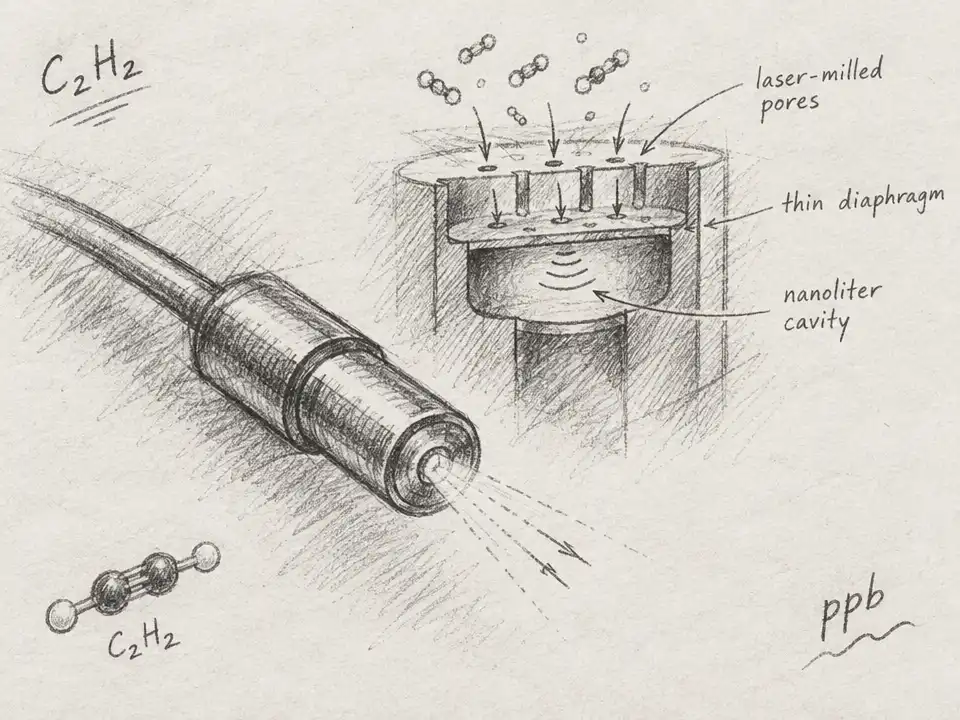
The device is a MEMS-integrated fiber-tip photoacoustic spectrometer. At its heart is a silicon chip measuring 3 mm by 3 mm, joined to a single-mode optical fiber. A suspended silicon nitride diaphragm, just 100 nm thick, faces the fiber end. Together, they form a cavity about 200 μm deep, with a volume of approximately 1.5 nL. That space is both a miniature gas cell and an optical microphone. The researchers’ goal was to make the cell small without making it deaf to the faint signals produced by trace gas.
Here is how the sensing works. Light sent down the fiber is tuned to a wavelength absorbed by acetylene. The team used a pump wavelength of 1532.83 nm. As acetylene molecules absorb the modulated light, they release energy as heat, making the gas expand and contract in step with the modulation. That creates a tiny oscillating pressure wave. The wave nudges the thin diaphragm; the movement changes how light reflects inside the fiber-and-diaphragm cavity. A second light signal reads that change. The sensor is not recording audible sound: it is turning a molecule’s response to light into a measurable optical signal.
Making room for the gas was the difficult part. The diaphragm must be sensitive enough to move with a weak pressure wave, but a conventional sealed diaphragm keeps the target molecules out. Simply opening a path through it could compromise the very membrane the sensor needs. The researchers’ solution was to mill several small pores around the diaphragm’s active area using a focused ion beam. The pores provide a route for gas to enter and leave while preserving the main vibrating region.
The opening does double duty. Gas can diffuse through it, but slow, ambient pressure changes can also leak away instead of shifting the diaphragm’s baseline. In effect, the pores act as an acoustic high-pass filter: they reduce low-frequency pressure disturbances while leaving the faster, deliberately generated signal useful for measurement. That helps stabilize the optical readout without an active feedback system to constantly correct it. The diaphragm itself is made using a wafer-scale manufacturing process, while the focused-ion-beam step precisely places the pores. The design joins repeatable chip fabrication with a tiny, carefully targeted modification.
In gas-phase tests, the researchers exposed the probe to acetylene concentrations ranging from 1 ppm to 5000 ppm. The measured signal tracked concentration with a reported correlation coefficient above 0.99. From a 1 ppm measurement and the system’s noise, they estimated a noise-equivalent concentration of 58.5 ppb at a 1-second integration time. A longer noise analysis found a minimum of 25 ppb at about 127 seconds. These figures describe different measurement conditions: waiting longer can reveal a weaker signal, but takes more time. For concentration steps in the test chamber, the sensor’s T90 response time—the time to reach 90% of a new reading—ranged from 6 to 8 seconds.
Then the team tried the harder setting: acetylene dissolved in transformer oil. A 40 μm-thick perfluoropolymer membrane wrapped the probe. It allows gases such as acetylene to pass through while blocking liquid oil from entering the sensor. The researchers immersed the packaged probe in oil samples whose acetylene concentrations had been calibrated using gas chromatography. The oil-phase signal increased with concentration, with a reported correlation coefficient of approximately 0.99.
For oil, the researchers estimated a noise-equivalent concentration of about 230 ppb at a 1-second integration time. They also tested a low-concentration oil sample containing about 1.12 ppm acetylene and observed a clear response. But the oil probe did not respond as quickly as the bare gas sensor: its T90 response time was approximately 320 seconds. The paper attributes that delay mainly to gas moving through the protective membrane, rather than to the sensor’s acoustic response. Even so, the authors compare this several-minute response with the hour-scale response of conventional degassing apparatuses.
The distinction between a demonstrated result and a future application matters here. The researchers tested a prototype with acetylene in laboratory gas and oil samples; they did not report a field trial inside a working transformer. And while the membrane passes several gases of interest, the experiments described focus on acetylene, so they do not establish how the sensor would distinguish a mixture of gases. The authors also suggest that direct exposure to gas, without the test chamber used in their experiments, could shorten the gas-phase response below one second. That is a possibility they propose, not a result they measured.
Still, the central engineering idea travels well beyond this one sensor: a tiny opening need not be a weakness if its job is designed carefully. Here, pores let molecules in, drain away unwanted pressure drift, and leave a delicate diaphragm free to register a chemical signal. By putting light delivery, gas sampling, acoustic sensing, and optical readout together at a fiber tip, the researchers offer a route toward compact probes for places where conventional instruments struggle to fit. The experiment’s most revealing feature may be that the sensor gets better at listening by learning exactly where—and how—to breathe.